
Blog
Get OEM BMW Body Shop Repairs With In House ADAS Calibration
Find a BMW body shop that meets factory standards without defaulting to a dealer. Verify OEM parts, in house ADAS calibration, and written warranties...
Choose either a BMW Certified Collision Repair Center or a BMW-capable independent shop that follows OEM repair procedures, never a general body shop working from guesswork. The deciding factors are the same either way: Original BMW Parts, technicians trained on BMW-specific repair data, and proper ADAS calibration before the car leaves the lot.
TL;DR:
Certified shops must use OEM parts, BMW-trained technicians, specialized equipment, and provide a repair certificate to meet factory standards.
ADAS calibration is a critical safety step that requires OEM-specific tools and trained staff; skipping it can impair system accuracy.
Repair timelines vary from days for cosmetic fixes to weeks for structural or aluminum work, with costs influenced by parts, materials, and regional labor rates.
Confirm a shop’s calibration method, parts policy, and warranty in writing before proceeding, regardless of certification status.
Independent BMW-capable shops often match dealer results with better scheduling flexibility and documented OEM procedures.
Table of Contents
What Makes a BMW Body Shop Truly Factory-Standard?
BMW’s own certification program spells out what “factory-standard” actually requires, and it’s a useful checklist even if you end up choosing a shop outside that network. According to BMW USA’s Certified Collision Repair Centers page, certified centers commit to BMW-trained technicians, Original BMW Parts, specialized equipment, a certificate of repair, and warranty coverage on the finished work.
Each of those pieces solves a different problem:
BMW-trained technicians complete ongoing training on repair procedures specific to BMW’s platforms, including aluminum and carbon-fiber body components that don’t behave like steel under heat or stress.
Original BMW Parts (OEM) are engineered to the exact tolerances of your car’s model year, which affects panel gaps, crash sensor placement, and how the car performs in a future collision.
Specialized equipment includes computerized measuring rigs for frame alignment, dedicated spray booths for factory-matched paint, and repair-data access that tells a technician exactly how BMW engineered the joint they’re fixing.
A certificate of repair documents what was done, with what parts, and under what warranty. It’s the paperwork that protects your resale value later.
A shop that can’t produce these four things in writing isn’t offering factory-standard repair, regardless of what the sign out front says.
Why ADAS Calibration Is a Safety Issue, Not a Formality
Modern BMWs rely on cameras and radar sensors for adaptive cruise control, lane-keeping assist, and automatic emergency braking. Advanced driver-assistance system (ADAS) calibration realigns those sensors after any repair that touches the bumper, windshield, fenders, or frame, and skipping it means those systems can misjudge distance or fail to trigger when they should.
Calibration costs typically require several hundred dollars per system or more, depending on whether the shop uses static calibration (stationary targets in a controlled bay) or dynamic calibration (a road test with scanning equipment), according to ADASLine’s BMW calibration guidance.
A shop equipped for OEM-level calibration will have:
Dedicated calibration bays with proper lighting and floor-level tolerances
BMW-specific diagnostic software that can read and write to the car’s onboard modules
Trained staff who verify calibration against BMW’s factory alignment specs, not a generic aftermarket standard
If a shop mentions calibration only as an afterthought, or can’t explain which method they use, that’s worth a follow-up question before you sign anything.
What’s the Timeline and Cost for a BMW Collision Repair?
A repair moves through predictable phases, and knowing them helps you spot delays before they become surprises:
Estimate and teardown to expose hidden damage behind bumpers and panels
Parts ordering, which can stretch timelines when OEM parts are backordered
Structural or frame repair using computerized measuring against factory specs
Paint and refinishing, color-matched to your car’s factory code
ADAS calibration to restore sensor accuracy
Final quality check and certificate of repair
Minor cosmetic work, a dent or scuffed bumper, often wraps in a few days. Structural repairs involving frame straightening or aluminum panel replacement can take several weeks, especially if the shop is booked out or waiting on parts from BMW’s supply chain.
Cost swings on a handful of variables:
OEM parts pricing versus aftermarket alternatives
Aluminum or carbon-fiber repair, which requires specialized tooling most general shops don’t own
Paint complexity, particularly multi-stage or metallic factory finishes
ADAS calibration fees per system affected
Regional labor rates, which industry repair-cost data shows vary significantly by market and shop type
Certified dealer body shops often charge higher labor rates than qualified independents doing the same OEM-level work, so certification alone doesn’t guarantee the best price.
How Do You Choose the Right BMW Body Shop?
Run through this before you commit to a shop, whether it’s a dealer network or an independent:
Does the shop use OEM repair procedures documented for your specific model?
Are technicians trained specifically on BMW platforms, not just general collision repair?
Can they perform ADAS calibration in-house, or do they outsource it?
Do they have the specialized tooling for aluminum and carbon-fiber repair?
Will they provide a written warranty on parts and labor?
Do they issue a documented certificate of repair when the job’s done?
What’s their parts policy: OEM only, or will they substitute aftermarket without asking?
Have they handled insurance claims like yours before?
When you call, ask directly: “Do you calibrate ADAS in-house, and what method do you use?” A shop confident in its process will answer specifically, static or dynamic, not vaguely. Ask, too, whether they’ll put the warranty terms and parts sourcing in writing before work starts.
Forum discussions among BMW owners confirm what the checklist implies: dealer-quality results aren’t exclusive to dealers. Plenty of dealers outsource collision work to vetted independents anyway. Verification matters more than the name on the building.
Pro Tip: Ask for the shop’s calibration and repair documentation before work begins, not after. A shop that hesitates to commit to paperwork upfront usually hesitates on quality too.
How Car Geeks Collision Delivers OEM-Level BMW Repairs
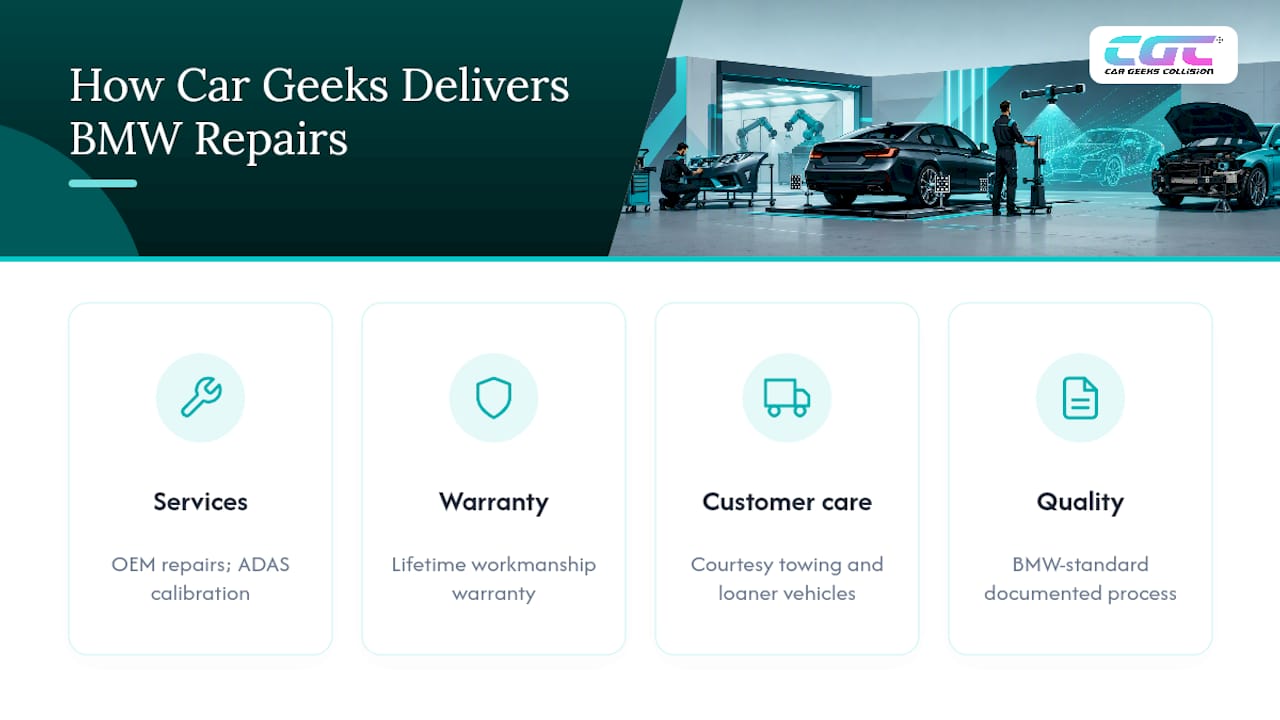
Car Geeks Collision handles OEM procedure repairs, ADAS diagnostics and calibration, structural and frame repair, and paint and refinishing on BMWs, alongside insurance coordination, courtesy towing, and loaner vehicles when available. Every repair carries a lifetime workmanship warranty, and our team documents the process the way BMW’s own certification standard expects.
An independent shop is often the more practical choice when scheduling flexibility matters or when your repair overlaps with EV or exotic-vehicle expertise that a single-brand dealer network doesn’t always carry in-house. A recent BMW 7 Series front-end restoration we completed shows what OEM-standard work looks like from estimate to final paint match.
What the Certification Checklist Gets Wrong
The BMW certification checklist is a solid baseline, but treating it as the whole answer misses something owners actually care about: who’s accountable when something’s wrong six months later. A certificate of repair means little if the shop that issued it won’t stand behind the work in writing.
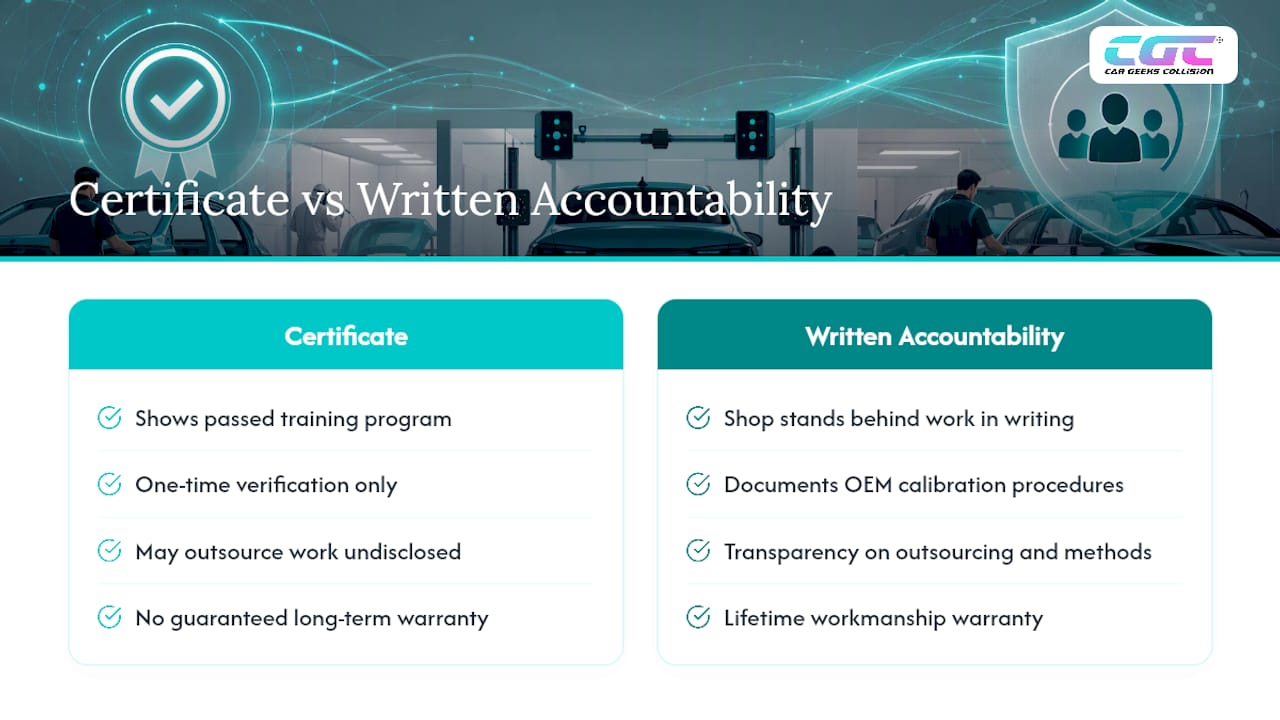
The conventional advice, “go certified, pay the premium, trust the badge,” skips the harder question of verification. Plenty of certified centers do excellent work. Plenty also outsource pieces of the job without telling you. The badge tells you a shop passed a training program once. It doesn’t tell you whether the technician who worked on your car last month still meets that standard, or whether your specific repair got the calibration it needed.
What should come first: ask for the calibration method, the parts policy, and the warranty terms in writing before you ask about certification status. A BMW-capable independent that documents OEM procedures and stands behind a lifetime workmanship warranty often serves you better than a certified badge with no paperwork to back it up.
— Car Geeks Collision
Ready to Book a BMW Collision Inspection?
An independent collision repair center in South Florida offers BMW owners a factory-standard alternative to dealer body shops, with OEM parts, trained technicians, and in-house ADAS calibration under one roof, often with shorter wait times than dealer networks during busy repair seasons. They coordinate directly with insurance carriers, arrange towing, and provide courtesy loaner vehicles when available, to help manage the repair process efficiently.
Every repair comes backed by a lifetime workmanship warranty and documented parts sourcing, the same paperwork trail the certification standard calls for. If your BMW needs bodywork, book an inspection through our collision repair page and get a written estimate before any work begins.
Sources
FAQ
Is It Better to Go to a Dealership for Body Work?
Not necessarily. A dealer’s certified network guarantees BMW-trained staff and OEM parts, but a vetted independent shop following the same OEM procedures, including in-house ADAS calibration, can deliver comparable results, often with more flexible scheduling.
Is Repairing a BMW Expensive?
Costs vary widely based on OEM parts pricing, aluminum or carbon-fiber repair needs, paint complexity, and ADAS calibration fees, with regional labor rates adding further variation. Minor cosmetic work costs far less than structural repairs requiring frame straightening.
Is There a Class Action Lawsuit Against BMW?
Yes, active filings exist covering issues like oil filter housing defects affecting model years roughly between 2014–2025, and a transfer case defect alleged in some 2019–2025 models. Check whether your specific model year and engine are covered before paying out of pocket for related repairs.
Is It Hard to Get Parts for a BMW?
OEM parts availability depends on the model and part, and backorders can extend repair timelines, particularly for structural or aluminum components. A shop with strong BMW parts sourcing relationships, whether certified or a capable independent like Car Geeks Collision, typically manages this better than a general body shop unfamiliar with BMW’s supply chain.
Recommended