
Blog
Tesla Paintless Dent Repair: What Owners Need to Know
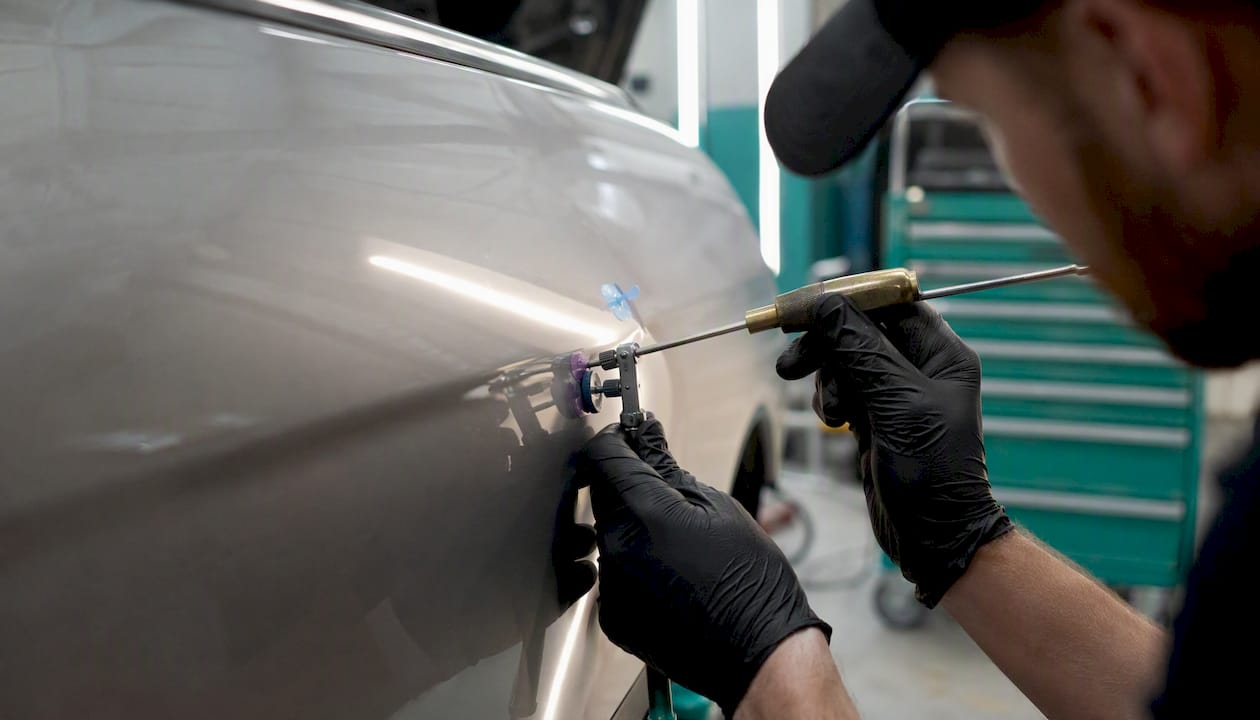
Discover how Tesla paintless dent repair can restore your vehicle’s look. Find out costs, techniques, and what you need to know today!
Tesla paintless dent repair (PDR) works well for most shallow, rounded dents with intact factory paint — but the outcome depends heavily on which panel is damaged and who performs the work. According to Tesla’s own body repair procedures (BR-17-10-001), PDR techniques are acceptable for many aluminum cosmetic repairs, provided the technician follows specific temperature limits, tool requirements, and disassembly steps. Model S and Model X owners have full aluminum bodies; Model 3 and Model Y owners have mixed construction, with some aluminum and some steel panels.
For a single small-to-moderate dent, most qualified shops quote somewhere in the $150–$500 range for steel panels and $300–$900 or more for aluminum, depending on size, location, and access. Aluminum repairs typically run 40–60% longer than equivalent steel jobs. If your paint is intact and the dent is shallow and rounded, PDR is almost certainly worth a professional evaluation before you consider anything more invasive.
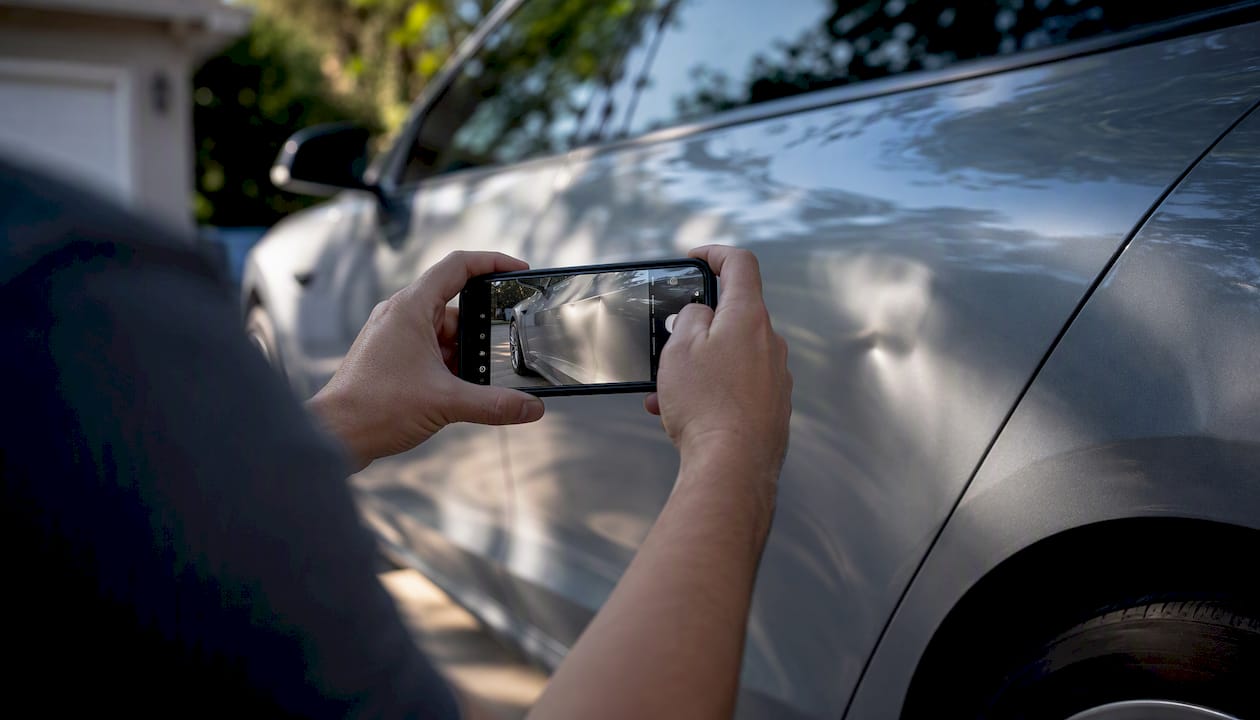
Your immediate next step: send three photos (straight on, 45-degree angle, and a close-up) to a Tesla-capable shop for a free photo evaluation, then schedule an in-shop assessment. A photo read takes minutes and tells you whether you have a strong PDR candidate or a repair that needs a different approach.
Key Takeaways
Tesla PDR works best on shallow, rounded dents with intact paint on aluminum panels — but only when performed by a technician trained in aluminum-specific technique and OEM procedures.
Point
Details
PDR suitability by panel
Model S/X are full aluminum; Model 3/Y are mixed — confirm panel material before any repair begins.
Aluminum demands more
The ASA/NAPDRT study found aluminum required 70–150% more force to repair than steel in sampled panels.
Aluminum repairs take longer
Shops typically estimate 40–60% longer session times for aluminum PDR versus comparable steel repairs.
Know the hard limits
Sharp creases, torn metal, punctures, and damaged paint are not PDR candidates — attempting PDR on these worsens the damage.
Cargeekscollision for South Florida
Cargeekscollision follows OEM procedures, uses a segregated aluminum repair area, and backs every repair with a lifetime workmanship warranty.
Table of Contents
How does paintless dent repair work on a Tesla?
PDR is the process of massaging metal back to its original contour without disturbing the factory paint. No filler, no sanding, no refinishing. When it works, the result is invisible and the car’s original paint stays intact, which protects both resale value and any remaining factory warranty on the finish.
On a Tesla, technicians use three core methods, often in combination:
Pushing from behind: A metal rod or pick tool is inserted through an access point behind the panel and used to apply controlled pressure from the inside out.
Glue-tab pulling: A specialized tab is bonded to the dent’s surface with a heat-activated adhesive, then pulled outward with a slide hammer or pulling bridge. Glue-pull systems are increasingly the primary method for aluminum panels because they use less heat and reduce the risk of coating intrusion. Systems like KECO glue-tab pulling are widely used in professional aluminum repair.
Heat-assisted work: Controlled, low-level heat (a heat gun or infrared lamp) can relax aluminum’s work-hardening and make the metal more responsive, but temperature must stay well below the annealing threshold.
The repair process follows a consistent sequence:
Intake and photo review — the technician documents the dent’s size, shape, and paint condition before touching anything.
Access preparation — trim pieces, inner panels, or sensors may need to be removed to reach the dent from behind.
Line-board reading — a fluorescent or LED line board is positioned to reflect across the panel, making high and low spots visible in precise detail.
Progressive pulls and pushes — the technician works in small, controlled increments, constantly re-reading the panel under the light board.
Final finish check — the repaired area is inspected under multiple light sources and angles to confirm the surface is level.
Pro Tip: A photo evaluation is a useful first filter, but aluminum panels on Teslas can hide stress or micro-damage that only shows up under a line board in person. Always follow a photo eval with an in-shop assessment before committing to a repair scope.
Why aluminum panels make Tesla PDR more demanding
Steel has “memory.” When you push a steel dent, the metal wants to return toward its original shape. Aluminum does not behave that way. It work-hardens as it deforms, meaning the metal stiffens and resists correction the more it is worked. Push too hard or too fast, and you create a high spot that cannot be walked back without risk of cracking the paint or permanently weakening the panel.
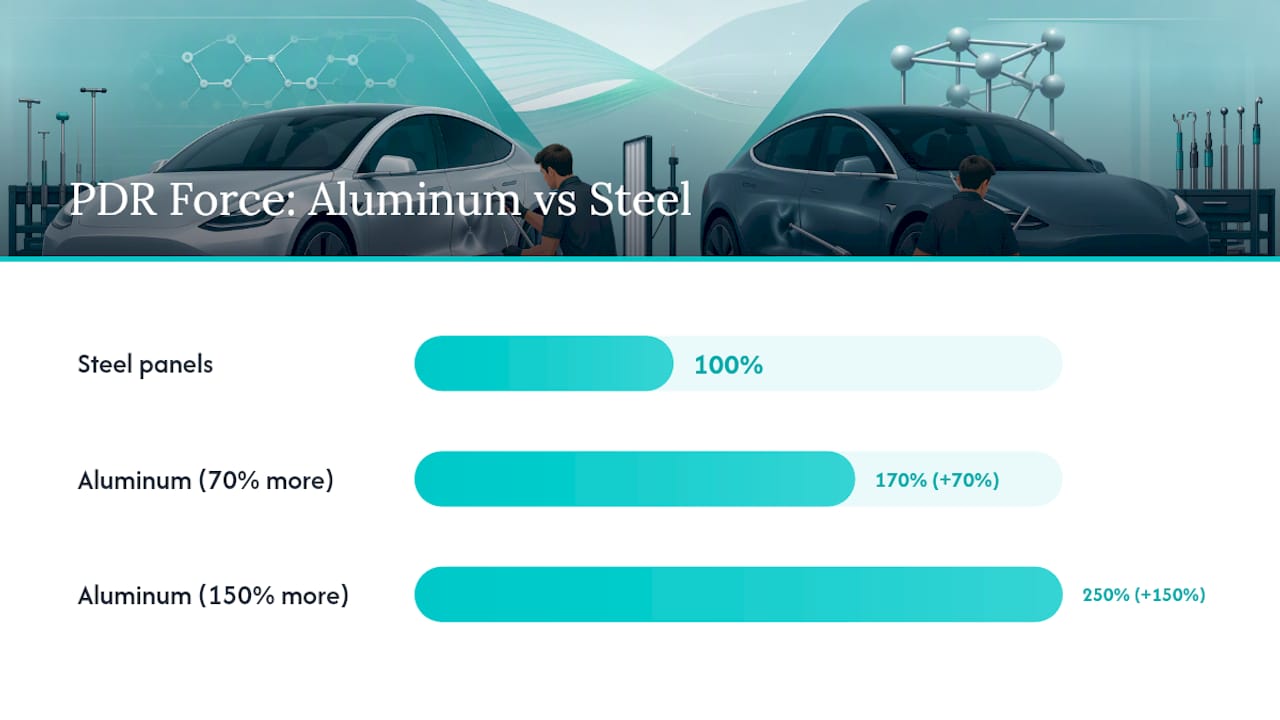
The ASA/NAPDRT aluminum vs. steel PDR study quantified this directly: in controlled testing on simulated hail damage, technicians estimated aluminum required 70–150% more force to reverse the same damage than steel panels in the sampled hoods. That is not a minor difference in technique — it is a fundamentally different repair discipline.
Heat can help, but it carries real risk. Aluminum begins to lose temper (anneal) at temperatures that a standard heat gun can reach. OEM guidance and industry sources often cite approximately 570°F (300°C) as a danger zone where aluminum temper can be permanently compromised. Tesla’s repair documentation includes explicit temperature cautions for this reason.
Which Tesla panels are aluminum vs. mixed?
Model S and Model X: Full aluminum body panels, including doors, hood, fenders, and roof.
Model 3 and Model Y: Mixed construction. Doors and hoods are commonly aluminum; other body panels may be steel or a combination.
Knowing your panel material before the repair starts is not optional — it determines the tools, technique, and time required.
Limitations specific to aluminum PDR:
Thin panel skins leave a narrow margin for error on tool tip selection and pressure.
Feature lines (sharp body creases) concentrate stress and are harder to restore cleanly.
Access-limited panels (rear quarters near structural attachments) may not allow proper tool placement.
Paint stress from the original impact may not be visible until the metal moves during repair.
According to EV-specialist PDR guides, Model S and Model X owners should expect every panel to be evaluated as an aluminum repair, while Model 3 and Model Y owners need panel-by-panel confirmation before assuming technique.
What does Tesla PDR cost, and how long does it take?
Cost varies more on aluminum repairs than on steel, because the technician’s skill level, tooling, and time commitment all increase. Owner-reported prices on forums like Reddit’s r/TeslaLounge show a wide range from roughly $300 to $1,500 depending on the shop, the panel, and the dent’s complexity. Tesla Service Center pricing tends to run at the higher end of that range.
Key factors that affect your quote:
Dent size and shape: Shallow, round dents are the best candidates. Sharp creases cost more and may not be PDR candidates at all.
Panel material: Aluminum repairs require specialized tools and take more time than steel.
Access: A dent on a door skin with easy inner-panel access costs less than one near a structural attachment or behind a sensor cluster.
Feature lines: A dent that crosses a body crease is significantly harder to restore invisibly.
Paint condition: Any existing chips, stress cracks, or flaking disqualify the dent from PDR entirely.
Technician experience and tooling: A certified aluminum PDR technician with proper glue-pull equipment commands higher rates — and earns them.
Aluminum repairs typically run 40–60% longer than comparable steel jobs. A single small steel dent might take 30–60 minutes; the same dent on an aluminum Tesla panel often takes 60–90 minutes or more, with additional time if trim removal is required.
For insurance claims, most carriers will cover PDR when it is the appropriate repair method. Getting a written estimate from a Tesla-capable shop before filing helps establish the correct repair scope.
When PDR won’t work and the risks you need to know
Not every dent is a PDR candidate, and attempting PDR on the wrong damage can make a bad situation worse. Knowing the hard limits protects your paint, your panel, and your car’s resale value.
Damage types that are generally not PDR candidates:
Sharp creases with stretched or torn metal
Punctures or holes of any size
Dents where the paint is already chipped, cracked, or flaking
Damage near structural attachments or reinforced areas
Rear-quarter damage that involves the vehicle’s structural geometry
Risks from improper PDR on aluminum:
Micro-cracks in the paint that are invisible at first but expand over time
High spots that cannot be corrected without refinishing
Tool marks from tips that are too aggressive for the panel gauge
Permanent weakening of the panel from overheating past the annealing threshold
OEM caution: Tesla’s body repair procedures require technicians to disconnect high-voltage systems and remove nearby sensors or modules before using pull-tab or weld-on systems. The documentation specifies that aluminum sanding should use no coarser than 80-grit abrasive, and that paint removal must occur in a properly ventilated area. These are not suggestions — they are procedural requirements that protect both the technician and the vehicle’s systems.
Do not attempt DIY PDR on a Tesla aluminum panel. Consumer-grade glue-pull kits lack the temperature controls, tip geometry, and line-board feedback that aluminum repair requires. The risk of creating an irreversible high spot, cracking the paint, or overheating the panel is real, and the repair cost afterward is substantially higher than a professional PDR job would have been.
How to pick a qualified PDR shop for your Tesla
The single biggest variable in Tesla PDR outcomes is the technician, not the dent. A shop with proper aluminum experience, the right tools, and a documented process will consistently outperform a generalist shop that occasionally works on EVs.
Pre-qualification checklist:
Confirmed experience with aluminum PDR on Tesla models (not just EVs generally)
Dedicated, segregated aluminum repair area to prevent steel dust contamination
I-CAR training or equivalent OEM-aligned certification for aluminum repair
Glue-pull systems with proper tab selection for aluminum gauge panels
Written workmanship warranty on the repair
Documented process for EV high-voltage safety and ADAS considerations when panels are removed
Questions to ask before booking:
Have you performed aluminum PDR on this specific Tesla model and panel?
Do you have a dedicated aluminum repair area separate from your steel work?
What glue-tab systems do you use, and how do you monitor temperature during heat-assisted work?
Do you provide before-and-after photos and a written warranty?
If ADAS sensors need to be removed for panel access, do you handle recalibration in-house?
Red flags to walk away from:
Vague or evasive answers about aluminum-specific experience
No before-and-after photo portfolio for Tesla or EV repairs
Unwillingness to provide a written warranty
Pressure to begin work without an in-shop inspection
No mention of EV high-voltage safety protocols
Pro Tip: Ask specifically about the glue-tab system the shop uses. A technician who can name the system (such as KECO or a comparable professional-grade kit) and explain why they chose it for aluminum is demonstrating real working knowledge — not just familiarity with the concept.
What to expect during your Tesla PDR appointment
A well-run PDR appointment on a Tesla follows a clear sequence, and knowing it in advance means you can hold the shop accountable at each step.
Intake and documentation — the technician photographs the dent from multiple angles and notes paint condition, panel material, and any pre-existing damage in writing.
In-shop assessment under line board — the panel is read under a fluorescent or LED line board to map the exact contour of the damage before any tools are applied.
Access preparation — inner trim, sensors, or adjacent panels are removed as needed to reach the dent from behind. This step is where EV high-voltage awareness matters.
PDR session — the technician works in progressive, controlled passes, re-reading the panel under the line board between each sequence of pushes or pulls.
Final inspection — the repaired area is checked under multiple light sources and angles. Any minor glazing or paint touch-up, if needed, is noted separately in the scope.
Delivery and documentation — you receive before-and-after photos, a written scope of work, and warranty paperwork before you drive away.
What you should receive at pickup:
Written estimate and final invoice with repair scope
Before-and-after photos of the repaired panel
Notes on any paint condition findings discovered during the repair
Workmanship warranty documentation
Realistic outcome expectations: a shallow, round dent on a flat panel section will typically produce a near-invisible result. A crease or a dent that crosses a feature line may leave a slight trace that is only visible under direct light at a specific angle. A qualified technician will tell you this before starting, not after.
How Cargeekscollision approaches Tesla PDR
At Cargeekscollision in Hollywood, Florida, a typical Tesla PDR job begins with a structured intake that mirrors the OEM procedure checklist from Tesla’s body repair documentation. Every repair starts with a photo review and an in-shop line-board assessment — no exceptions — because aluminum panels on a Tesla can hide stress that a photo alone will not reveal.
The shop’s workflow for aluminum PDR includes:
OEM procedure checklist review before any tools are applied
Dedicated aluminum repair area, segregated from steel work to prevent galvanic contamination
Glue-tab pulling as the primary method for accessible dents, with temperature monitoring throughout any heat-assisted steps
Line-board verification at multiple stages of the repair, not just at the end
ADAS recalibration in-house when panel removal or adjustment affects sensor positioning
Cargeekscollision serves Tesla owners throughout South Florida, including Hollywood, Fort Lauderdale, Aventura, Hallandale Beach, Pembroke Pines, Miramar, and surrounding Broward and Miami-Dade communities. For owners who want to understand the full scope of Tesla-specific repair options, the Tesla collision repair overview covers structural, paint, and ADAS work alongside PDR.
The case for getting this right the first time
PDR for Teslas is genuinely one of the best repair options available when the conditions are right. It preserves factory paint, costs less than refinishing, and leaves no trace when a qualified technician handles it. The problem is not the method — it is the mismatch between a straightforward-sounding repair and the real technical demands of aluminum panels.
Most owners who end up with a poor PDR result did not choose a bad shop on purpose. They chose the fastest or cheapest option without knowing what questions to ask. Aluminum PDR on a Tesla is not a commodity service. The technician’s training, tooling, and willingness to follow OEM procedures are what separate a near-invisible result from a repair that costs twice as much to fix correctly the second time. Prioritize qualifications over price, every time.
Tesla PDR at Cargeekscollision: get a photo evaluation or in-shop quote
For Tesla owners in South Florida who want PDR done to OEM standards, Cargeekscollision offers a straightforward path from photo evaluation to finished repair. The shop’s EV body repair service covers aluminum PDR alongside ADAS calibration, structural repair, and paint work — all under one roof, with a lifetime workmanship warranty on every job.
What Cargeekscollision provides for Tesla PDR:
Free photo evaluation (send three photos: straight on, 45-degree, close-up)
In-shop line-board assessment before any work begins
Dedicated aluminum repair area, segregated from steel work
Glue-tab pulling with temperature monitoring for heat-assisted steps
ADAS recalibration in-house when panel access requires sensor removal
Written warranty paperwork and before-and-after photo documentation at pickup
To get started, gather three photos of the dent, your VIN, and the panel location. Then request a quote or book an assessment through the Cargeekscollision website. The photo evaluation is free, and the in-shop read takes less than an hour.
Sources
The sources below are the primary documents and industry references that substantiate this guide. Each one is worth reading directly if you want the original data or procedural detail.
Recommended