
Blog
Drivers: Replace a Fired Seat Belt Pretensioner, 2–7 Day Remanufacture
Locked belt or persistent airbag light after a crash? Learn shop steps for safe pretensioner replacement, remanufacture timelines (2–7 day mail in), and...
If your seat belt is locked or your SRS/airbag light stays on after a crash, the pretensioner has likely deployed and needs a certified replacement or remanufacture, not a DIY reset. This almost always requires an SRS module scan or reset to clear stored crash data before the light will go off for good. A dealer, certified remanufacturer, or qualified collision shop is the safest way to handle it, and mail-in remanufacture can save money when the webbing and housing survived the crash intact.
TL;DR:
Replacing a deployed pretensioner requires a certified rebuild or full OEM replacement, not a DIY reset or reuse of salvage parts, due to single-use pyrotechnic design.
Proper diagnosis involves connecting an SRS scan tool to confirm deployment codes, inspect the assembly for damage, and document all findings before replacement.
Final steps include reprogramming or resetting the SRS module, running a system self-test, and verifying that the warning light stays off, ensuring the system functions correctly.
Costs vary from remanufactured units for undamaged assemblies to OEM parts for damaged housings, with additional charges for module resets and multiple seating positions.
Choosing a qualified shop with certified remanufacture documentation, proper Haz-Mat handling, and experience with insurance billing is essential for safety and compliance.
Table of Contents
OEM, Remanufactured, or Used: Which Replacement Part Is Right?
Why Does the Airbag Light Stay On After Pretensioner Replacement?
How Car Geeks Collision Handles Pretensioner Replacement and SRS Restoration
Get a Seat Belt Pretensioner Diagnostic at Car Geeks Collision
How Do You Know if a Seat Belt Pretensioner Deployed?
The seat belt pretensioner sits in the buckle or the retractor, and its job is to yank the belt tight in milliseconds during a crash, before the airbag even finishes inflating. That tightening comes from a small pyrotechnic charge that fires once. Once it fires, the mechanism is spent. There’s no resetting it, no re-cocking it, and no way to make it fire twice.
A few symptoms point straight at deployment rather than a simple mechanical hang-up:
The seat belt is locked solid and won’t retract into the reel, even after you tug and release it repeatedly.
The SRS or airbag warning light stays lit after the ignition cycle completes, instead of flashing off after a few seconds.
A scan tool pulls diagnostic trouble codes tied to the pretensioner circuit or squib resistance.
The airbags themselves deployed, which almost always means every pretensioner in that seating position fired too.
A locked, non-retracting belt after a collision is frequently the direct result of pyrotechnic deployment, not a jammed reel or a bent bracket. Visual clues back this up: a melted or blistered plastic housing near the buckle stalk, a faint burnt smell in the cabin, or a slightly deformed retractor mechanism.
Statistic callout: NHTSA’s research on pretensioners and load limiters confirms these devices measurably reduce fatality risk when paired with load limiters, but they only work once. That single-use design is exactly why a fired pretensioner has to come out of the vehicle entirely.
The reason a proper scan matters so much here is that not every SRS light means a fired pretensioner. Sometimes it’s a wiring fault, a corroded connector, or a failed sensor with nothing pyrotechnic involved. A technician using an SRS-capable scan tool can tell the difference between a genuine deployment code and a circuit fault in a few minutes, which keeps you from replacing a part that didn’t actually fire, or worse, driving around with a fired one you assumed was fine.
What Happens During Professional Pretensioner Replacement?
A proper seat belt pretensioner replacement is a documented process, not a swap-and-go job. Here’s what it typically looks like in a shop that takes SRS work seriously:
Pull the codes first. A technician connects an SRS-capable scanner and reads every stored trouble code before touching a bolt, which tells them exactly which pretensioners fired and whether other SRS components need attention too.
Document everything. Photos, code printouts, and notes on which seating positions deployed become part of the repair file, especially important if an insurance carrier is paying for the work.
Remove and inspect the assembly. The technician pulls the seat belt assembly, checks the webbing for cuts or fraying, inspects the buckle switch, and examines the retractor housing for physical damage beyond the spent charge.
Decide: remanufacture or full replacement. If the webbing and hardware are intact, a certified remanufacture rebuild is often the more economical path. If there’s physical damage beyond the pyrotechnic charge, a new OEM assembly is the safer call.
Handle the pyrotechnic component correctly by following proper liability and transport insurance for Haz-Mat shipping, ensuring safe rebuild logistics and compliance. Spent units headed for remanufacture ship under Class 9 hazardous materials shipping rules, since they still contain unfired chemical components in some designs. This isn’t optional paperwork. It’s federal shipping regulation.
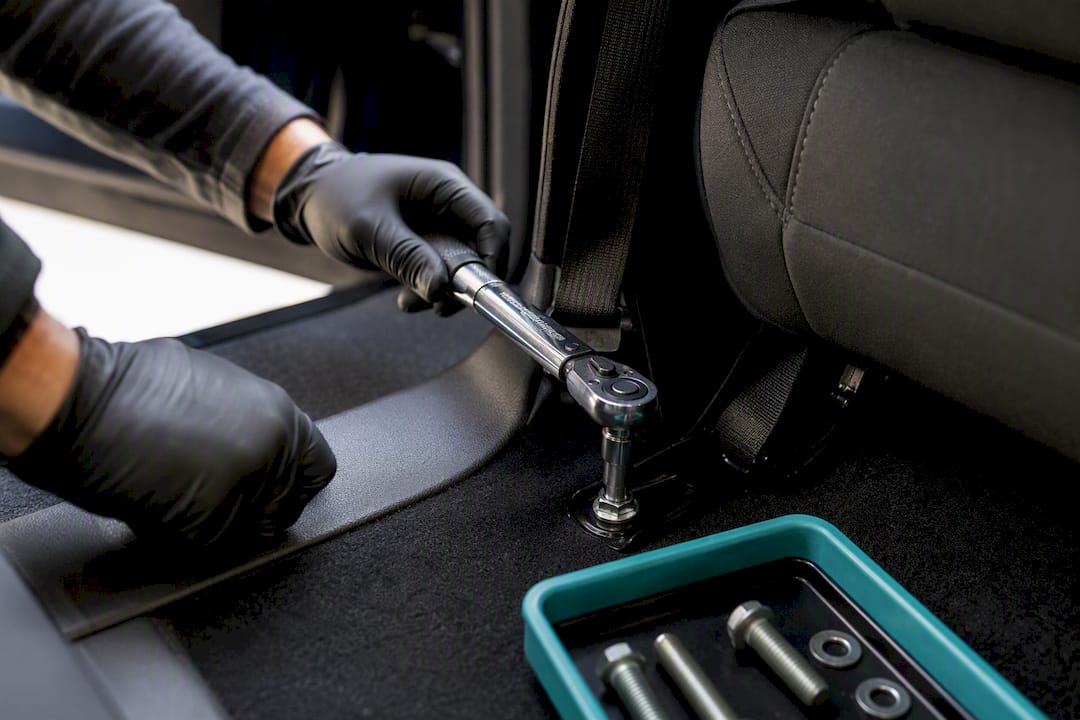
Install to torque spec. Whether it’s a remanufactured unit coming back or a new OEM assembly, every bolt goes into the manufacturer’s torque specification, and every connector gets reseated and tested for continuity.
Run final SRS diagnostics. The technician clears codes, performs the module reset or reprogramming step, then runs a full system self-test to confirm the SRS light stays off and every restraint component reports ready.
Pro Tip: Ask your shop whether they document squib resistance readings before and after the install. A quality remanufacturer includes this in the paperwork because SRS modules expect specific resistance values, and a mismatch will trip the warning light right back on.
The step people skip when they try this themselves is usually the last one. Bolting in a new pretensioner without running full diagnostics afterward is like reinstalling a car battery without checking that the alternator is charging it. The part might be fine, but the system around it needs to confirm that on its own terms.
How Much Does Seat Belt Pretensioner Replacement Cost?
Pricing depends heavily on whether you’re paying for a remanufacture rebuild or a brand-new OEM assembly, and whether the airbag control module needs a reset or a full replacement.
Remanufactured pretensioner: generally the most budget-friendly option when the webbing and housing are undamaged, since you’re paying for a rebuild rather than a new part.
New OEM pretensioner assembly: costs more upfront but comes with full manufacturer warranty coverage and no rebuild history to track.
SRS module reset or reprogramming: an additional labor line, since clearing stored crash data is a separate diagnostic step from the mechanical swap.
Airbag module replacement: if the module itself is damaged rather than just needing a reset, this adds meaningfully to the bill, since the module has to be reprogrammed to the vehicle’s VIN.
Multiple seating positions: a front-impact crash often fires pretensioners on both front seats, which roughly doubles the parts cost even though labor doesn’t scale the same way.
Dealer pricing tends to run higher than an independent collision shop with the same SRS diagnostic equipment, mostly because of parts markup rather than labor rate differences.
Statistic callout: Because pretensioners are single-use devices by design, there’s no scenario where “just check if it’s still good” is a legitimate diagnostic step. If it fired, it’s coming out, full stop.
Turnaround time splits into two tracks. An in-shop replacement using OEM parts already in stock can often happen same-day or next-day, since it’s mechanical work plus a diagnostic cycle. Mail-in remanufacture typically takes two to seven days round-trip, since the unit has to ship out under Haz-Mat rules, get rebuilt, and ship back before installation. Shops juggling multiple seating positions, a damaged airbag module, or parts backorders should tell you upfront if the estimate is going to stretch beyond that window.
OEM, Remanufactured, or Used: Which Replacement Part Is Right?
The part you choose has real safety implications, not just budget ones. Here’s how the three main options stack up.
OEM new assembly is the right call when the housing or webbing shows damage beyond the pyrotechnic charge, or when you want zero rebuild history in the vehicle’s repair file. It’s the most straightforward option for insurance documentation too.
Certified remanufactured units are a legitimate, cost-saving choice when a reputable rebuilder replaces the initiator and any consumed internal components, then documents the rebuild with traceable paperwork and a warranty. Quality remanufacture work includes resistance checks that match what the SRS module expects, which is exactly the detail that separates a professional rebuild from a shortcut.
Used pretensioners pulled from salvage vehicles are, frankly, a gamble you shouldn’t take. There’s no reliable way to confirm whether a used unit already deployed and got swapped back in, or whether it sat in a flood-damaged vehicle that corroded its internals. Given that NHTSA’s own data ties pretensioner function directly to occupant survival outcomes, that’s not a corner worth cutting to save a little cash.
When you’re evaluating a remanufacturer, ask for their Haz-Mat shipping certification and a sample of the paperwork they provide with a rebuilt unit. A shop that hesitates to show you documentation is a shop you should walk away from.
Why Does the Airbag Light Stay On After Pretensioner Replacement?
Swapping in a new or remanufactured pretensioner doesn’t automatically clear the SRS light, and this trips up a lot of DIYers who assume the mechanical fix is the whole job. The airbag control module stores crash-event data internally, and that stored data keeps the warning light active until something specifically clears it.
Here’s the sequence a technician follows to actually finish the job:
Scan and read stored codes to confirm which components the module logged as deployed.
Reset or reprogram the module, which on most vehicles clears the crash-data flag without requiring a full module swap.
Replace the module only when it’s physically damaged or when the reset procedure itself fails, since a damaged module can’t reliably hold a reset.
Run a system self-test using the scan tool to confirm every SRS component reports back green, not just that the dashboard light went dark.
Skipping straight to step four without steps one through three is how DIY resistor tricks and cheap “airbag light reset” gadgets get a bad reputation. They can make the light go off temporarily, but they don’t actually restore the SRS system’s ability to detect a future crash correctly. A successful repair has to include verification with an SRS-capable scan tool, because clearing the light without addressing the underlying crash data can leave the whole system nonfunctional even though the dashboard looks fine. Car Geeks Collision’s airbag module reset process walks through exactly what that verification sequence looks like on modern vehicles.
What Can You Safely Do Yourself Before Calling a Shop?
There’s a meaningful difference between doing your own triage and doing your own repair, and the line matters here more than almost anywhere else in a vehicle.
Safe to do yourself:
Visually inspect the belt and buckle area for burn marks, melted plastic, or a housing that looks visibly cracked.
Read diagnostic codes with an SRS-capable scan tool to confirm whether you’re dealing with a deployment or a wiring fault.
Remove interior trim panels for inspection, but only after disconnecting the battery and waiting the manufacturer-specified capacitor discharge time listed in your service manual.
Never do yourself:
Attempt to rebuild or “recharge” a pyrotechnic pretensioner. These charges aren’t user-serviceable under any circumstance.
Bypass a persistent SRS light with a resistor or a cheap plug-in module. This can mask a genuine safety fault and may create liability if you’re ever in another collision.
Install an undocumented used pretensioner pulled from a salvage yard with no deployment history attached.
Continuing to drive with a bypassed SRS warning isn’t just risky for your own safety. It can also create real complications with an insurance claim if an adjuster later discovers the warning was masked rather than fixed.
Pro Tip: Manufacturer battery-disconnect wait times vary by vehicle, sometimes several minutes, sometimes longer, and that number lives in your service manual, not in general internet advice. Look it up for your specific make and model before you touch anything near the SRS wiring harness.
If reassembly is part of your plan at all, stick to the correct fasteners and torque specs for seat belt anchor bolts specifically. These bolts are engineered to hold under crash loads, and a mismatched or under-torqued bolt defeats the entire point of the repair.
How Do You Choose a Qualified Shop for This Repair?
Not every body shop has the diagnostic equipment or training to handle SRS work correctly, so ask these questions before you commit:
Do you install OEM or certified remanufactured parts, and can you show documentation for either? A shop that can’t answer clearly is guessing.
Is an SRS module reset or reprogramming included in the estimate, or is it billed separately later? You want this itemized upfront, not discovered as a surprise line item.
How do you handle Haz-Mat shipping if a unit goes out for remanufacture? A shop that’s never heard the term Class 9 hazardous materials probably isn’t sending parts to a certified rebuilder.
What’s the warranty on parts and labor for this specific repair? Get it in writing.
Do you have experience billing this repair directly to insurance carriers? This matters if the pretensioner deployment came from an at-fault collision.
Red flags to walk away from immediately: a shop that offers to “just clear the code” without addressing the mechanical fault, one that won’t show you remanufacture paperwork when you ask, or one with no SRS-capable scan tool on the premises at all. The trust signals that actually matter are a written warranty, real experience navigating insurance claims, and diagnostic equipment that can verify ADAS and SRS systems together, since many modern vehicles tie these systems closer than people expect.
How Car Geeks Collision Handles Pretensioner Replacement and SRS Restoration
Car Geeks Collision follows OEM repair procedures for pretensioner replacement, full SRS diagnostics, and ADAS calibration on everything from daily drivers to Tesla, Rivian, Porsche, and other luxury and exotic vehicles that come through Hollywood, Florida. Every restraint repair includes a documented SRS scan before and after the work, and the shop backs its repairs with a lifetime workmanship warranty.
When you bring a vehicle in, expect a straightforward sequence: full SRS and ADAS diagnostics, a written estimate that itemizes parts and labor separately, and direct coordination with your insurance carrier if the damage came from a collision claim. Car Geeks Collision also handles courtesy towing and offers loaner vehicles when available, so a locked seat belt or an active SRS light doesn’t leave you stranded while the repair happens. The 7-step repair process the shop follows keeps every stage, from initial diagnostics through final verification, documented and visible to the customer.
What the Conventional Advice Gets Wrong About This Repair
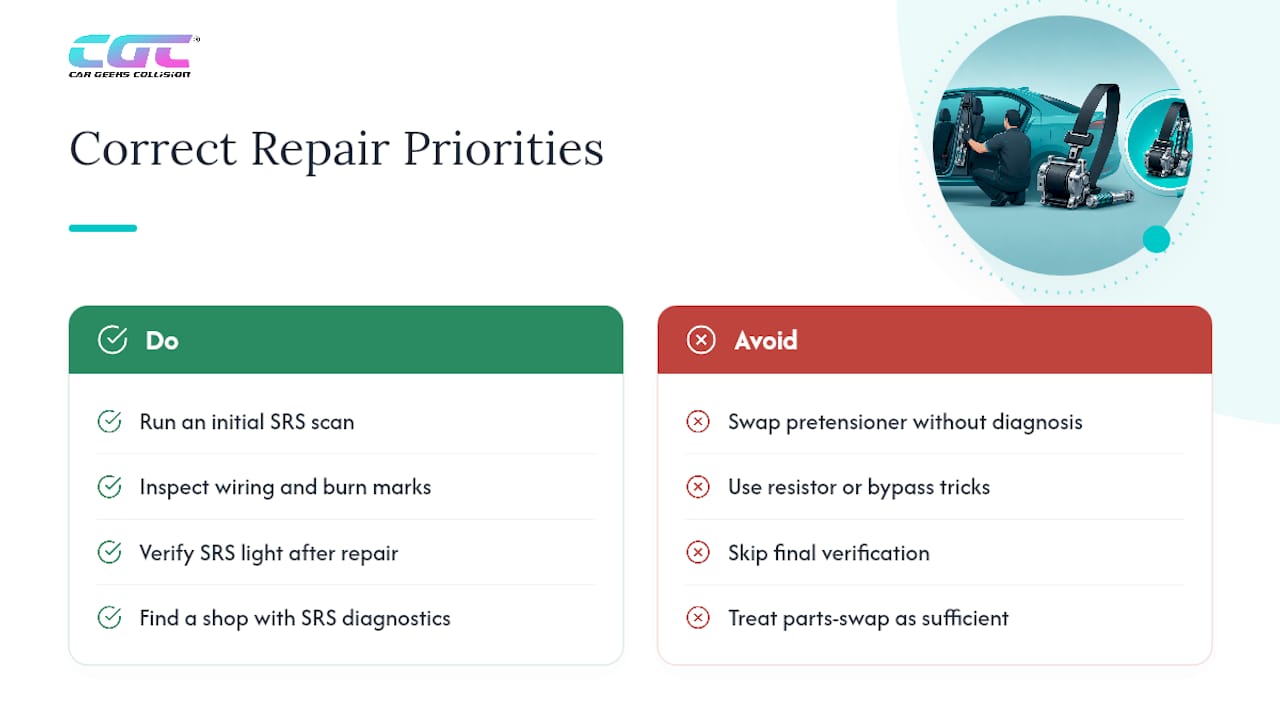
Most online guides treat pretensioner replacement as a parts-swap problem: buy the part, bolt it in, done. That framing undersells the actual risk, which lives less in the mechanical install and more in the diagnostic bookends around it. Skipping the initial scan means you might replace a pretensioner that never fired while ignoring a wiring fault that’s the real culprit. Skipping the final verification means a masked SRS light instead of a restored one.
The DIY resistor and bypass tricks that circulate online deserve more skepticism than they get. They solve a dashboard annoyance while leaving the actual safety system compromised, and that’s a trade no vehicle owner should make knowingly. The genuinely useful DIY work here is triage: reading codes, inspecting for burn marks, understanding what you’re looking at before you call a shop. That knowledge makes you a better customer, not a substitute for one. Prioritize finding a shop with real SRS diagnostic capability first. Everything else, including cost comparisons between remanufacture and OEM, only matters once you’ve cleared that bar.
— Car Geeks Collision
Get a Seat Belt Pretensioner Diagnostic at Car Geeks Collision
If your seat belt locked up in a crash or your SRS light won’t clear, Car Geeks Collision gives you a direct path to a real answer instead of guesswork with a resistor kit. A diagnostic appointment includes a full SRS scan, physical inspection of the belt and buckle assembly, and a written estimate that separates parts, labor, and any module reset work so you know exactly what you’re paying for and why.
Car Geeks Collision coordinates directly with insurance carriers when the damage stems from a covered collision, and offers courtesy towing along with loaner vehicles when available, so you’re not without a car while the repair happens. Every restraint and SRS repair is backed by a lifetime workmanship warranty. Whether you’re driving a daily commuter or something from the luxury and exotic lineup the shop specializes in, the auto body repair team can get your SRS system verified and your belt back to factory-safe function. Book a diagnostic appointment through the full services page to get started.
Sources
The safety claims in this guide draw on NHTSA’s technical analysis of pretensioners and load limiters, which documents their measurable effect on crash survival and confirms their single-use design. For a plain-language breakdown of how the pyrotechnic mechanism actually works, HowStuffWorks’ explainer on seatbelt pretensioners covers the engineering in accessible detail. Manufacturer guidance, including Kia’s owner manual warnings on pretensioner activation, consistently instructs owners to have these systems inspected and replaced by authorized service after any deployment, never serviced at home.
FAQ
How Much Does It Cost to Replace a Seat Belt Pretensioner?
Cost depends on whether you choose a remanufactured unit or a new OEM assembly, plus whether an SRS module reset or replacement is needed; remanufacture is generally the more budget-friendly path when the webbing and housing are undamaged.
Can I Fix a Faulty Seat Belt Pretensioner Myself?
You can safely inspect the belt and read SRS codes yourself, but the pyrotechnic component itself must be replaced or professionally remanufactured. Rebuilding a spent charge or bypassing the warning light isn’t a safe or legal DIY option.
How Long Does It Take to Replace a Seat Belt Pretensioner?
In-shop replacement with OEM parts in stock can often happen same-day or next-day. Mail-in remanufacture typically takes two to seven days round-trip due to Haz-Mat shipping and rebuild time.
Will the SRS Light Turn Off After I Replace the Pretensioner?
Not automatically. The airbag control module stores crash data that needs a proper reset, reprogramming, or module replacement, plus a final diagnostic verification, before the light clears for good.
Is a Used Pretensioner From a Salvage Yard a Safe Option?
Generally not. There’s no reliable way to confirm a used unit’s deployment history, and given how directly these devices affect crash outcomes, that unknown history isn’t a risk worth taking.
Recommended