
Blog
When Repairability Counts: Carbon Fiber vs Aluminum for Car Parts
Shop aware comparison of carbon fiber vs aluminum for cars: CFRP can be about 40% lighter when matched. Damage, repair, and recycling explained.
Choose carbon fiber when minimizing weight and dialing in specific stiffness matters more than cost or repair convenience. Choose aluminum when predictable ductility, lower manufacturing cost, easier repair, and recyclability drive the decision. The trade-off comes down to two things: carbon fiber’s anisotropic, often brittle failure mode versus aluminum’s isotropic, forgiving one, and the repair complexity that follows each. The sections below walk through the numbers, the applications, and the shop-floor realities behind that call.
TL;DR:
Carbon fiber parts can be roughly 40% lighter than aluminum equivalents with the same stiffness and strength, but only if engineered specifically for load directions.
Aluminum offers predictable deformation signals and easier, more economical repairs, making it preferable for mass-market crash structures and high-volume production.
Manufacturing costs favor aluminum at high volumes due to mature tooling, while CFRP remains more expensive, especially for low-volume, custom, or prototype parts.
CFRP’s damage detection requires non-destructive testing, and structural repairs are often less reliable and more labor-intensive than repairing aluminum components.
Recycling aluminum is well-established and retains properties after reprocessing, whereas CFRP recycling reduces fiber length and strength, limiting its environmental advantages.
Table of Contents
What Actually Drives the Difference: Density, Strength, and Stiffness
Manufacturing Reality: What It Costs to Actually Build the Part
Carbon Fiber vs Aluminum: The Numbers Side by Side
Density alone tells a lot of the story: carbon fiber reinforced polymer (CFRP) laminates run roughly 1.5 to 1.6 g/cm³ against aluminum’s 2.70 g/cm³, a gap that shows up directly in part weight. But density is only half the engineering picture. The table below lines up the properties that actually decide which material wins a given design brief.
Property
Carbon Fiber (CFRP)
Aluminum (6061/7075)
Density
~1.5–1.6 g/cm³
~2.70 g/cm³
Tensile strength
~600–1,500 MPa (fiber direction)
~200–600 MPa
Young’s modulus
High, direction-dependent
Consistent, isotropic
Impact behavior
Brittle failure, internal delamination risk
Ductile, visible deformation
Fatigue tendency
Excellent in-plane, weak off-axis
Predictable, well-characterized
Repairability
Specialized, often replace
Widely supported, straightforward
Recyclability
Limited, energy-intensive recovery
Mature, high-value recycling
Three things jump out from that comparison:
Carbon fiber’s strength range overlaps aluminum’s high end at the bottom, meaning a poorly designed laminate can actually underperform a well-chosen aluminum alloy.
Aluminum’s failure mode gives a visual warning (bending, creasing) before it breaks; carbon fiber can fail internally with no visible sign.
Recyclability and repair ease favor aluminum across nearly every ownership scenario, which matters more as vehicles age.
What Actually Drives the Difference: Density, Strength, and Stiffness
Carbon fiber isn’t simply “lighter aluminum.” It’s a fundamentally different kind of material. Aluminum is isotropic, meaning it behaves the same way no matter which direction you load it. CFRP is anisotropic. Its strength and stiffness depend entirely on fiber orientation, so a laminate that’s excellent under tension along the fiber axis can be surprisingly weak when loaded off-axis or through-thickness.
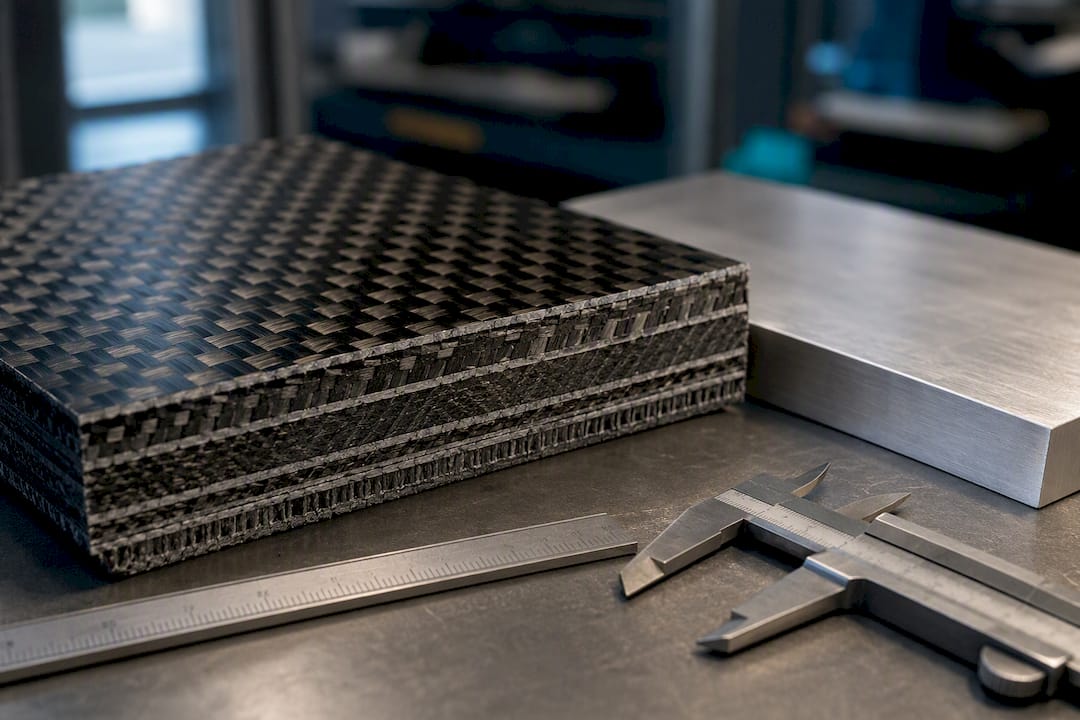
That difference shows up in the numbers. Representative CFRP laminates run 600 to 1,500 MPa in tensile strength along the fiber direction, while common structural alloys like 6061 and 7075 aluminum sit closer to 200 to 600 MPa depending on temper and grade. Engineers usually care less about raw strength than about specific strength and specific stiffness, meaning strength or stiffness divided by density. That’s where carbon fiber pulls ahead: a well-aligned laminate can deliver stiffness-to-weight performance aluminum simply can’t match when fiber orientation lines up with the load path.
Statistic Callout: A carbon fiber structure engineered to match an aluminum part’s mechanical performance can end up roughly 40% lighter for equivalent stiffness and strength, but only if the layup schedule accounts for every loading direction the part will see in service.
Thermal and electrical behavior separate the two just as sharply. Aluminum conducts heat and electricity well, which makes it useful for heat sinks and grounding paths, but it also expands noticeably with temperature. CFRP has near-zero thermal expansion along the fiber axis and poor electrical conductivity, which is why aerospace designers like it for dimensional stability but have to add separate provisions for lightning protection and EMI shielding.
Where Each Material Actually Gets Used
Material choice tracks closely with what a part has to survive and how many of them get built. Formula 1 monocoques, aircraft wing skins, and high-end road bike frames lean on carbon fiber because shaving mass pays off directly in speed, fuel burn, or lap time. Crash structures, engine blocks, and mass-production body panels lean on aluminum because ductile deformation absorbs crash energy predictably and stamping scales to hundreds of thousands of units a year.
Motorsport and aerospace: CFRP dominates where every gram matters and production volumes are low enough to justify hand layup or autoclave curing.
Mainstream automotive crash structures: Aluminum extrusions and stampings remain the default because their ductile crumple behavior is well understood by crash engineers and regulators alike.
Cycling: High-end frames favor carbon fiber for ride stiffness and weight; aluminum still leads on affordable and gravel-oriented bikes where impact resistance and repairability matter more.
Consumer electronics and marine parts: Aluminum wins on cost and machinability; CFRP appears mostly in performance-focused subsystems.
A growing number of vehicles split the difference. Hybrid architectures pair an aluminum subframe with a carbon fiber monocoque or body skin, capturing weight savings where they matter most while keeping the parts that absorb crash energy in a material that behaves predictably and repairs easily.
Manufacturing Reality: What It Costs to Actually Build the Part
Aluminum’s manufacturing playbook is mature and cheap at scale: stamping, extrusion, and CNC machining all run on tooling that’s been optimized for decades. Carbon fiber’s process menu is more varied, and every option trades speed against quality and cost. Hand layup is slow and labor-intensive. Prepreg with autoclave curing produces excellent, consistent laminates but demands expensive equipment and long cure cycles. Resin transfer molding (RTM) and automated fiber placement (AFP) push CFRP closer to production-line speeds, but the capital investment is steep.
That process gap shows up directly in per-part economics. At low volumes, CFRP parts routinely cost multiple times more per unit than an equivalent stamped or machined aluminum part, largely because tooling and labor dominate the cost structure. Automated CFRP processes narrow that gap as volume climbs, but they rarely erase it entirely.
Prototyping: Aluminum wins almost every time, thanks to fast CNC turnaround and low tooling investment.
Low to mid volume: CFRP can be justified when weight savings translate into performance or range gains that outweigh the per-part premium.
High volume: Aluminum’s stamping and extrusion tooling amortizes fast; CFRP tooling lead times and capital costs make it a harder sell unless automation is already in place.
How Damage Actually Behaves in the Shop
Aluminum tells you it’s hurt. A collision bends, creases, or tears the metal, and a trained technician can see the deformation and measure it against factory specifications. Carbon fiber often hides its damage. A hard impact can delaminate internal plies or crack the resin matrix without leaving a visible mark on the surface, which means assessing CFRP damage usually requires more than a visual inspection — ultrasonic testing or tap testing to find hidden separation between layers.
Repair paths diverge from there. Aluminum panels often get straightened, welded, or panel-replaced using equipment most collision shops already run, and their finish can be preserved longer with ceramic coatings that protect against wear and corrosion. Structural CFRP repairs, when they’re even feasible, follow practices borrowed from aerospace and racing: overlap joints, resin injection, and proof-load testing to confirm the repaired section can carry its designed load again. That extra verification step adds labor and time replacement often ends up the more sensible choice for structural composite panels.
Visible dents and creases: usually repairable in aluminum, rarely in CFRP.
Hidden delamination: requires non-destructive testing regardless of material, but is far more common in carbon fiber after impact.
Structural CFRP panels: replacement is frequently faster and more reliable than attempting a validated structural repair.
Pro Tip: When aluminum and carbon fiber components meet at a joint or fastener, stray metal shavings and improper isolation can trigger galvanic corrosion that shows up months after the repair. Ask any shop working on mixed-material vehicles how they control contamination during the job, not just afterward.
What Happens to Each Material at the End of Its Life
Aluminum has one of the most established recycling streams of any structural material, and recycled aluminum retains most of its mechanical properties while requiring far less energy to reprocess than primary smelting. Carbon fiber recycling exists through mechanical shredding and pyrolysis, but recovered fiber typically loses length and strength, and the recycling infrastructure remains far smaller in scale.
Aluminum: high recovery rates, mature scrap markets, minimal property loss after recycling.
Carbon fiber: recoverable, but fiber quality drops and processing capacity is limited.
Lifecycle math: weight savings from CFRP can offset its higher embodied energy over a vehicle’s life, particularly in EVs where every kilogram saved extends range.
Turning Requirements Into a Material Decision
Every material choice should start with the load case, not the marketing pitch. Work through these steps in order:
Identify the primary KPI. Is the part optimized for minimum weight, minimum cost, crash energy absorption, or long-term durability?
Map the load case. Multi-axial or fatigue-dominated loading favors aluminum’s predictable isotropy; aligned unidirectional loading favors CFRP’s specific stiffness.
Calculate required specific stiffness or strength. If the weight budget is tight and loads are well-defined, CFRP’s stiffness-to-weight ratio usually wins.
Check production volume. Low volume and rapid iteration favor aluminum’s machinability; committed high-volume programs can justify CFRP’s tooling investment.
Estimate total repair and ownership cost. Factor in insurance, part availability, and technician access to composite repair capability, not just the sticker price.
Scenario
Likely Material
Why
Track-focused body panel, low volume
Carbon fiber
Weight and stiffness dominate; repair cost is secondary
Mass-market crash structure
Aluminum
Predictable ductility, mature crash simulation data
EV battery enclosure needing range gains
Hybrid or CFRP
Weight savings extend range enough to offset cost
Daily-driver fender or door skin
Aluminum
Lower cost, easier repair, better insurance economics
Before committing to a structural CFRP part, confirm your insurer and repair network can actually service it. That single check avoids a lot of pain down the road.
When to Choose Carbon Fiber vs Aluminum
Weight is the deciding factor and loads are predictable: carbon fiber, engineered with the right layup.
Cost, repairability, or recyclability matter more than shaving grams: aluminum.
Crash energy absorption is the primary job of the part: aluminum’s ductile behavior remains the safer default.
You need both: a hybrid design, aluminum substructure with carbon fiber skins or panels, often captures most of the weight benefit without giving up repair practicality everywhere on the vehicle.
Quantify the lifecycle cost, not just the sticker price, before locking in either material.
Our View From the Repair Bay
We see the aftermath of both materials every week, and it’s changed how we think about this comparison. Carbon fiber panels almost always get a harder look before we commit to repair. If there’s any suspicion of delamination beneath the clear coat, we lean toward replacement rather than gambling on a repair that can’t be proof-tested to the standard the part deserves.
Aluminum tells a different story. It bends, it creases, and in most cases it can be straightened or panel-replaced using equipment already common in structural repair. That difference has real cost implications for owners over the life of the vehicle, especially on luxury and exotic cars built around carbon fiber structural components. If your car mixes both materials, the smartest question to ask a shop before you hand over the keys is simple: do they have real experience assessing composite damage, or do they just replace anything carbon fiber by default because they lack the diagnostic tools to know better?
— Car Geeks Collision
Car Geeks Collision works on both materials daily, from Porsche 911 structural repairs to Ferrari composite panel assessments, and coordinates directly with insurers on repair-versus-replace decisions for EV and Tesla owners whose vehicles increasingly mix aluminum and carbon fiber in the same structure. If your car needs a shop that can tell the difference between a repairable dent and a hidden delamination, start with our auto body repair services.
Sources
FAQ
Is carbon fiber better than aluminum?
Neither material is universally better. Carbon fiber wins on weight and specific stiffness when the load path is well engineered; aluminum wins on cost, ductility, repairability, and recyclability.
What is the downside of carbon fiber?
Its biggest downsides are anisotropic strength (weak off-axis loading), brittle failure that can hide internal damage, high per-part cost at low volumes, and limited recycling infrastructure compared to aluminum.
Will carbon fiber stop a bullet?
Standard automotive or aerospace CFRP laminates are not designed or tested for ballistic protection; stopping a bullet requires purpose-built ballistic composites with different fiber architecture and thickness, not the CFRP used in vehicle panels or frames.
Is carbon fiber stronger than metal?
In fiber-direction tensile strength, CFRP laminates can reach 600 to 1,500 MPa versus roughly 200 to 600 MPa for common aluminum alloys, but that strength is direction-dependent, so a poorly oriented laminate can underperform metal in off-axis loading.
Recommended