Blog
Hidden Frame or Unibody Damage After a Minor Accident: Signs You Should Not Ignore

A minor crash can move unibody reference points without obvious exterior damage. Learn the warning signs, inspection steps, and repair considerations.
A minor accident can leave a vehicle looking almost untouched while moving structural reference points underneath the body. A bumper cover may spring back, paint damage may be limited, and the car may still drive. None of those signs proves the structure is within specification.
Hidden unibody damage after a minor accident can affect alignment, tire wear, panel fit, crash-energy management, suspension geometry, and the position of cameras or radar units. The right answer comes from measurements and manufacturer repair information—not from appearance alone.
Frame construction and unibody construction are different
Traditional body-on-frame vehicles use a separate structural frame with the body mounted above it. Most modern passenger cars and many crossovers use unibody construction, where stamped steel, aluminum, adhesives, welds, reinforcements, rails, pillars, floors, and aprons work together as the structure.
Drivers often use the phrase “frame damage” for both designs. In a unibody vehicle, a structural concern may involve a front rail, rear rail, apron, strut tower, floor section, rocker panel, pillar, crossmember, or attachment point. The repair decision depends on the damaged material, location, severity, access, and the vehicle maker’s procedures.
How a low-speed impact can create hidden movement
Bumpers and exterior panels are designed to manage force, but collision energy still travels through brackets, absorbers, reinforcement bars, suspension mounts, and body joints. A curb strike, angled bumper hit, wheel impact, or parking-lot collision can load one part of the structure more than another.
The visible dent does not show the entire path of the force. Plastic covers can return close to their original shape while retainers, reinforcements, mounting flanges, or reference points remain shifted. Previous damage and corrosion can also change how a vehicle responds.
Warning signs that deserve a structural inspection
The steering wheel is no longer centered while driving straight.
The vehicle pulls, wanders, or feels different during braking.
A wheel appears farther forward or backward in its opening.
New tire wear develops on one edge or in an uneven pattern.
Doors, hood, trunk, liftgate, or fuel door do not open or close normally.
Panel gaps have changed or one side sits higher than the other.
Wind noise, water leaks, rattles, or interior trim movement appeared after the impact.
Alignment cannot be brought within specification or will not remain consistent.
Driver-assistance or restraint-system warnings are present.
These symptoms can have more than one cause. They do not automatically prove structural damage, but they are reasons to inspect and measure the vehicle rather than guessing.
Why a wheel alignment is not the same as structural measurement
An alignment machine measures wheel angles such as camber, caster, and toe. Those readings are important, but they do not map the complete body structure. A technician may need to confirm the position of suspension attachment points and compare body reference locations in three dimensions.
If a mounting point has moved, adjusting alignment angles without correcting the underlying condition may hide a symptom instead of resolving the cause. Damaged wheels, tires, control arms, knuckles, subframes, and bushings must also be separated from structural conditions during diagnosis.
How hidden unibody damage is evaluated
Document the impact. Record the collision direction, visible damage, warning lights, driving symptoms, and relevant repair history.
Inspect and scan. Examine gaps, seams, welds, coatings, suspension parts, reinforcements, mounting points, and electronic systems.
Disassemble where necessary. Remove covers, liners, trim, or related parts so concealed areas can be seen.
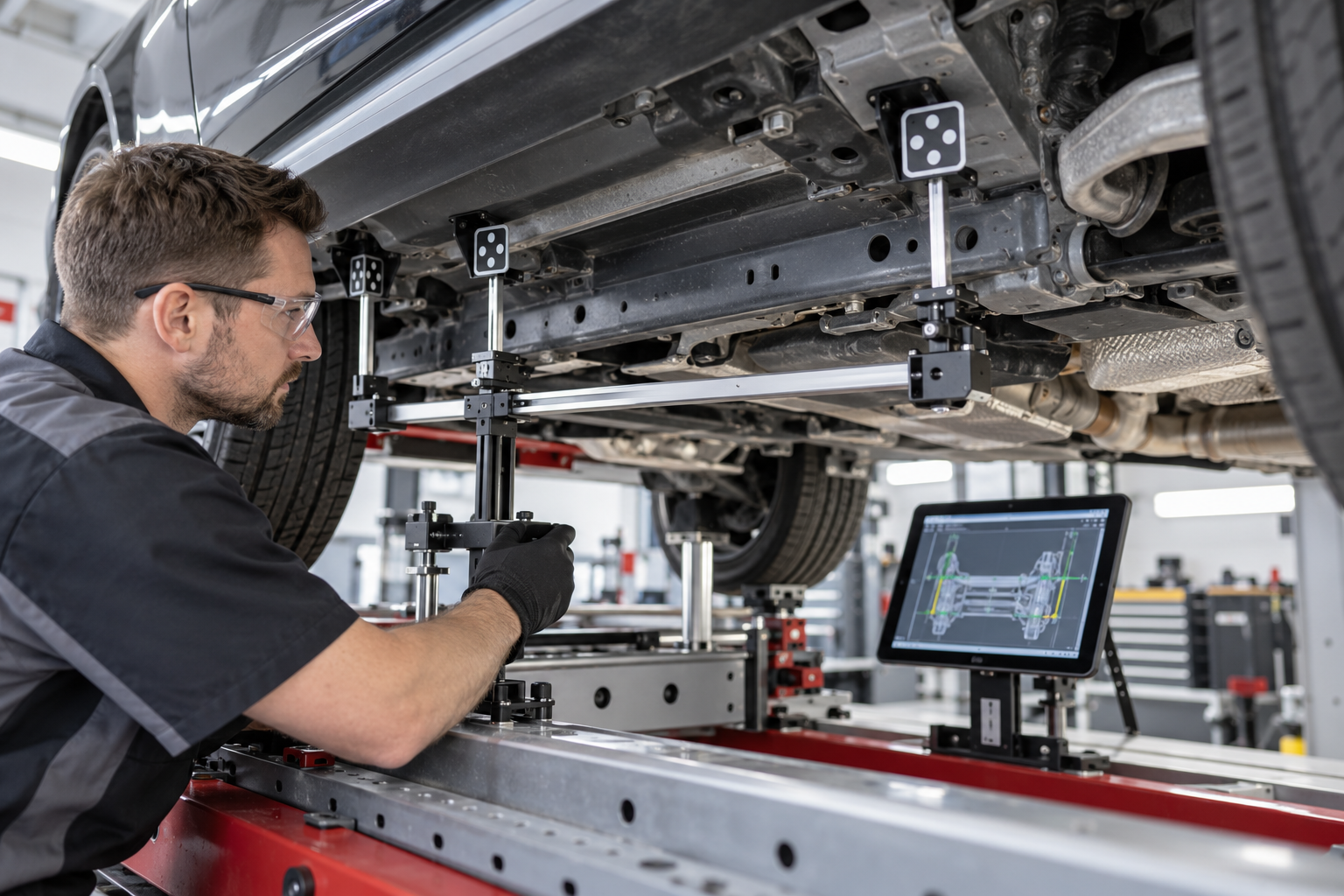
Measure reference points. Use an appropriate three-dimensional electronic or mechanical measuring system and compare results with vehicle-specific data.
Review repair procedures. Determine whether damaged components may be straightened, sectioned, or must be replaced, and identify required joining and corrosion-protection methods.
Verify the completed repair. Re-measure, align, scan, calibrate, road-test, and document results as applicable.
Electronic measuring provides objective evidence
A three-dimensional measuring system can compare multiple length, width, and height points with published vehicle data. This helps identify twist, sway, mash, sag, or local movement that may not be obvious during a visual inspection.
Measurements can also help a repairer explain why an estimate changes after disassembly. The results should be interpreted by a qualified technician; a single number without vehicle context does not define the complete repair plan.
When straightening may be possible—and when replacement may be required
Some structural areas may be restored with controlled pulling and measuring when the manufacturer permits it and the metal has not been compromised beyond allowable limits. Other components may require full or partial replacement because of material grade, heat sensitivity, cracks, severe deformation, inaccessible damage, or explicit repair restrictions.
Ultra-high-strength steels and aluminum components often have specific limits on straightening, heat, sectioning, and attachment methods. Correct welding, riveting, adhesive bonding, corrosion protection, dimensional control, and quality checks all matter. The least expensive-looking option is not necessarily the safest or most durable one.
Modern sensors make dimensional accuracy even more important
Cameras, radar units, blind-spot sensors, parking sensors, steering-angle data, and other systems depend on accurate mounting positions and vehicle geometry. A sensor bracket or body reference point that is slightly out of position can affect aiming even when the dashboard shows no obvious warning.
After structural, suspension, bumper, glass, or alignment work, manufacturer procedures may require pre-repair and post-repair scans, static or dynamic calibrations, aiming, ride-height checks, or specific road conditions. Calibration should follow the applicable procedure for that vehicle and repair.
Insurance estimates can change after disassembly
An initial estimate is commonly based on visible conditions. Hidden damage may only become accessible after the bumper, lamps, liners, trim, suspension parts, or interior panels are removed. Photos, scan reports, measurements, repair procedures, invoices, and supplement documentation help support an accurate repair plan.
If you are working with an insurer, ask how hidden damage and supplements will be handled. Keep copies of estimates and final repair documentation. Coverage and claim decisions depend on the policy and circumstances, so questions about benefits should be directed to the insurer.
Frequently asked questions
Can a small bumper hit bend a unibody?
It can, depending on impact angle, speed, overlap, vehicle design, previous damage, and where the force entered the structure. Inspection and measurement are needed to know.
Will the dashboard warn me about structural damage?
No. Warning lights may identify some electronic faults, but the vehicle does not directly diagnose all dimensional or structural conditions.
Can an alignment prove the frame is straight?
No. Alignment readings evaluate wheel angles. Structural measurement evaluates body and mounting reference points. Both may be needed.
Is all frame or unibody damage unsafe to repair?
No. Many vehicles can be repaired correctly when the damage is accurately assessed and approved procedures are followed. The appropriate method varies by vehicle and component.
Should I drive the vehicle before it is inspected?
If steering, braking, tire clearance, warning lights, fluid leaks, doors, restraints, or visibility are affected, limit driving and arrange professional guidance or towing. When in doubt, prioritize safety.
Schedule a structural-damage evaluation in South Florida
Car Geeks Collision helps drivers in Hollywood and surrounding South Florida communities investigate damage that may be hidden behind a minor-looking impact. An evaluation can include visual inspection, diagnostic scanning, disassembly, alignment checks, and structural measurement as appropriate for the vehicle.
When requesting an estimate, provide the year, make, model, impact photos, collision direction, warning messages, driving symptoms, and insurance information. Accurate documentation helps the repair team build a complete plan and verify the vehicle after repairs.