
Blog
Expect $500 to $25,000: Tesla Body Repair Costs and Checklist
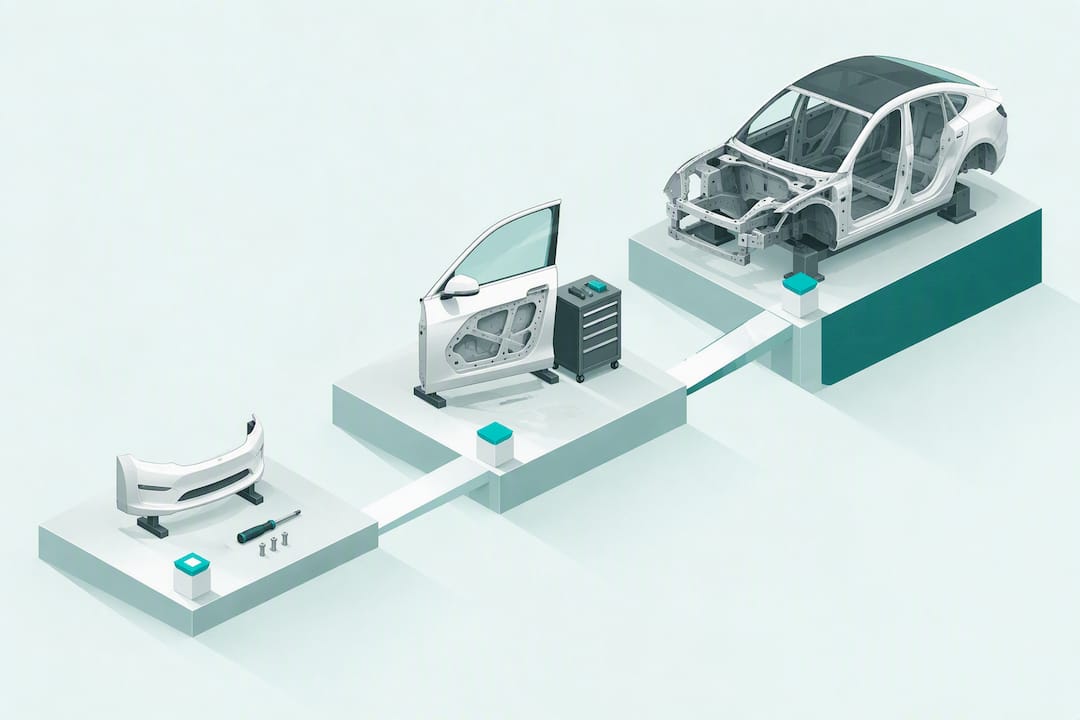
See realistic Tesla repair ranges from $500 to $25,000+, learn why costs jump, and use a publisher‑sourced line‑item checklist to verify any teardown...
Minor Tesla body damage, like a scuffed bumper or a single dented panel, typically runs $500 to $3,500. Moderate damage involving sensors or door replacement lands between $3,500 and $12,000. Major structural or battery-area damage pushes past $12,000. The final number swings on three things: hidden damage found once the panel comes off, whether ADAS calibration is required, and whether the battery pack needs inspection or removal. The next section breaks these bands into real repair scenarios.
TL;DR:
Minor Tesla body repairs, such as bumper scuffs or small dents, typically cost between $500 and $3,500, mostly depending on hidden damage and calibration needs.
Moderate repairs, including sensor recalibration and panel replacements, usually range from $3,500 to $12,000, with higher costs near structural or battery areas.
Structural or battery-related damage can exceed $12,000, often due to strict material restrictions, parts lead times, and extensive teardown procedures.
Repair estimates based solely on visual inspection tend to underestimate costs; a teardown reveals hidden damage and calibration requirements, significantly affecting final pricing.
Choosing a repair shop that thoroughly documents every step, especially OEM procedures, sensor calibration, and battery safety, ensures a more accurate and reliable recovery process.
Table of Contents
Tesla Body Repair Cost by Damage Severity
A repair estimate almost always starts as a guess based on what an adjuster or estimator can see from the outside. What’s underneath the panel determines the real number.
Minor repairs ($500 to $3,500) cover the kind of damage most owners hope for after a parking lot mishap: bumper scuffs, small dents that don’t crack the paint, or a single-panel respray. A rear bumper cover with light scuffing and no sensor damage might run $800 to $1,500 total. A door ding requiring paintless dent repair and a blend panel often lands under $1,200.
Moderate repairs ($3,500 to $12,000) typically involve a bumper replacement paired with recalibrating parking sensors or cameras, a full door or fender swap, or paint blending across two or three panels. A rear bumper replacement with sensor recalibration on a Model 3 commonly totals $4,000 to $6,500 once labor, paint, and scanning are factored in.
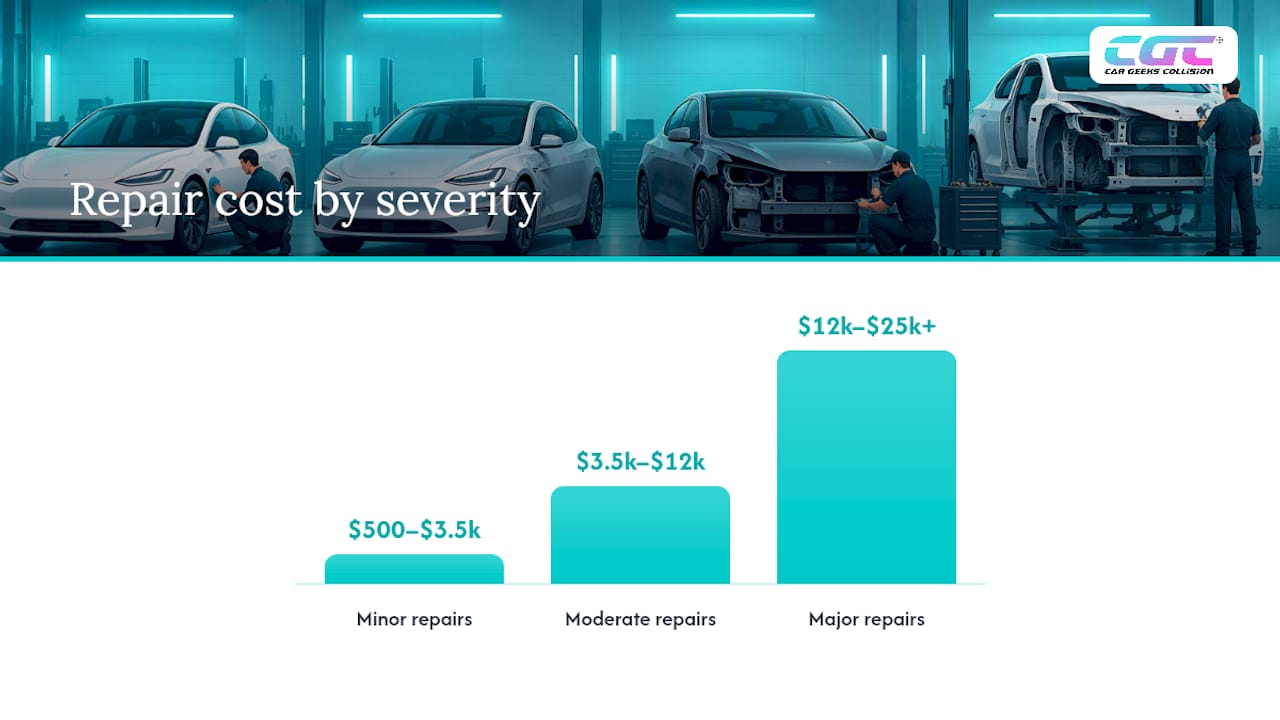
Major repairs ($12,000 and up) involve frame or rail damage, roof structure work, or anything near the battery enclosure. These jobs require extensive teardown, structural alignment, and multiple inspection points before a shop can even finalize a quote.
Mitchell’s collision data shows why the moderate-to-major jump happens so often: the average repairable battery-electric vehicle claim hit $6,236 in 2024, noticeably higher than the typical gas-powered vehicle claim. A few real-world reference points:
Bumper scuff, no sensors: $500 to $1,500
Bumper replacement with camera or sensor recalibration: $4,000 to $6,500
Door or fender replacement with paint blend: $5,000 to $9,000
Frame rail or structural repair near the battery: $12,000 to $25,000+
Why Tesla Repairs Cost More Than a Typical Car
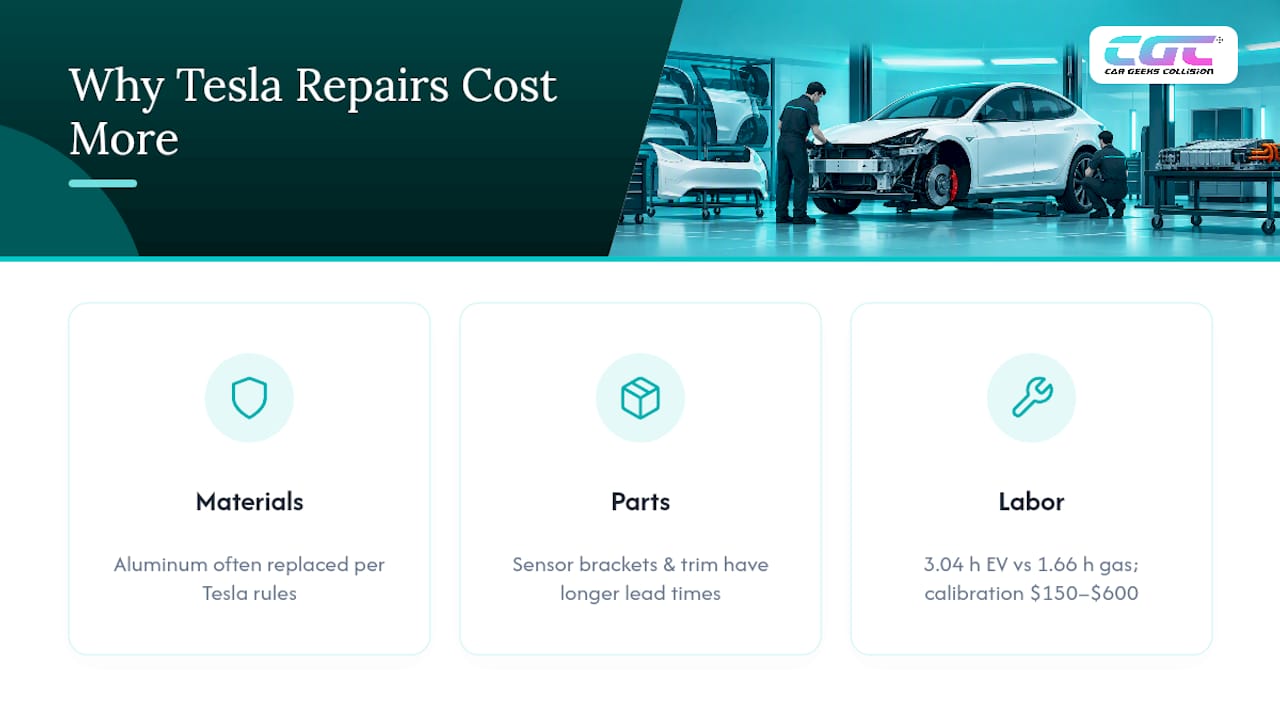
Three forces drive Tesla repair expenses above what owners expect from a comparable gas-powered vehicle: materials, parts, and labor.
Tesla’s own repair documentation restricts how technicians can work certain structural components. Aluminum extrusions and cast parts often cannot be reshaped or repaired at all. Tesla’s body repair procedures specify approved fasteners and welding methods by component, which means a bent structural piece frequently gets replaced rather than straightened. That replacement decision alone can add thousands to an estimate that a traditional shop might have closed with a repair.
Parts availability compounds the problem. Sensor brackets, camera housings, and specific trim pieces sometimes carry longer lead times than mainstream automakers’ parts, which stalls a repair even after the estimate is approved.
Labor hours run higher too. Mitchell found EV estimates carry 3.04 mechanical labor hours versus 1.66 for gas vehicles, largely from battery de-energizing and added safety steps. ADAS recalibration adds another line: a single camera or radar recalibration often runs $150 to $600, while multi-sensor jobs after a front-end hit climb higher.
Pro Tip: Ask your shop whether the estimate lists calibration under a separate “scan” or “aiming” line rather than a line labeled “calibration.” Some estimates bury it under diagnostic codes, which makes it easy to assume no ADAS work happened when it actually did.
How to Read Your Insurance Estimate and Know Your Rights
The first number your insurance company gives you is a starting point, not a final bill. According to the Insurance Information Institute, an adjuster’s preliminary estimate is based on visible damage. Once the shop opens the panel, a teardown estimate often reveals more, and that triggers a supplement request back to the insurer.
When you get a written estimate, check for three things:
Whether parts are listed as OEM, recycled, or aftermarket, since this affects both cost and fit.
Whether labor hours are broken out separately for body work, paint, and mechanical or battery-handling tasks.
Whether ADAS calibration or scanning appears as its own line item.
If your shop’s estimate disagrees with the insurer’s, ask for teardown photos documenting the damage. You also have the right to choose your own repair shop rather than one the insurer suggests. Keep a copy of every supplement request; documentation is what separates a smooth claim from a drawn-out dispute.
Diminished value, the resale loss a car suffers after a reported accident, is handled separately from repair costs and depends heavily on your state’s laws and proof requirements. Don’t assume it’s baked into your repair invoice.
Why a Small Dent Can Turn Into a Big Bill
Teardown is where estimates change the most. Once a technician removes the bumper cover or panel, common hidden findings include:
Cracked sensor brackets or camera mounts behind the fascia
Damaged foam absorbers or crush structures
Bent mounting points that weren’t visible from outside
Additional structural reinforcement damage near the impact zone
A responsible shop documents each hidden item with photos before submitting a supplement to your insurer, giving you a paper trail if questions come up later. One distinction matters here: battery inspection labor is not the same as battery replacement. Mitchell notes that EV collision work often requires de-energizing or removing the battery just to safely access nearby structure, which adds labor and time but doesn’t necessarily mean the pack itself is damaged.
How Long Tesla Body Repairs Actually Take
Minor repairs typically wrap in 3 to 7 days. Moderate repairs, especially those needing calibration or a panel swap, run 1 to 3 weeks. Major structural or battery-area repairs can stretch 3 to 8 weeks or longer, driven by parts lead times, paint blending schedules, and calibration appointment availability. Battery-handling safety steps add their own scheduling constraints on top of standard teardown time.
How to Get an Accurate Tesla Body Repair Quote
Getting a number you can trust means asking the right questions before you sign off on any repair.
Request a written estimate and ask directly whether it’s preliminary or teardown-backed. A preliminary number based on photos alone will almost always change once the panel comes off.
Confirm the supplement process in writing. Ask how the shop documents and submits additional findings to your insurer, and how quickly you’ll be notified.
Check the part source on every line. OEM, recycled, and aftermarket parts carry different costs and different fit and warranty implications.
Look for separated labor categories. Body labor, paint hours, ADAS scanning or calibration, and battery-handling labor should each appear as distinct lines, not folded into a vague total.
Ask about the shop’s experience with your exact model and year. Tesla publishes model-specific repair procedures, and a Model 3 from 2024 can have different repair steps than an older Model S.
Ask for a post-repair scan report, not just a calibration invoice, so you know ADAS systems were verified as functional before you drive away.
Pro Tip: If you’re worried about resale value after a reported accident, raise diminished value with your insurer early and keep every estimate, photo, and repair invoice. Proof matters more than the claim itself when it comes to recovering that loss.
Reviewing an estimate line by line before approving anything is also covered in our guide to getting accurate Tesla collision repair quotes, which walks through comparing multiple shop estimates side by side.
How a Qualified Tesla and EV Shop Documents Your Repair
A shop that knows electric vehicles builds its estimate around evidence, not guesswork. That means referencing OEM procedures for your specific model, scanning for ADAS faults before and after repair, and following documented battery safety steps rather than skipping straight to a repair quote. Car Geeks Collision follows this approach on every EV that comes through the shop, providing:
Teardown photos attached to every supplement request
Line-by-line documentation showing which parts were replaced and why
Calibration reports confirming sensors and cameras were verified post-repair
A lifetime workmanship warranty on completed repairs
Owners also get help coordinating with their insurance company and access to a loaner vehicle when one is available, which takes pressure off an already stressful process.
What Actually Matters When Choosing a Shop
Chasing the lowest bid on a Tesla repair almost always costs more later, once hidden damage surfaces without documentation to back the supplement. Insist on written teardown evidence and calibration proof before you sign anything. And remember: battery inspection labor on your estimate is not the same line item as battery replacement. Keep them separate.
— Anns
Get an Estimate Built on Documentation, Not Guesswork
Some shops offer repairs built around OEM-aligned procedures and full teardown documentation, so the number you approve actually holds up once the panel comes off.
Every estimate at Car Geeks Collision starts with a teardown inspection, not a guess from a photo. That means ADAS calibration, sensor mounts, and any battery-area concerns get documented and photographed before a supplement ever reaches your insurer. Whether you’re dealing with a Model 3 bumper hit or structural damage near a rail, the shop coordinates directly with your insurance company and provides a courtesy loaner vehicle when one is available, so you’re not stuck without a car while parts come in. Every completed repair carries a lifetime workmanship warranty. If you’ve got Tesla or EV body damage anywhere from Hollywood to Fort Lauderdale, Aventura, or Weston, request an inspection through the services page and get a written estimate you can actually trust.
Where This Information Comes From
The cost figures and repair standards in this article draw from Tesla’s official body repair procedures, Mitchell’s EV collision insights reporting, and consumer guidance from the Insurance Information Institute.
Sources
FAQ
Is It Expensive to Repair Body Damage on a Tesla?
Tesla body repairs tend to cost more than repairs on a comparable gas-powered car, mainly due to material restrictions, parts lead times, and ADAS calibration requirements. Minor damage still runs affordably, often $500 to $3,500, while moderate to major damage climbs quickly once sensors, panels, or structural components are involved.
Does Tesla Do Bodywork Repairs?
Tesla doesn’t operate general bodywork shops the way a traditional dealer network does. Independent collision shops that follow Tesla’s published repair procedures, like the OEM-aligned documentation referenced throughout this article, handle the actual repair work.
What’s the Most Expensive Repair on a Tesla?
Structural or frame damage near the battery enclosure is typically the most expensive repair category, often exceeding $12,000 once teardown reveals reinforcement damage or requires extensive realignment. Battery pack replacement itself, when actually needed rather than just inspected, adds significantly beyond standard structural repair costs.
Does Tesla Fix Dents and Scratches?
Yes, minor dents and scratches are among the most common and least expensive repairs, frequently handled through paintless dent repair or a single-panel respray for $500 to $1,500. Some collision repair shops handle routine cosmetic repairs alongside more involved structural and EV-specific work.
Recommended