
Blog
Why Is My Tesla A/C Not Cooling? Diagnostics and Repair Explained

Tesla A/C blowing warm air or cooling poorly? Learn the possible causes, diagnostic process, and when to request an inspection in Hollywood, FL.
A Tesla air-conditioning system that blows warm air, cools intermittently, produces an unusual odor or noise, or displays a climate-control warning needs proper diagnosis before anyone can recommend a repair.
The cause could involve airflow, a refrigerant leak, an electrical component, a sensor, a compressor, collision damage, or—in equipped vehicles—the heat-pump system. Similar symptoms can have different causes, so replacing parts or adding refrigerant before testing the system can waste time without solving the underlying problem.
Car Geeks Collision serves Tesla and EV owners from its independent collision and auto repair center at 2133 Pembroke Rd in Hollywood, Florida.
Common Signs of a Tesla Climate-Control Problem
A climate-control concern may be obvious, such as warm air coming from the vents, or it may appear only under certain conditions.
Air that does not become cold.
Cooling that is weak or intermittent.
Different temperatures or airflow in different parts of the cabin.
A cabin that takes unusually long to cool.
Reduced airflow from the vents.
Unusual compressor, fan, clicking, buzzing, or vibration sounds.
Musty or unpleasant odors from the vents.
Moisture or water appearing somewhere it should not.
A climate-control warning on the touchscreen.
A system that struggles during South Florida’s hottest or most humid conditions.
Tesla notes that its vehicles operate more quietly than gasoline-powered vehicles, so occupants may notice normal air-conditioning compressor sounds more readily. A sound is not automatically evidence of a failed compressor. Changes in sound, performance, or associated warning messages provide more useful diagnostic context.
Why a Tesla A/C May Blow Warm Air
Warm or weak airflow is a symptom, not a diagnosis. Possible causes include several mechanical, electrical, airflow, or control-system issues.
A Refrigerant Leak
An air-conditioning system is designed to operate with a specified refrigerant type and quantity. If the refrigerant level is low, the system may have a leak at a line, seal, connection, condenser, or another component. The location and cause need to be identified before the correct repair can be determined.
Condenser, Line, or Seal Damage
The condenser and connected components can be vulnerable to road debris, corrosion, prior service damage, or collision-related forces. A damaged line, connection, or seal can also allow refrigerant to escape.
Compressor or Electrical Problem
A compressor-related symptom does not necessarily mean the compressor itself must be replaced. The problem could involve power delivery, wiring, connections, a controller, a sensor, a cooling fan, or another part of the thermal-management system. Testing should come before a parts recommendation.
Restricted Airflow
A cabin filter, blower problem, evaporator condition, blocked air path, or vent-control issue may reduce airflow even when part of the refrigeration system is operating. This is why “the air isn’t cold” and “hardly any air comes from the vents” should not automatically be treated as the same problem.
Sensor, Module, or Software-Related Issue
Tesla climate control relies on electronic controls and information from multiple sensors. A relevant diagnostic trouble code, sensor fault, communication issue, or software condition may affect operation. A scan can provide useful evidence, but diagnostic codes identify detected conditions—not necessarily the component that should be replaced.

Illustrative image: diagnostic information can help narrow down electrical, sensor, control, or thermal-system concerns.
Heat-Pump System Issue
Some Tesla configurations use heat-pump systems. These systems can integrate cabin conditioning with other vehicle thermal-management functions, making accurate vehicle identification and model-specific procedures especially important.
Refrigerant and Service Procedures Vary by Tesla
There is no single refrigerant specification or service procedure that should be applied to every Tesla.
The correct refrigerant, oil, charge quantity, diagnostic procedure, safety precautions, and service equipment can depend on the model, model year, manufacturing configuration, compressor design, thermal-management system, and previous repairs.
Official Tesla service information for different models demonstrates why the vehicle-specific service procedure and underhood labeling must be checked instead of relying on a universal specification.
What a Professional Tesla A/C Diagnostic May Involve
The appropriate procedure depends on the symptoms and vehicle configuration. A methodical inspection may include the following steps.
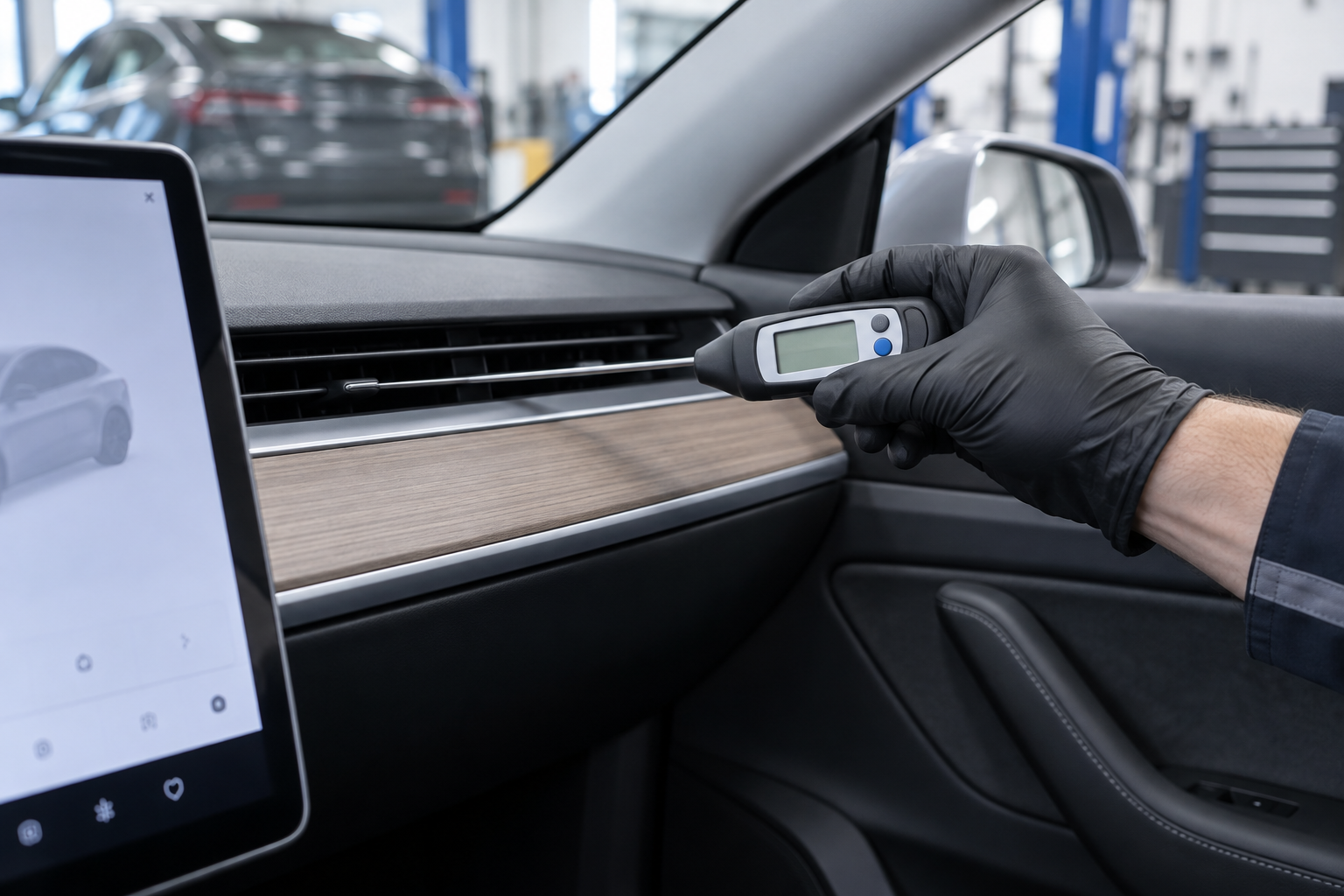
Illustrative image: a vent temperature reading can help document whether the system is cooling as expected.
1. Confirm the Symptoms
The diagnostic process should begin by establishing when the problem started, whether it occurs during every drive, whether airflow changes with different settings, whether a warning is displayed, whether refrigerant has previously been added, and whether the vehicle was recently involved in a collision or repair.
2. Inspect the Vehicle
A visual inspection may reveal collision damage, displaced components, damaged refrigerant lines, leakage evidence, electrical connector damage, debris near the condenser, airflow restrictions, or previous repairs requiring closer examination.
3. Check Airflow and Filters
Before assuming the refrigeration system has failed, a technician may check cabin air filters, blower operation, vent airflow, air distribution, odor or moisture concerns, and differences between cabin zones.
4. Scan for Diagnostic Information
A vehicle scan may reveal codes or system information involving sensors, temperature readings, electrical circuits, communication faults, compressor control, fans, or thermal-management components. Codes must be interpreted alongside physical testing.
5. Evaluate System Performance
Depending on the vehicle and applicable procedure, diagnosis may involve comparing vent temperature, ambient temperature, refrigerant pressures, sensor readings, compressor operation, cooling-fan operation, and the conditions under which the symptom appears.
6. Inspect Relevant Components
The technician may need to examine the compressor, condenser, fans, lines, seals, sensors, electrical connectors, blower components, and applicable heat-pump or thermal-management components. Not every vehicle requires every test.
7. Repair the Verified Cause
Only after testing identifies a supported cause should a shop recommend repairing or replacing a component.
8. Verify Operation After Repair
Verification may include rechecking vent temperature and airflow, confirming relevant readings, rescanning applicable diagnostic codes, checking for leaks, and operating the system under the conditions that previously produced the symptom.
Why Adding Refrigerant Is Not a Complete Diagnosis
Adding refrigerant may temporarily improve cooling if a system is low, but it does not explain why the refrigerant level dropped.
If a leak exists, adding refrigerant without locating and addressing the problem can allow the condition to return. Charging a system with the wrong refrigerant, oil, quantity, or equipment can also create additional complications.
Professional motor-vehicle A/C service involving refrigerant is regulated. The U.S. Environmental Protection Agency requires paid MVAC service technicians to hold Section 609 certification and use approved refrigerant-handling equipment.
A proper service decision should be based on accurate vehicle identification, applicable service information, inspection and testing evidence, proper refrigerant handling, and verification after repair.
Tesla A/C Problems After a Collision
A collision does not automatically damage the air-conditioning system. However, front-end and underbody damage can affect components that support cabin climate control and vehicle thermal management.
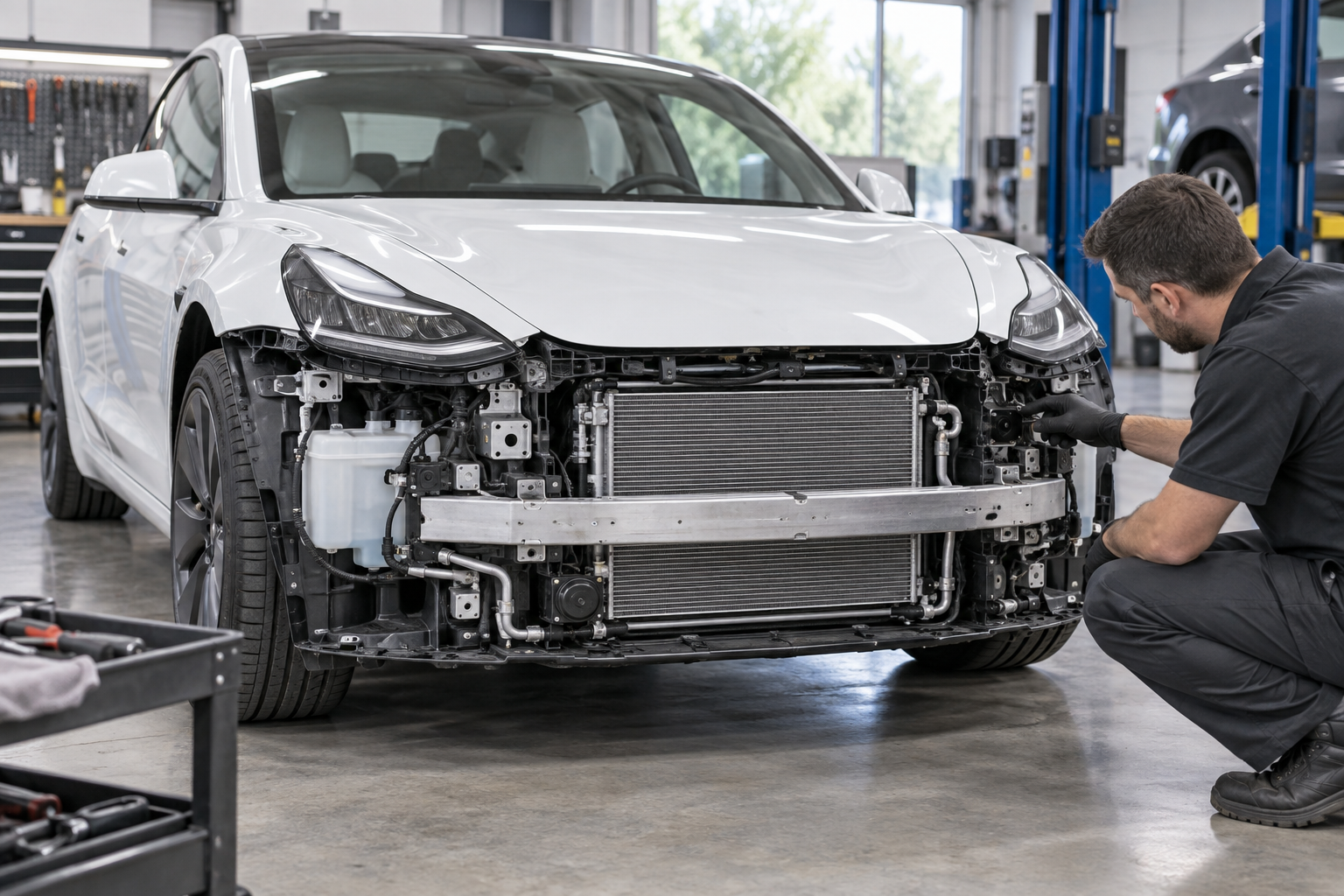
Illustrative image: front-impact damage may require inspection of nearby cooling and A/C components.
Depending on the location and severity of the impact, affected areas may include:
The condenser.
Refrigerant lines and connections.
Cooling fans.
Sensors.
Electrical wiring and connectors.
Component brackets and mounting points.
Air ducts or airflow paths.
Related cooling or thermal-management components.
A component can also be displaced without showing an obvious external leak. A Tesla that develops cooling problems after a collision should therefore be inspected in the context of the impact and the repairs already performed.
Learn more: https://cargeekscollision.com/services/collision-repair
EV body repair: https://cargeekscollision.com/services/ev-body-repair
Insurance-claim assistance: https://cargeekscollision.com/benefits/insurance
Is Every Sound or Puddle an A/C Failure?
No. Tesla explains that compressor operation may be more noticeable because an electric vehicle is quieter than a combustion-powered vehicle. Some clear water below the vehicle can also result from normal air-conditioning dehumidification.
Useful questions include whether the sound is new, cooling performance is reduced, a warning is present, the moisture appears inside the cabin, or the symptom began after a collision or repair. If a fluid cannot be identified safely, avoid touching it and have the vehicle inspected.
Why A/C Performance Matters in South Florida
Hollywood and the surrounding South Florida area combine high temperatures, humidity, strong sun, and frequent climate-control use.
Tesla recommends cabin preconditioning as one way to prepare the vehicle in hot weather. Preconditioning can improve comfort, but it cannot correct an underlying mechanical, refrigerant, airflow, electrical, or control-system fault.
An inspection is appropriate when the cabin consistently fails to reach the selected temperature, cooling performance has noticeably declined, or the vehicle displays a climate-control warning.
Authoritative Resources
Tesla owner’s manuals: https://www.tesla.com/ownersmanual/
Tesla Model 3 climate controls: https://www.tesla.com/ownersmanual/model3/en_us/GUID-4F3599A1-20D9-4A49-B4A0-5261F957C096.html
Tesla hot-weather guidance: https://www.tesla.com/ownersmanual/model3/en_us/GUID-6F5B7B3F-F020-471D-9D46-D1F990A6237A.html
EPA motor-vehicle A/C requirements: https://www.epa.gov/mvac/regulatory-requirements-mvac-system-servicing
Illustrative image: Car Geeks Collision serves drivers from Hollywood and nearby South Florida communities.
Frequently Asked Questions
Why is my Tesla A/C blowing warm air?
Possible causes include a refrigerant leak, airflow restriction, electrical problem, sensor fault, compressor-control issue, damaged condenser or line, or a thermal-management problem. Because several faults can produce similar symptoms, the system should be tested before parts are recommended.
Can low refrigerant be corrected without repairing a leak?
Adding refrigerant may temporarily restore cooling, but it does not correct an existing leak. The system should be inspected to determine why its refrigerant level is low and what repair is appropriate.
Does a Tesla heat pump require specialized diagnosis?
A heat-pump-equipped vehicle should be diagnosed using information applicable to its model, year, hardware, and symptoms. Its climate-control and thermal-management functions may involve multiple sensors, valves, electrical components, and control strategies.
Can a collision cause Tesla climate-control problems?
It can, depending on the impact. Front-end or underbody damage may affect the condenser, refrigerant lines, fans, sensors, mounting points, wiring, or related thermal-management components. Not every collision damages the A/C system, so inspection is necessary.
Where can I request a Tesla A/C diagnostic in Hollywood, Florida?
Contact Car Geeks Collision at 2133 Pembroke Rd in Hollywood or submit an online estimate request. Provide the model, model year, symptoms, warning messages, and relevant collision or repair history.
Request an A/C Inspection in Hollywood, Florida
If your Tesla is blowing warm air, cooling inconsistently, producing an unusual odor or noise, or showing a climate-control warning, request an inspection before assuming which component has failed.
Car Geeks Collision is located at 2133 Pembroke Rd, Hollywood, FL 33020. The next step is to provide the vehicle’s model, model year, symptoms, warning messages, and any relevant collision or repair history.
Request an inspection or estimate: https://cargeekscollision.com/estimate
Review Car Geeks Collision’s A/C and HVAC services: https://cargeekscollision.com/services/ac-hvac-repair
A repair recommendation should be made only after the vehicle and its system configuration have been inspected.