
Blog
Range Rover Suspension Problems: Warning Signs, Diagnosis and Repair

Learn what Range Rover suspension warnings, uneven ride height, overnight dropping, and handling changes may mean—and when to arrange professional diagnosis in Hollywood, FL.
A Range Rover that leans, drops overnight, refuses to raise or lower, rides unusually firm, or displays a suspension warning needs a vehicle-specific diagnosis. These symptoms do not automatically identify a failed air spring, compressor, sensor, or control module. The correct next step depends on the model, model year, suspension configuration, recent damage, and diagnostic findings.
For drivers in Hollywood and South Florida, this guide explains the warning signs to document, when continued driving may be unsafe, and what a professional suspension inspection may examine.
Range Rover suspension warning signs
One corner or one side of the vehicle sits lower than the others
The vehicle loses ride height after parking or overnight
The suspension will not raise, lower, or maintain its selected height
An air-suspension or adaptive-dynamics warning appears
The ride becomes unusually harsh, bouncy, or unstable
Knocking, clunking, or other new noises appear over bumps
Steering feel, tire clearance, or vehicle handling changes
The concern begins after a collision, curb strike, pothole, or repair
Record when the symptom occurs and whether it affects one corner, one axle, or the entire vehicle. A pattern that appears only after parking may lead to a different diagnostic path than a warning that appears immediately after startup.
Why a symptom does not confirm the failed part
Several mechanical, pneumatic, electrical, and control-system conditions can create similar suspension symptoms. A vehicle that will not rise may have a leak, valve concern, power or wiring fault, sensor issue, compressor-control problem, damaged component, or another model-specific condition. Replacing a part based only on the symptom can leave the original problem unresolved.
Range Rover models and model years do not all use identical suspension hardware or control strategies. The vehicle identification number and exact configuration matter when selecting service information, test procedures, and replacement parts.
Why does a Range Rover drop overnight?
A vehicle that loses height while parked may be losing or redistributing air, or it may not be maintaining the commanded ride height. Note how long the change takes and photograph the vehicle on level ground before and after parking. Whether one corner, one side, one axle, or the whole vehicle drops can help guide the inspection.
Overnight height loss does not by itself prove that an air spring has failed. Connections, valves, sensors, control logic, and other components may also need to be evaluated.
Does a Range Rover that will not raise need a compressor?
Not necessarily. The compressor is one part of the system, but a vehicle may fail to raise for multiple reasons. A technician should confirm the warning, review relevant fault information, inspect for leaks or physical damage, and test the applicable controls before recommending compressor replacement.
Can you keep driving with a suspension warning?
Do not assume a suspension warning is harmless. If the vehicle is sitting unusually low, a tire is rubbing, steering or handling has changed, the suspension cannot maintain height, or a red or urgent warning is displayed, limit driving and seek professional guidance. Continuing to drive may create additional damage or an unsafe handling condition.
If the vehicle cannot maintain safe ground or tire clearance, ask whether towing is the appropriate next step rather than attempting a longer drive.
What a professional suspension diagnosis may examine
The inspection should follow the symptoms and the specific vehicle. Depending on the concern, a diagnostic process may include:
Confirming the customer’s complaint on level ground
Comparing ride height at the affected corners
Inspecting accessible suspension, steering, wheel, and tire components
Checking for evidence of pneumatic or hydraulic leakage where applicable
Scanning relevant control systems for stored fault information
Evaluating height sensors, wiring, valves, compressor operation, and controls as indicated
Reviewing recent collision, curb-impact, repair, alignment, or battery history
Consulting model- and VIN-specific service information before recommending repairs
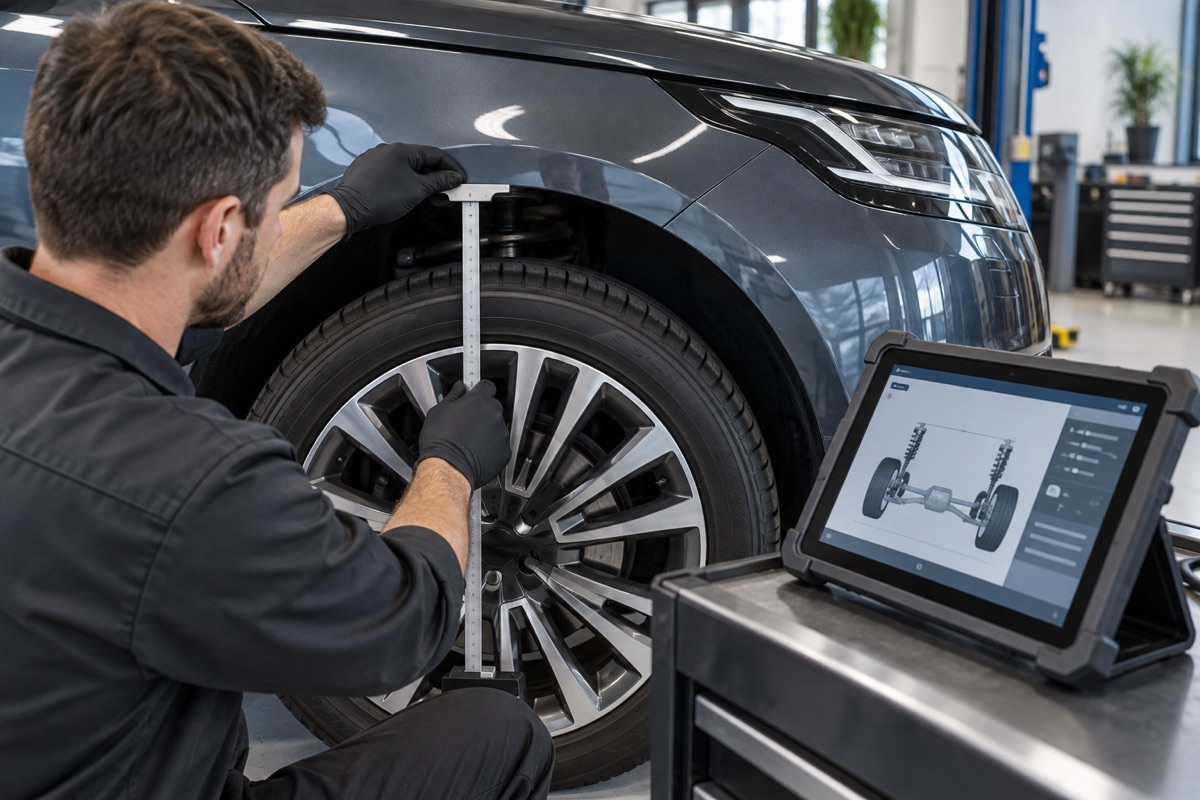
A useful diagnosis explains which finding supports the recommended repair. It should distinguish the failed component from damage or symptoms that developed because the system could no longer maintain the correct ride height.
Suspension problems after a collision or curb impact
A collision, pothole, or curb strike can affect more than an obvious control arm or wheel. The inspection may need to consider steering parts, mounting points, sensors, wiring, wheel and tire damage, alignment, and structural areas that locate suspension components.
If the concern began after an accident, document when the warning appeared and share any repair or insurance information available. Hidden damage may not be visible while the vehicle is sitting on the ground.
When alignment or calibration may be needed
Alignment or ride-height calibration may be required after certain component replacements, collision repairs, or work that changes sensor position or suspension geometry. The requirement depends on the specific vehicle and repair procedure. Calibration should not be treated as a substitute for repairing a leak or damaged component.
What to record before your appointment
Exact model, model year, powertrain, and VIN
The warning message exactly as displayed
Which corner or side appears low
Whether the vehicle drops only after parking
Whether restarting changes the condition
Any new noises, handling changes, or tire contact
Recent collision, curb strike, pothole, alignment, battery, or repair history
Photos or video taken on level ground
This information can make an intermittent concern easier to reproduce and helps the repair facility prepare the correct diagnostic approach.
Range Rover suspension help in Hollywood, Florida
Car Geeks Collision helps Range Rover owners understand vehicle damage, diagnostic findings, repair recommendations, and appropriate next steps. If your vehicle is leaning, losing ride height, showing a suspension warning, or behaving differently after an impact, contact the Hollywood team with the model, year, VIN, and symptoms so the concern can be reviewed.
Frequently asked questions
Why is my Range Rover leaning to one side?
A Range Rover may lean because of an air leak, height-sensor issue, control fault, damaged suspension component, or another vehicle-specific condition. The affected corner is useful diagnostic information, but testing is required before selecting a repair.
Why does my Range Rover suspension drop overnight?
Overnight height loss may indicate that the system is losing or redistributing air or is unable to maintain the commanded height. Record whether one corner, one axle, or the whole vehicle drops and how quickly it happens.
Can I drive with an air-suspension warning?
That depends on the warning and how the vehicle is behaving. Avoid continued driving if the vehicle is unusually low, a tire is rubbing, handling has changed, or ride height cannot be maintained.
Does failure to raise mean the compressor is bad?
No. Leaks, valves, sensors, wiring, power supply, control faults, and model-specific conditions can produce similar symptoms. Diagnosis should confirm the cause before parts are replaced.
Can collision damage affect Range Rover suspension?
Yes. An impact can affect suspension components, wheels, steering parts, sensors, wiring, alignment, or mounting points. Both visible and hidden damage may need to be inspected.
Will the suspension need calibration after repair?
It may. Calibration or alignment requirements depend on the vehicle and the repair performed. The applicable service procedure should determine what is required.
Discuss the next step for your Range Rover
If your Range Rover is leaning, dropping, riding differently, or displaying a suspension warning, contact Car Geeks Collision in Hollywood, FL. Describe the symptoms and recent vehicle history so the team can advise you on inspection, repair, or towing considerations.