
Blog
Mercedes-Benz Suspension Problems: Warning Signs, Diagnosis and Repair in South Florida

Mercedes-Benz suspension warning or uneven ride height? Learn the common causes, diagnosis steps, and repair options from Car Geeks Collision in South Florida.
A Mercedes-Benz should feel controlled, quiet, and predictable. If the vehicle sits lower on one corner, bounces after a bump, pulls during braking, makes a clunk over rough pavement, or displays a suspension warning, the cause should be diagnosed before parts are replaced.
Mercedes-Benz suspension design varies by model, year, powertrain, and option package. A C-Class, E-Class, S-Class, GLC, GLE, GLS, G-Class, AMG, EQE, or EQS may use conventional springs and dampers, adaptive damping, air suspension, hydraulic systems, rear steering, or electronically managed ride-height functions. Accurate repair starts with identifying the exact vehicle and testing the complete system.
Suspension warning signs that deserve prompt attention
Arrange an inspection soon if the vehicle leans, drops after parking, repeatedly raises or lowers itself, feels unstable, or shows a suspension or ride-height warning. Stop driving and seek assistance if a wheel appears out of position, the tire contacts the body, steering changes suddenly, braking stability is affected, or a component is visibly loose, broken, or leaking heavily.
Continuing to drive with a severe suspension fault can damage tires, wheels, steering parts, sensors, wiring, or body components. It can also make emergency maneuvers less predictable.
Common Mercedes-Benz suspension symptoms
One corner sits lower than the others
The vehicle sinks after several hours or overnight
Ride height is slow to change or does not change
A suspension, chassis, or ride-height warning appears
The ride is unusually harsh, floaty, or bouncy
Clunking, creaking, knocking, or rattling occurs over bumps
The vehicle pulls, wanders, or feels unstable at speed
The steering wheel is off-center
Tires wear unevenly or develop cupping
The nose dives during braking or the body rolls excessively
A compressor runs frequently or sounds unusually loud
Fluid or air-system leakage is suspected
These observations help build a test plan, but several different faults can create similar symptoms.
Why a Mercedes-Benz suspension may fail
Air springs, struts, and line leaks
On vehicles equipped with air suspension, leaks may develop in an air spring, strut assembly, seal, fitting, reservoir, distribution block, or air line. A small leak may cause one corner to drop only after parking. A larger leak can prevent the vehicle from reaching normal height or force the compressor to run too often.
Air-suspension compressor or relay concerns
The compressor supplies pressurized air, but it should not be replaced solely because the vehicle is low. A system leak, restricted intake, damaged wiring, relay fault, thermal shutdown, control command, or worn compressor can produce similar behavior. The original cause should be corrected so a replacement compressor is not overloaded.
Ride-height sensors and linkage
Height sensors report vehicle position to the suspension controller. A bent linkage, damaged sensor, connector problem, wiring fault, incorrect installation, or lost calibration can produce implausible height readings. Sensor data should be compared with physical measurements at each corner.
Shocks, struts, and adaptive damping
Conventional and electronically controlled dampers can wear, leak, bind, or develop internal faults. A weak damper may cause bouncing, poor tire contact, nose dive, or uneven tire wear. An adaptive-damping warning may also involve wiring, connectors, sensors, control modules, or calibration rather than the damper alone.
Control arms, ball joints, and bushings
Rubber bushings isolate vibration while allowing controlled movement. Age, heat, road impacts, and fluid contamination can lead to cracking or separation. Ball joints and control-arm joints can develop play. These problems may cause clunks, vague steering, braking instability, or alignment changes.
Wheel bearings, mounts, and related parts
A wheel bearing, top mount, spring pad, sway-bar link, tie rod, or subframe bushing may imitate a suspension problem. Diagnosis should consider steering, brakes, tires, and wheel condition because noise and vibration can travel through the chassis.
AIRMATIC, hydraulic, and advanced chassis systems
Mercedes-Benz has used several suspension technologies, including AIRMATIC air suspension and model-specific hydraulic or electronically controlled chassis systems. Some vehicles combine adaptive dampers with air springs; others may use systems such as Active Body Control or E-ACTIVE BODY CONTROL. Equipment varies, so the VIN and installed options must guide diagnosis.
These systems may use pumps, compressors, accumulators, valve blocks, pressure sensors, height sensors, hydraulic lines, air lines, electronic control units, and software calibrations. A warning message does not automatically identify the failed component. Scan data, pressure or leak testing, physical inspection, and ride-height measurements must agree.
Why the exact model and powertrain matter
Suspension layout and service procedures can differ across sedans, coupes, SUVs, AMG models, hybrids, and electric vehicles. Battery location and vehicle weight can affect lifting points, alignment specifications, component loads, and repair procedures. Rear-wheel steering and driver-assistance systems may also require additional checks after suspension or alignment work.
Service information for the exact VIN should be used for lifting, depressurization, component replacement, fastener procedures, ride-height calibration, alignment, and road-test verification.
What to record before scheduling diagnosis
Model, year, mileage, and powertrain
The exact dashboard warning or message
Whether the vehicle is low at one corner, one axle, or everywhere
How long it takes to sink after parking
Whether the compressor runs frequently
When noises occur: bumps, turns, braking, acceleration, or parking maneuvers
Recent pothole, curb, road-debris, towing, tire, alignment, or collision events
Previous suspension repairs or aftermarket modifications
Photos of the vehicle's stance after sitting overnight can help document an intermittent ride-height concern.
How professional Mercedes-Benz suspension diagnosis should proceed
Confirm the exact model, VIN, equipment, and complaint.
Inspect tire size, condition, pressure, wheel damage, and vehicle stance.
Measure ride height at consistent reference points.
Scan chassis, suspension, steering, brake, and related modules.
Review fault history and live data from height, acceleration, pressure, and steering sensors.
Inspect struts, springs, air lines, hydraulic lines, compressors, pumps, connectors, and mounts.
Check control arms, bushings, ball joints, tie rods, sway-bar links, bearings, and subframes.
Perform approved leak, pressure, or output tests when applicable.
Check alignment only after loose, bent, or leaking parts are addressed.
Calibrate ride height, steering, or chassis systems when required.
Complete a controlled road test and verify warning-free operation.
Replacing the first component associated with a fault code can miss the real cause. Mechanical condition, electrical commands, measured height, and system pressure should tell the same story.
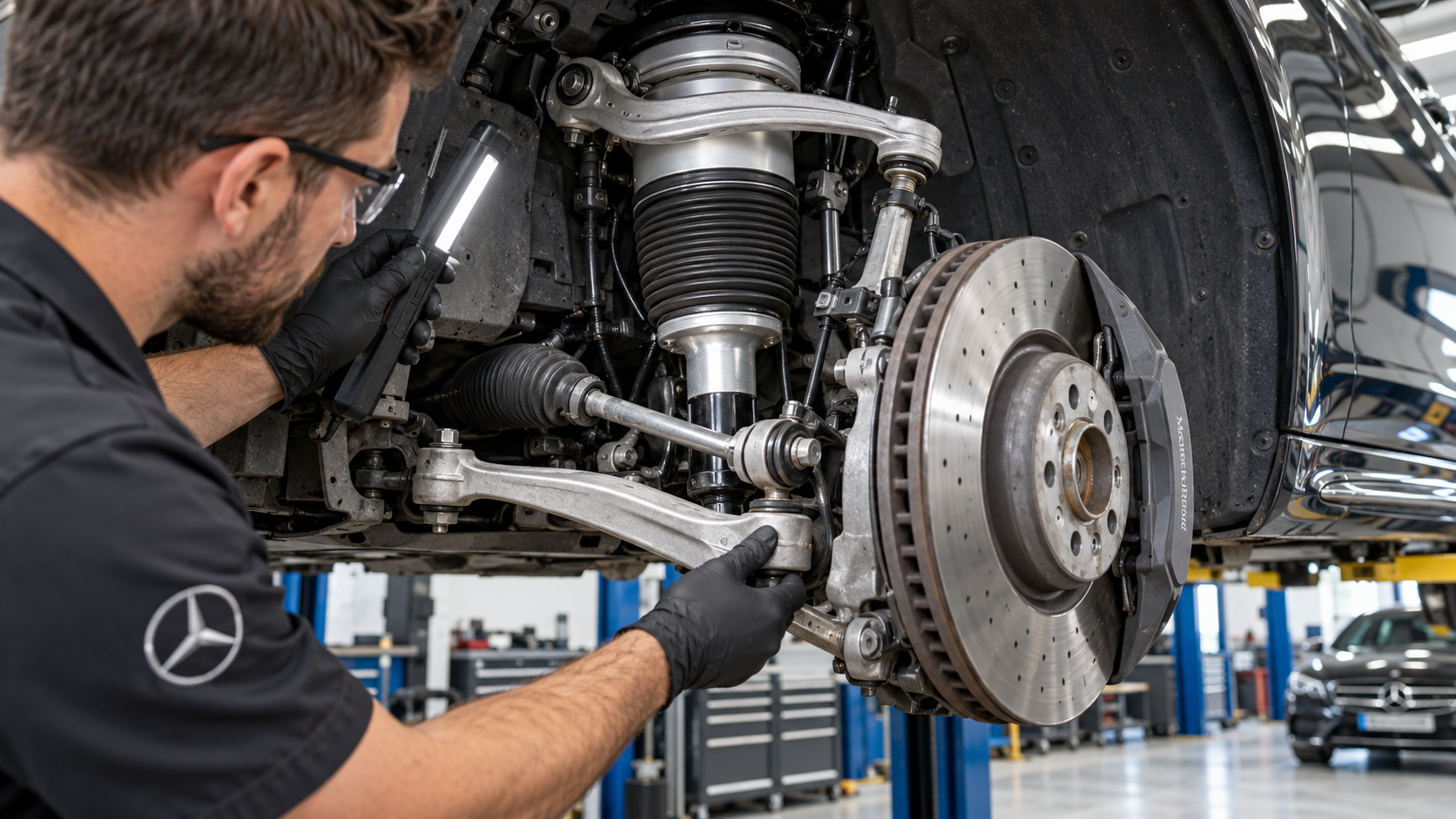
Collision and pothole-related suspension damage
A curb strike, pothole, or collision can bend a control arm, strut, tie rod, knuckle, wheel, subframe, or mounting point. It can also damage height sensors, wiring, air lines, brackets, and alignment targets. A vehicle may still drive while carrying hidden geometry changes that cause tire wear or unstable handling.
Alignment readings can reveal that a problem exists, but adjustment alone cannot correct a bent part or shifted mounting point. Collision history, structural measurements, suspension inspection, and wheel alignment should be evaluated together.
Repair options depend on the confirmed fault
The correct repair may involve an air spring, strut, damper, compressor, relay, valve block, line, sensor, control arm, bushing, ball joint, tie rod, sway-bar link, mount, wheel bearing, wiring repair, or alignment correction. Some repairs also require depressurization, special lifting procedures, ride-height calibration, steering-angle initialization, or software-guided functions.
Parts should be selected for the exact vehicle configuration. Mixing incompatible components or skipping calibration can create ride-height, handling, warning-light, or tire-wear problems.
Frequently asked questions
Why does my Mercedes-Benz sink overnight?
A slow air leak at a spring, strut, fitting, valve block, reservoir, or line is one possibility. Valve behavior, sensor data, and control strategy also matter. Testing is needed to identify where pressure is being lost.
Can I drive with an AIRMATIC warning?
It depends on ride height, handling, tire clearance, the exact warning, and whether the system can maintain pressure. If the vehicle is very low, unstable, contacting a tire, or showing a stop-driving message, do not continue.
Does a low corner always mean the air strut is bad?
No. The fault could involve a line, fitting, valve block, sensor linkage, wiring, control command, or another part. The corner and system should be tested before replacement.
Do I need an alignment after suspension repair?
Often, yes—especially after work involving control arms, tie rods, struts, subframes, ride-height changes, or impact damage. The need depends on the repair and factory procedure.
Why is my suspension noisy if no warning light is on?
Many mechanical parts are not directly monitored. Worn bushings, joints, mounts, links, bearings, or loose hardware may create noise without storing an electronic fault.
Schedule Mercedes-Benz suspension diagnosis in South Florida
Car Geeks Collision helps Mercedes-Benz owners in Hollywood and surrounding South Florida communities evaluate suspension warnings, uneven ride height, air-system leaks, clunks, steering concerns, tire wear, alignment problems, and collision-related chassis damage.
If your Mercedes-Benz does not sit, steer, or ride correctly, request an estimate and share the model, year, powertrain, warning message, recent impact history, and when the symptom appears. Accurate details help the diagnostic process begin efficiently.