
Blog
Mercedes-Benz Convertible Roof Problems: Diagnosis and Repair in South Florida

Mercedes-Benz convertible roof stuck or leaking? Learn common causes, diagnosis steps, and repair options from Car Geeks Collision in South Florida.
A Mercedes-Benz cabriolet roof combines body panels or fabric, latches, hinges, hydraulic or electric actuators, sensors, wiring, seals, drains, and control logic. If the top stops halfway, moves unevenly, will not latch, leaks water, or displays a roof warning, forcing it can turn a small fault into bent hardware or damaged trim.
Mercedes-Benz roof systems vary by model and generation. An SL, SLC, E-Class Cabriolet, C-Class Cabriolet, CLK Cabriolet, or other convertible may use a folding soft top, retractable hardtop, hydraulic cylinders, electric motors, or a combination of systems. Accurate repair begins with identifying the exact vehicle, reproducing the symptom safely, and checking the complete operating sequence.
When a convertible-roof problem needs prompt attention
Stop operating the roof if it twists, binds, makes a loud crack or grind, strikes trim, leaves a panel unsupported, or begins leaking hydraulic fluid. Do not keep holding the switch when movement has stopped. Keep people and objects away from hinges, latches, and storage-compartment covers because the mechanism contains powerful pinch points.
If the roof will not secure for driving, follow the model-specific emergency procedure or arrange transport. A partially latched top can create wind, water, and safety risks.
Common Mercedes-Benz convertible-top symptoms
The roof does not begin its opening or closing cycle
Operation starts and then stops halfway
The top moves slowly, unevenly, or only in one direction
A roof, trunk, partition, or latch warning appears
The windows do not lower or index as expected
The trunk divider or luggage partition is not recognized
The front header or rear deck will not latch
A hydraulic pump runs but the roof does not move correctly
Fluid appears near cylinders, trim panels, the trunk, or roof storage area
Clicking, grinding, popping, or straining noises occur
Water enters around seals, glass, drains, or the rear window
Fabric is loose, damaged, stained, or separating from the rear glass
The exact point in the operating sequence is important. Each stage depends on previous switches and sensors confirming that a panel, latch, window, partition, or deck lid is in the correct position.
Why a Mercedes-Benz convertible roof may stop working
Battery voltage and electrical supply
Roof operation requires stable voltage. A weak battery, charging problem, blown fuse, relay fault, poor ground, damaged connector, or high-resistance wiring can interrupt the cycle. The vehicle may still start while voltage drops too far during roof operation.
Position switches, Hall sensors, and control logic
The controller relies on multiple position signals. A misadjusted switch, damaged sensor, broken wire, lost initialization, or implausible signal can prevent the next step. Fault codes and live data help identify which condition is missing, but the mechanical position must be checked as well.
Hydraulic pump, fluid, lines, and cylinders
Many Mercedes-Benz convertibles use hydraulic pressure to move the roof, latches, or storage cover. Low fluid usually points to leakage rather than normal consumption. A weak pump, leaking cylinder, damaged hose, restricted valve block, or internal bypass can cause slow, uneven, or incomplete movement.
Hydraulic fluid can travel behind trim and appear far from the source. Proper diagnosis includes inspecting cylinders, hose connections, the pump area, and affected trim instead of refilling the reservoir alone.
Latches, cables, hinges, and linkages
A roof may stop because a latch does not release, a cable stretches, a hinge binds, a bracket loosens, or a linkage bends. Forcing the top can damage synchronized parts or change panel alignment. Mechanical resistance should be corrected before an actuator or pump is blamed.
Windows, trunk partition, and deck-lid interlocks
The top may be disabled when a window, trunk latch, luggage divider, deck lid, or cargo-position switch does not report the required state. A roof fault can therefore begin with a component that appears unrelated to the roof itself.
Seals, drains, and water intrusion
Water leaks may result from blocked drains, displaced seals, compressed weatherstrips, damaged fabric, rear-window bonding, body alignment, or previous collision repair. Water can also damage wiring, sensors, control modules, and interior materials if the source is not corrected.
Why the exact Mercedes-Benz model matters
Retractable hardtops and folding soft tops use different sequences, components, and emergency procedures. Even within the same model name, a later generation may use different sensors, pump locations, latches, or calibrations. Service information for the exact VIN should guide trim removal, depressurization, manual operation, fluid specification, adjustments, initialization, and final testing.
Some systems coordinate the roof with door glass, quarter windows, trunk functions, seat or head-restraint positions, and wind-deflector components. Treating one isolated symptom without checking the full sequence can leave the original problem unresolved.
What to record before scheduling diagnosis
Model, year, mileage, and roof type
The exact warning message or indicator
Whether the failure occurs while opening, closing, or both
The stage where movement stops
Any noise, twist, hesitation, or hydraulic-pump sound
Recent battery replacement, low-voltage event, jump-start, or electrical work
Recent collision, trunk, glass, upholstery, water-leak, or body repair
Fluid spots, damp trim, musty odor, or visible seal damage
Outside temperature and whether the symptom is intermittent
A short video recorded from a safe distance can help document an intermittent sequence problem. Do not place hands near moving components to make the recording.
Why resets and manual forcing may make things worse
A reset or initialization can help only when the system and mechanical positions are correct. It will not repair a leak, bent linkage, failed switch, weak pump, damaged latch, or broken wire. Repeatedly cycling a struggling roof may overheat the pump, drain the battery, or misalign panels.
Emergency closing procedures are model-specific. Incorrect release of a latch or hydraulic circuit can allow a heavy panel to move unexpectedly. Use the owner's manual or qualified assistance rather than improvised force.
How professional convertible-roof diagnosis should proceed
Confirm the exact model, VIN, roof design, and complaint.
Check battery condition, charging voltage, fuses, relays, grounds, and connectors.
Scan roof, body, door, trunk, and related control modules.
Review fault history and live position data through the complete roof sequence.
Inspect latches, cables, hinges, linkages, brackets, fabric, panels, and seals.
Check windows, trunk partition, deck lid, and other interlock inputs.
Inspect the pump, reservoir, hydraulic lines, valve block, and cylinders where equipped.
Test for leaks, pressure loss, motor output, and mechanical resistance as appropriate.
Correct alignment or damaged components before calibration.
Initialize or calibrate the system when required.
Verify multiple complete cycles, water sealing, warning-free operation, and panel fit.
The sequence matters. A pump may run because a sensor never confirms movement, or a sensor may stay unchanged because a latch is mechanically stuck. Electrical data and physical inspection must agree.
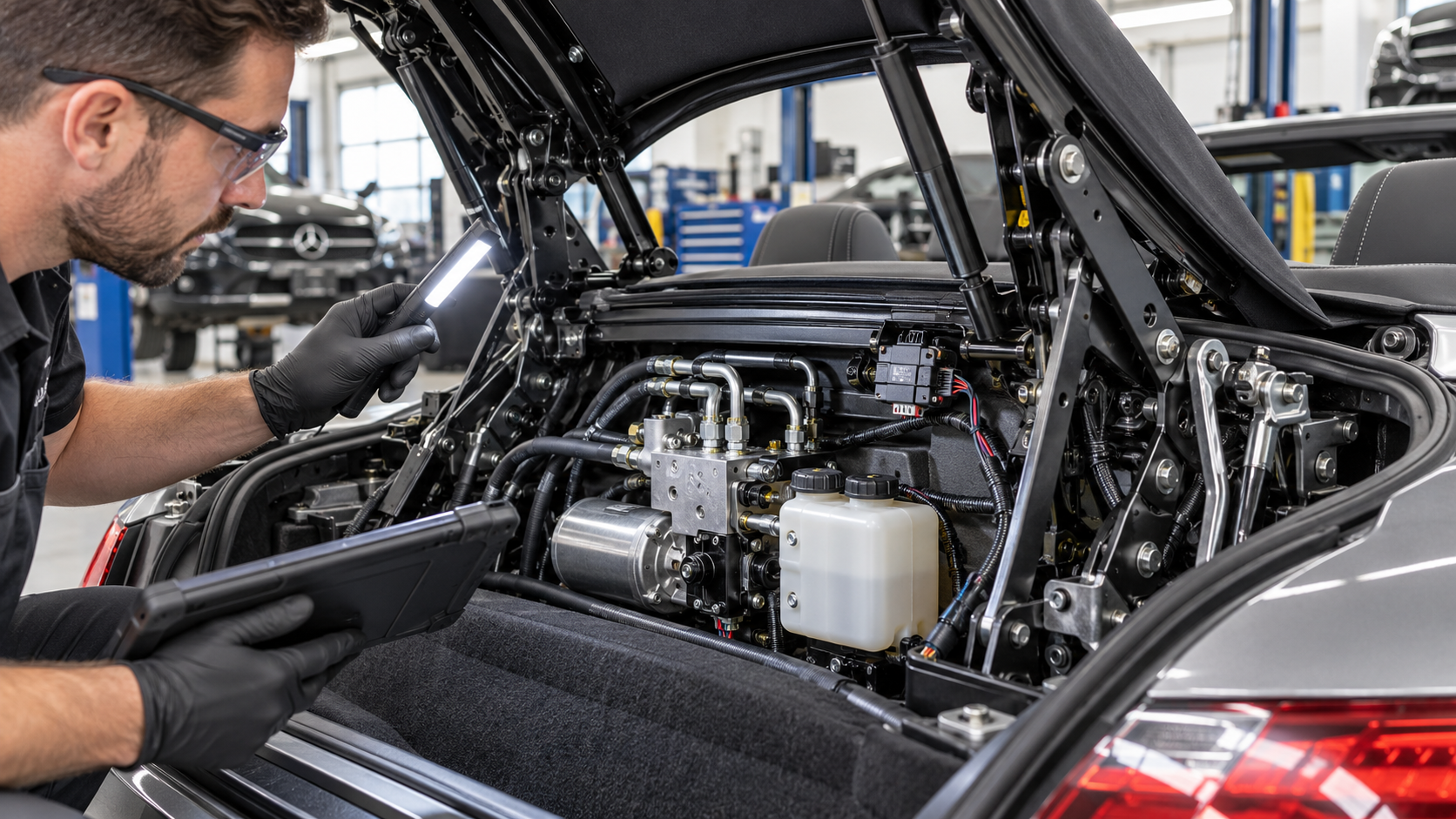
Collision-related convertible-roof damage
Even a moderate rear, side, windshield-frame, or quarter-panel impact can affect roof geometry, storage-compartment alignment, latches, hinges, sensors, wiring, drains, or seals. A repaired body opening that is slightly out of position may cause binding, wind noise, water leaks, or intermittent warnings.
When a roof problem begins after collision or body work, diagnosis should include the impact area, previous repairs, panel gaps, mounting points, and water-management paths. Replacing a motor or sensor will not correct distorted structure or misaligned hardware.
Repair options depend on the confirmed fault
The correct repair may involve a switch, sensor, latch, cable, hinge, linkage, motor, hydraulic pump, cylinder, hose, valve block, control module, wiring repair, seal, drain, fabric section, rear-window bond, or panel adjustment. Some components may be serviceable individually; others are supplied as assemblies.
After repair, the system may require initialization, calibrated panel alignment, fluid bleeding, window normalization, and repeated operational tests. Water testing should be controlled and should verify drains and sealing without flooding the cabin.
Frequently asked questions
Can I drive with the convertible top stuck open?
Only if the roof and storage cover are fully secured in a position approved for driving. A partially latched or unsupported panel can move unexpectedly. When in doubt, arrange professional assistance.
Why does the roof stop when the pump is still running?
Possible causes include low hydraulic pressure, a leak, internal bypass, a stuck latch, excessive mechanical resistance, or a position signal that does not change. Pump sound alone does not confirm correct pressure or movement.
Can low battery voltage cause a roof warning?
Yes. Low or unstable voltage can interrupt operation or create communication faults. The battery and charging system should be tested, but stored roof faults and mechanical conditions must still be evaluated.
Does adding hydraulic fluid fix a slow roof?
Not if fluid escaped through a leak. Refilling without locating the source can lead to repeated failure, contaminated trim, and pump damage. Use only the specified fluid and procedure after the system is inspected.
How long does convertible-roof repair take?
Timing depends on the model, failed component, access, fluid cleanup, alignment needs, parts availability, water damage, and whether body or trim work is required. Diagnosis is necessary before giving a reliable schedule.
Schedule Mercedes-Benz convertible-roof diagnosis in South Florida
Car Geeks Collision helps Mercedes-Benz owners in Hollywood and surrounding South Florida communities evaluate tops that stop, bind, leak, move unevenly, display warnings, or develop problems after collision and body repair.
If your Mercedes-Benz convertible roof is not operating correctly, request an estimate and share the model, year, warning message, stage where movement stops, recent repair history, and any fluid or water leakage. Accurate details help the diagnostic process begin efficiently.