Blog
Mercedes-Benz Collision Repair Costs in South Florida: What Affects the Estimate?

What determines Mercedes-Benz collision repair costs? Learn how parts, hidden damage, sensors, paint, labor, and insurance affect a South Florida estimate.
There is no reliable one-price answer for Mercedes-Benz collision repair. Two cars with similar-looking bumper damage can require very different parts, labor, scans, calibrations, paint work, and structural procedures. A complete estimate depends on the model, equipment, impact path, hidden damage, repair method, and parts availability.
This guide explains the main factors that affect Mercedes-Benz collision repair costs in South Florida without using misleading flat-rate promises. The goal is to help owners understand an estimate, ask better questions, and plan for changes that may appear after disassembly.
Why a photo cannot determine the final repair cost
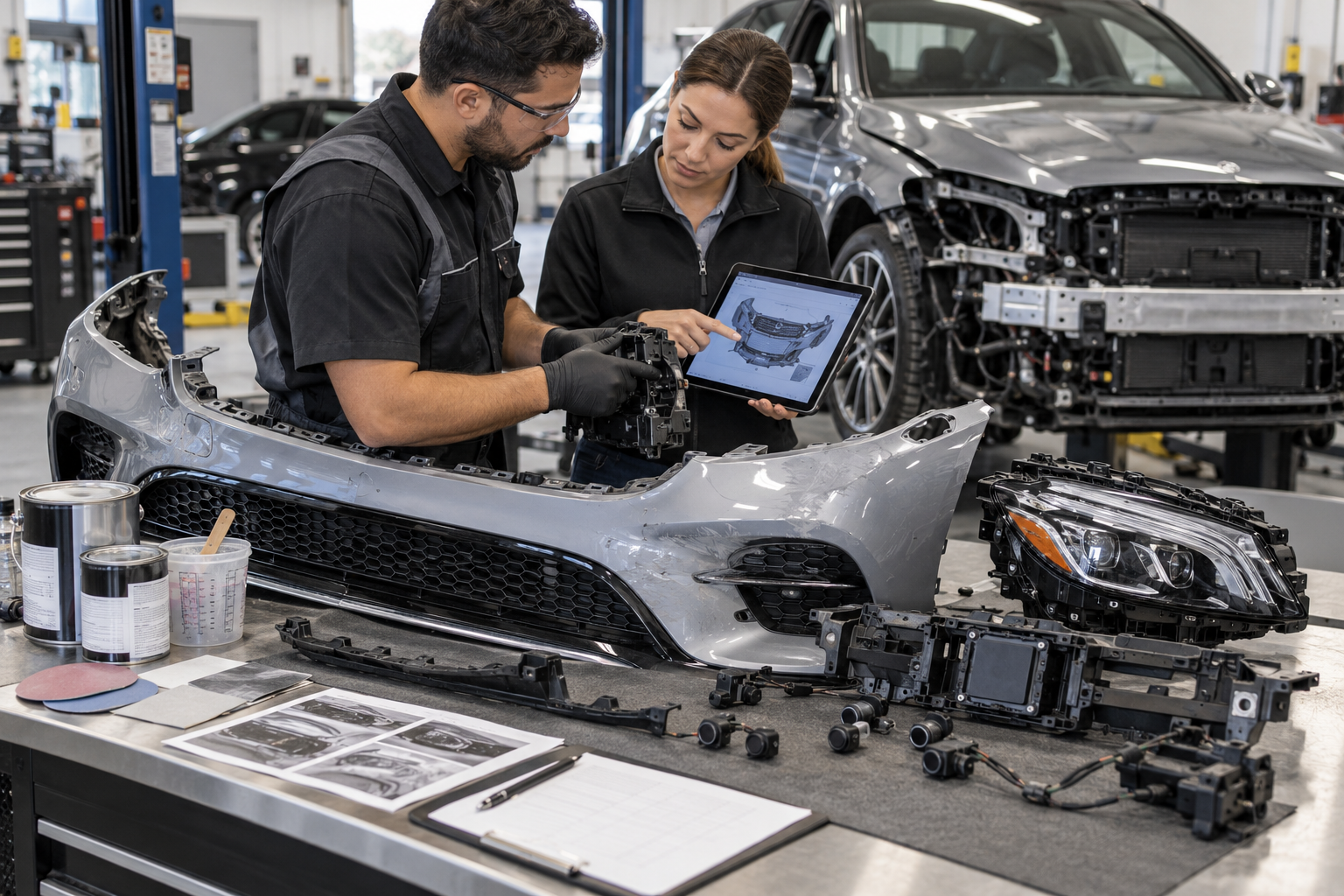
Photos are useful for documenting visible damage, but they cannot show every broken retainer, compressed absorber, bent reinforcement, damaged wiring connector, shifted sensor bracket, or distorted mounting point behind the exterior panels. Modern bumper covers often return close to their original shape even when components underneath have moved.
An initial estimate is therefore a starting point. A repair plan becomes more accurate after the vehicle is identified by VIN, options are confirmed, diagnostic scans are completed, damaged areas are disassembled, and manufacturer procedures are reviewed.
The biggest factors in a Mercedes-Benz collision estimate
Vehicle model and options. A sedan, coupe, SUV, AMG model, electric vehicle, or convertible can use different structures and equipment.
Impact location and severity. A direct bumper impact differs from a hit that reaches a wheel, rail, pillar, cooling module, or suspension mount.
Hidden damage. Brackets, absorbers, wiring, air ducts, shutters, reinforcements, and structural points may only be visible after teardown.
Part type and availability. OEM, recycled, and aftermarket options vary by component, equipment, fit, and insurer authorization.
Material and joining method. Steel grade, aluminum, adhesives, rivets, welds, and corrosion protection affect procedures and labor.
Electronic systems. Cameras, radar, parking sensors, lighting modules, restraint systems, and network faults may require testing or calibration.
Refinishing complexity. Metallic, pearl, multi-stage, matte, and tinted finishes require different materials and blending decisions.
Parts cost is only one part of the total
A collision estimate can include body labor, refinishing labor, mechanical labor, frame or measuring operations, paint materials, hazardous-waste charges, scans, calibrations, sublet services, alignment, glass work, towing, storage, taxes, and replacement hardware. Not every repair needs every operation.
Small clips, one-time-use fasteners, seam sealers, adhesives, foams, corrosion-protection products, and labels may appear minor but are necessary to restore the vehicle according to the applicable procedure. Reusing a damaged or restricted fastener to reduce the estimate can create fit, noise, water-intrusion, or safety problems.
OEM, aftermarket, and recycled components
Part choice can change price, delivery time, preparation, warranty, fit, and compatibility with sensors or trim. An OEM component is designed for the vehicle, but availability and cost vary. A recycled part must be checked for correct option content, prior repair, corrosion, shipping damage, and usable mounting points. An aftermarket part requires verification of fit and application.
The estimate should identify the proposed part type. If an insurer specifies a part, the repairer still has to determine whether it is correct for the VIN and whether additional preparation or transfer operations are required.
Advanced driver-assistance systems can add required operations
Mercedes-Benz vehicles may use forward cameras, radar units, blind-spot monitoring, parking sensors, surround-view cameras, steering-angle information, and other driver-assistance features. A bumper, windshield, suspension, wheel-alignment, or structural repair can affect how these systems are positioned.
Pre-repair scans help document faults and identify systems that need attention. Post-repair scans, static or dynamic calibration, aiming, programming, or road testing may be required depending on the model and repair. Calibration is a precision operation, not an optional electronic reset.
Structural materials and repair procedures matter
Modern Mercedes-Benz bodies can combine conventional steel, high-strength and ultra-high-strength steels, aluminum, cast components, adhesives, rivets, and laser-welded assemblies. These materials do not all respond to heat, pulling, cutting, or welding in the same way.
A structural estimate may include measuring before, during, and after repair; controlled pulling; panel replacement; specialized joining; corrosion protection; and destructive weld testing. The correct method must follow the applicable vehicle-specific information rather than a generic body-shop habit.
Paint color and finish affect labor and materials
Color matching involves more than reading a paint code. Technicians may evaluate color variants, vehicle age, previous refinishing, metallic orientation, pearl layers, transparency, and adjacent-panel differences. Spray-out cards and controlled booth conditions help confirm the formula before the vehicle is painted.
Blending may be recommended to create a continuous visual match. Matte finishes have additional restrictions because gloss and texture cannot be polished like a conventional clear coat. Paint thickness near radar or ultrasonic-sensor zones may also be limited by manufacturer procedures.
Why the estimate may change after teardown
The repairer documents visible damage and verifies the vehicle and options.
Diagnostic scans and measurements establish a baseline.
Damaged panels, bumper assemblies, liners, trim, or suspension parts are removed as authorized.
Hidden conditions are photographed and added to the repair plan.
Parts availability, procedures, calibrations, and related operations are confirmed.
A supplement is submitted when the documented repair differs from the initial estimate.
A supplement does not automatically mean the first estimate was careless. Collision damage often extends into areas that cannot be safely or accurately assessed until components are removed.
Insurance, deductibles, and owner-authorized work
The deductible is the policyholder’s agreed share of a covered claim; it is separate from the total repair cost. Coverage, labor rates, part selections, betterment, prior damage, and claim decisions depend on the policy and circumstances. Direct coverage questions to the insurer.
Owners should receive clear explanations of insurer-paid work, customer-paid operations, unrelated prior damage, and optional services. Ask for changes to be documented before authorizing additional work whenever possible.
How to compare collision estimates fairly
Confirm that both estimates describe the same damage and level of disassembly.
Compare part numbers and whether parts are OEM, aftermarket, recycled, repaired, or transferred.
Check for scans, calibration, alignment, measuring, corrosion protection, and one-time-use hardware.
Review paint operations, blend decisions, materials, and sensor-area restrictions.
Ask what is excluded, preliminary, pending teardown, or subject to supplement.
Compare the repair plan and warranty—not just the bottom-line total.
Frequently asked questions
Can I get an exact Mercedes-Benz repair price from photos?
Usually not. Photos can support a preliminary estimate, but hidden damage, options, scans, measurements, and parts research may change the plan.
Does a higher estimate always mean a better repair?
No. Quality depends on whether the estimate includes the correct operations, parts, procedures, documentation, and verification—not price alone.
Will using insurance increase the repair price?
The damage and required procedures determine the repair. Insurance affects coverage and claim handling, while customer-pay and insurance estimates should still describe the actual work planned.
How long does a collision estimate remain valid?
Parts prices, availability, labor needs, and hidden damage can change. Ask the repairer which items are confirmed and whether the estimate has an expiration or supplement conditions.
Can the shop start before every part arrives?
Sometimes, but sequencing depends on damage, space, parts, insurer authorization, and the risk of leaving the vehicle disassembled. The repairer should explain the plan.
Request a Mercedes-Benz collision estimate in South Florida
Car Geeks Collision helps Mercedes-Benz owners in Hollywood and surrounding South Florida communities document collision damage and build a vehicle-specific repair plan. Bring the VIN, insurance information, claim number if available, photos, warning messages, and details about how the impact occurred.
A careful inspection can separate visible cosmetic damage from structural, mechanical, electronic, and refinishing requirements. That is the most reliable way to understand the estimate and the steps needed to restore the vehicle.