
Blog
Luxury-Car Bumper Repair: When Can It Be Repaired Instead of Replaced?

Can your luxury car’s damaged bumper be repaired, or must it be replaced? Learn how materials, sensors, hidden damage, and fit affect the decision.
A damaged bumper on a luxury vehicle is more than a cosmetic problem. Modern bumper assemblies can contain parking sensors, radar units, cameras, air ducts, wiring, absorbers, reinforcement bars, brackets, trim, and precisely shaped covers. Deciding whether to repair or replace the bumper requires an inspection of the complete system—not just the visible scrape or dent.
Some scuffs, dents, and localized cracks can be repaired safely and refinished. Other damage compromises mounting points, sensor performance, material strength, or fit and makes replacement the more appropriate choice. The correct decision depends on the vehicle, bumper material, damage location, manufacturer procedures, and hidden conditions found after disassembly.
What parts make up a modern bumper assembly?
Painted bumper cover or fascia
Energy absorber and reinforcement beam
Mounting brackets, retainers, guides, and tabs
Grilles, lower valance, spoilers, and decorative trim
Parking sensors, radar modules, cameras, and wiring
Headlamp-washer, towing-eye, or access covers
Air ducts, active grille shutters, and aerodynamic panels
A cover may look lightly damaged while brackets, absorbers, reinforcement components, or sensors behind it have shifted. Careful disassembly is often necessary before the final repair plan can be confirmed.
Bumper damage that may be repairable
Repair may be practical when damage is localized, the correct plastic-repair procedure is available, and critical mounting or sensor areas remain within specification. Examples can include:
Surface scratches and paint transfer
Minor dents or deformation without stretched material
Small tears or cracks in repairable locations
Limited gouges that do not remove excessive material
Broken tabs that have an approved repair method
Cosmetic damage away from radar or sensor zones
The bumper must still fit adjacent panels correctly, support its components, and accept a durable refinish. A low price alone should never determine whether the cover is repairable.
When bumper replacement is usually the safer choice
Cracks extend through multiple body lines or highly stressed areas
Material is badly stretched, torn, burned, or missing
Critical mounting points cannot be restored accurately
The cover remains distorted after controlled reshaping
Damage affects a radar transmission zone or sensor opening
Previous repairs have weakened or contaminated the plastic
The manufacturer prohibits repair in the damaged location
Repair labor and refinishing would exceed a sensible replacement plan
Replacement of the cover does not necessarily mean replacing every component. Grilles, trim, sensors, or hardware may be transferable if they pass inspection and the manufacturer permits reuse.
Why the bumper material matters
Bumper covers use different thermoplastics and blends. The material identification mark helps determine cleaning, heating, welding, adhesive, reinforcement, and refinishing procedures. A method suitable for one plastic may fail on another.
Heat can reshape some deformation, but excessive temperature can change the surface, weaken the material, or damage sensor-related areas. Professional repair controls temperature and restores the part without improvised melting or excessive filler.
Parking sensors and radar change the repair decision
Ultrasonic parking sensors must sit at the correct angle and depth. A repaired opening, thick paint edge, distorted bracket, or incorrect retainer can cause false warnings or missed detections. Radar units are even more sensitive to position and the materials in front of them.
Some manufacturers limit repairs, fillers, paint thickness, films, or accessories in radar zones. A bumper cover that looks cosmetically repairable may still need replacement if the damaged area affects sensor transmission or calibration.
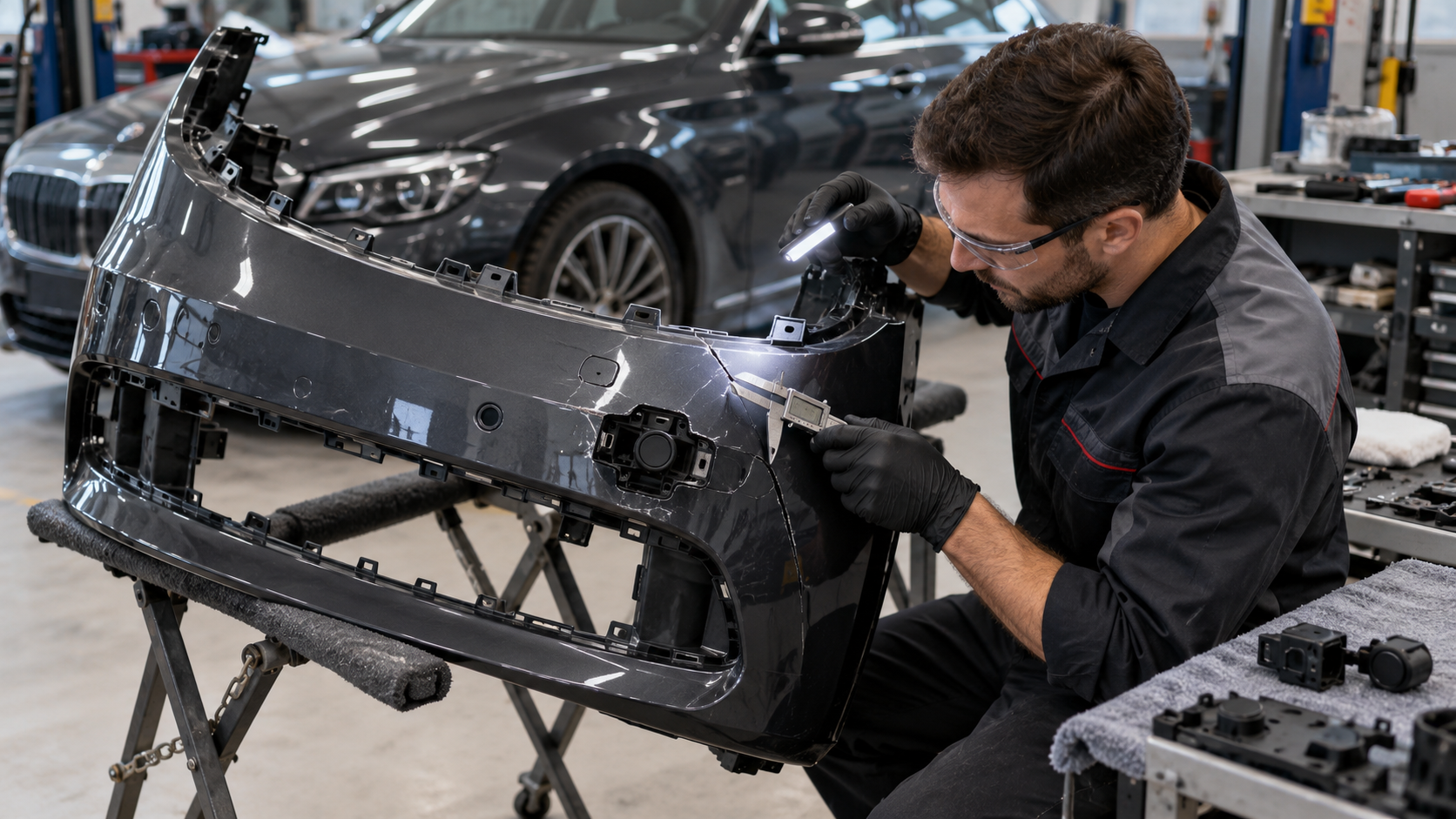
Hidden damage behind the bumper cover
After removal, technicians may find cracked guides, compressed absorbers, bent reinforcement, damaged wiring, broken shutters, shifted radar brackets, or damage to the rear body panel. These conditions can change the estimate and must be corrected before the cover is fitted and painted.
Panel gaps also matter. A bumper that will not align may indicate damaged retainers or structural movement rather than a problem with the cover alone.
OEM, aftermarket, recycled, and repaired bumpers
Part choice affects fit, material behavior, sensor compatibility, preparation time, warranty, and refinishing. An OEM cover is designed for the vehicle, but availability and cost vary. Aftermarket and recycled parts require careful verification of part number, options, damage, previous repairs, and sensor provisions.
A quality estimate should identify the proposed part type and any necessary operations. The cheapest cover can become expensive if it requires extensive correction or does not support the vehicle’s equipment properly.
How professional bumper repair should proceed
Identify the vehicle, options, sensors, and bumper material.
Document visible damage and scan relevant systems.
Remove the cover when needed to inspect hidden components.
Review manufacturer repair restrictions and sensor requirements.
Compare repair feasibility, durability, labor, and replacement cost.
Restore or replace damaged brackets, absorbers, and reinforcement parts.
Complete approved plastic repair and surface preparation.
Use refinishing materials and paint processes appropriate for the sensor zones.
Reassemble with correct hardware and verify panel fit.
Perform scans, calibrations, and operational checks when required.
Paint matching and refinishing considerations
Luxury vehicles may use metallic, pearl, multi-stage, matte, or tinted finishes. Color matching requires the paint code, variant evaluation, spray-out testing, and controlled application. Adjacent-panel blending may be recommended depending on color, damage location, and finish.
Parking sensors and radar areas can have paint-thickness or coating restrictions. Refinishing should follow the applicable manufacturer and paint-system guidance rather than applying extra material to hide poor preparation.
Frequently asked questions
Can a cracked plastic bumper be repaired?
Often, but not always. The plastic type, crack location, length, previous repairs, missing material, mounting points, and sensor zones determine whether a durable repair is possible.
Does a scratched bumper need to be replaced?
Usually not when the damage is limited to the surface. Deep gouges, deformation, exposed substrate, and hidden damage should still be evaluated.
Will bumper repair affect parking sensors?
It can if sensor openings, brackets, paint thickness, wiring, or mounting angles are changed. Sensors should be inspected and tested after repair.
Is replacement always more expensive?
Not necessarily. A complex repair can require more labor than a replacement cover. Part price, availability, calibration, refinishing, and related damage all affect the final cost.
How long does bumper repair take?
Timing depends on disassembly, hidden damage, parts, plastic-repair complexity, paint process, sensor calibration, and insurer approval. A complete inspection is needed for a reliable schedule.
Schedule a bumper-damage evaluation in South Florida
Car Geeks Collision helps drivers in Hollywood and surrounding South Florida communities evaluate damaged luxury-car bumpers, mounting hardware, sensors, radar components, reinforcement parts, and finishes.
Send the year, make, model, photos, collision location, warning messages, and insurance information when requesting an estimate. A proper inspection will determine whether repair or replacement offers the safest, most durable result.