
Blog
When $300–$600 Appraisal Pays: Diminished Value Appraisal for Drivers

Drivers: how to get a market based diminished value appraisal, why $300–$600 reports often beat insurer math, and when filing is worth it.
Diminished value is usually recoverable when another driver caused the crash and you can document the loss, and the fastest way to prove it is a market-based appraisal, not the insurer’s own math. Independent appraisals typically run $300 to $600, and insurers often open negotiations far below that appraisal’s conclusion using their own internal formula. If your car had solid pre-loss value and visible structural or panel damage, order a professional appraisal and pull your repair records before you file anything.
TL;DR:
Market-based appraisals typically range from $300 to $600, often resulting in settlements two to five times higher than insurer formulas.
Inherent diminished value is most commonly claimed because it relies on market stigma and doesn’t depend on repair quality.
A proper appraisal involves establishing pre-loss value, assessing damage, pulling market comparables, and clearly explaining the methodology.
The 17c formula is flawed, limited by a 10% cap, double discounts for mileage, and conservative multipliers, making it a weak starting point.
Filing claims against the at-fault driver’s insurer is usually more successful than first-party claims, with documentation and timing being key factors.
Table of Contents
What Diminished Value Means and Its Three Types
Diminished value is the gap between what your car was worth before the crash and what it’s worth after the repair, even when the repair looks flawless. Body shops and appraisers generally sort it into three categories, and knowing which one applies to your car changes how you build the claim.
Immediate diminished value is the drop in worth the instant the accident happens, before any repair occurs. It’s mostly a theoretical figure used in total-loss math rather than a claim basis.
Inherent diminished value is the loss that remains after a proper repair, driven purely by the fact that the car now carries an accident on its title or vehicle history report. Buyers pay less for it, period, even when the bodywork is invisible.
Repair-related diminished value results from a repair that wasn’t done correctly. Mismatched paint, panel gaps, or aftermarket parts substituted for OEM components all fall here.
Inherent diminished value is the type behind most successful claims, because it doesn’t depend on proving a repair mistake. It rests on a documented market fact: buyers and dealers discount vehicles with an accident history, even after professional repairs restore them to spec, a stigma effect that’s well documented in legal analysis of diminished value claims. A detailed breakdown of how repair quality feeds into that stigma shows why the shop you choose matters just as much as the appraisal you order.
How Is a Diminished Value Appraisal Produced?
A credible appraisal isn’t a guess dressed up in a PDF. It follows a defined process, and skipping steps is exactly what gives insurers an opening to reject it.
Establish pre-loss value. The appraiser pulls a baseline from sources like NADA, Black Book, or actual comparable listings for your exact year, make, model, and trim.
Assess the damage and repair quality. This includes reviewing repair invoices, structural measurements, and whether OEM procedures were followed.
Pull market comparables. The appraiser gathers real sales data on similar vehicles with accident histories versus clean-history equivalents in your region.
Write the methodology narrative. This section explains exactly how the appraiser moved from raw data to a dollar figure, not just what the figure is.
State the conclusion. A defensible report ends with a specific diminished value number tied directly to the comparables cited above it.
A report worth submitting includes the VIN, the pre-loss valuation source, the comparable sales data itself, a written methodology explanation, and the appraiser’s credentials. The Diminished Value Institute publishes Standards of Practice that define these core elements, and a growing number of courts and regulators favor appraisals built on real market comparables over rigid formulas, according to those same standards. Reports that skip the methodology section and just state a number are the ones insurers dismiss fastest, and appraisal guidance on proper report construction confirms methodology transparency is what actually holds up in negotiation or small claims court.
Pro Tip: Ask any appraiser upfront whether their report follows a USPAP-compatible approach. If they hesitate or don’t know what that means, keep looking.
How Do Insurers Calculate the 17c Formula?
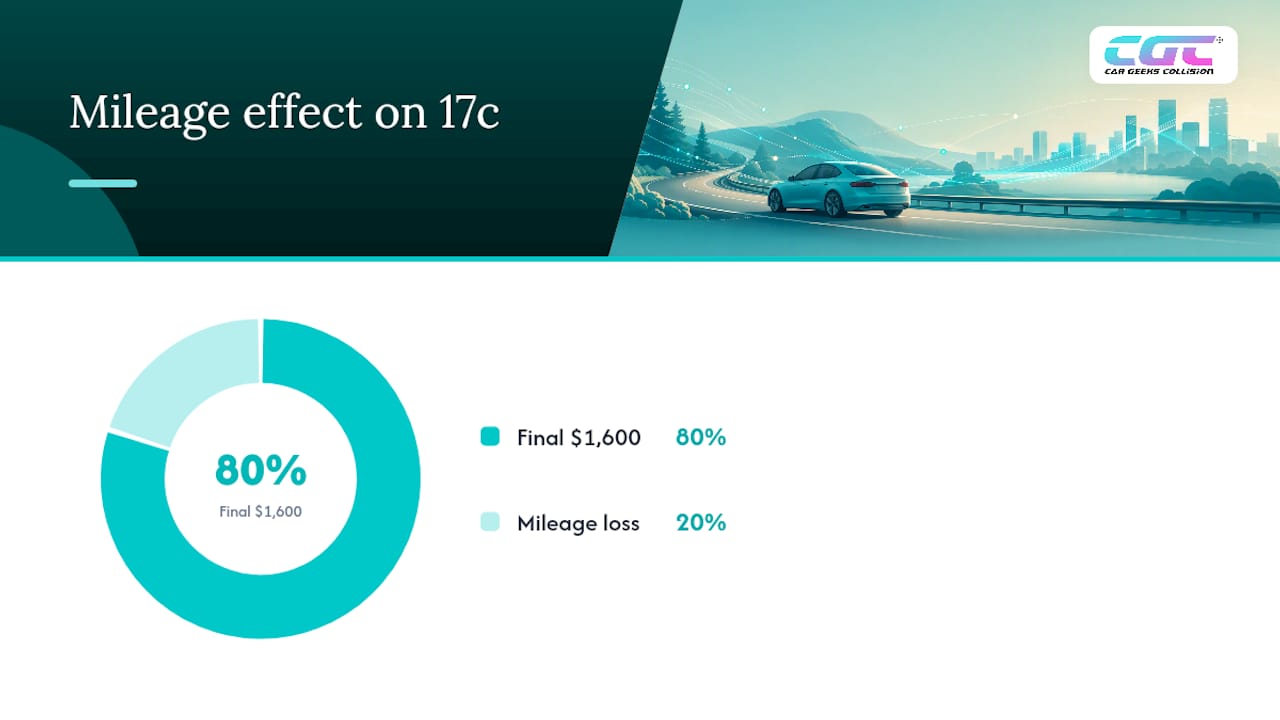
Insurers commonly reach for a shortcut called the 17c formula, named after the State Farm v. Mabry case that popularized it.
Here’s a rough example. Moderate structural damage might apply a 0.5 damage multiplier, bringing it to $2,000. A mileage multiplier around 0.8 for a car with 40,000 miles drops the final number to roughly $1,600.
That 10% cap exists no matter how severe the actual damage was, and the formula was never designed to reflect real resale markets. It’s a starting number, not a settlement.
The formula has real problems worth flagging before you accept a check:
The 10% cap applies regardless of whether the true market loss is higher.
Mileage gets discounted twice in some insurer calculations, once in the base value and again in the multiplier.
The multipliers themselves are conservative by design, favoring the insurer’s bottom line over your car’s actual market performance.
Treat any 17c number as an opening offer, not a conclusion. A market-based appraisal is what pushes the real settlement higher.
Who Can File a Diminished Value Claim?
Eligibility depends heavily on whether you’re the at-fault party or the victim, and on which state you live in.
Third-party claims against an at-fault driver’s liability insurer are widely viable across most states and represent the most common path to a successful payout.
First-party claims, where you’d file against your own insurer after a not-at-fault accident, are commonly excluded by policy language in most states, though a handful of states carve out exceptions.
Statutes of limitation vary by state, often ranging from two to six years for property damage claims, so filing sooner protects your options.
Verify your state’s specific rules through your state insurance department or a certified appraiser before spending money on documentation.
Most successful diminished value recoveries come through third-party claims filed against the at-fault driver’s insurer, since first-party policies typically don’t cover this loss category at all.
What Documents Should You Collect Before Filing?
Insurers and small-claims judges both respond to paper trails, not stories. Assemble this before you send anything.
A professional market-based appraisal with full methodology.
Itemized repair invoices showing parts and labor detail separately.
Before-and-after photos of the damage and completed repair.
A vehicle history report showing the accident entry (CARFAX is the most widely recognized).
The police report from the accident.
VIN and odometer records confirming mileage at time of loss.
The appraisal and vehicle history report prove inherent diminished value, the stigma buyers attach once an accident shows up on the title. Repair invoices and photos prove repair-related diminished value, if the work itself fell short. Send everything by certified mail, keep your originals, and request itemized rather than summary invoices from your repair shop. A digital damage documentation workflow at the time of vehicle intake can also make before-and-after evidence far easier to compile later.
Are Diminished Value Claims Worth the Cost?
Independent appraisals typically run $300 to $600, with luxury vehicles, EVs, and cars needing structural repair pushing toward the higher end because those appraisals demand more specialized comparables.
Professional appraisals often produce results two to five times higher than the insurer’s 17c number, especially on vehicles with structural damage or high pre-loss value, according to detailed analysis of diminished value filing.
A simple breakeven rule: if your expected diminished value is under $1,000, the appraisal fee may eat too much of the recovery to justify hiring a professional.
For vehicles worth $30,000 or more with visible structural repair, the math almost always favors paying for a certified appraisal.
If your pre-loss value was modest and the damage was cosmetic, a lower-cost informal estimate might be all you need. If you’re driving something expensive, especially an EV or a performance import, hire an appraiser experienced with that specific class of vehicle, since complex or high-value vehicles carry appraisal challenges that generic formulas can’t capture.
How Do You File and Negotiate a Diminished Value Claim?
The process moves in a predictable sequence, and knowing the order in advance keeps you from getting rushed into a low settlement.
Order your appraisal and gather every supporting document listed earlier.
Write a demand letter that includes the appraisal, repair invoices, photos, and a clear dollar amount you’re seeking.
Send the letter to the at-fault driver’s insurer and set a response deadline, typically 14 to 30 days.
Expect a counteroffer. Insurers rarely accept the first demand outright.
Request the insurer’s calculation in writing. This forces them to reveal their comparables or formula assumptions, giving your appraiser something concrete to rebut.
Get a written rebuttal from your appraiser addressing the insurer’s specific numbers point by point.
Escalate if talks stall. Options include a complaint to your state insurance regulator or filing in small claims court if the amount fits jurisdictional limits.
Pro Tip: Never negotiate off the insurer’s opening number alone. Ask for their calculation in writing first; it’s the single fastest way to expose a weak 17c-based lowball offer.
Most negotiations run two to three rounds before landing on a number, and appraisals built with full methodology tend to close that gap faster than a bare estimate. Accept a settlement once it’s reasonably close to your appraisal’s conclusion. Escalate when the gap stays wide after a written rebuttal.
How Long Does a Diminished Value Claim Take?
A professional appraisal typically takes 3 to 7 business days once the appraiser has your full documentation in hand. The negotiation that follows usually stretches several weeks, often longer with multiple counteroffer rounds.
If the insurer accepts your first demand, expect payment within a few weeks of the signed agreement.
If they counter low, plan for at least one additional round of written exchanges before a figure settles.
If they deny the claim outright, your options narrow to a state regulator complaint or small claims court, where jurisdictional dollar limits and local court schedules add weeks to months before resolution.
Small claims cases move faster than civil suits but still depend heavily on your local court’s calendar. Weigh the extra weeks against the size of the gap between your appraisal and the insurer’s final offer before deciding to escalate.
How Repair Documentation Strengthens Your Diminished Value Claim
An insurer looking for a reason to dispute your claim will target the repair itself first, and that’s where your choice of shop matters. Documentation from a shop that follows OEM repair procedures gives your appraiser far more to work with than a generic repair invoice.
Itemized invoices breaking out parts and labor by line item.
Documented use of OEM repair procedures rather than shortcuts.
ADAS calibration reports showing sensors and cameras were properly reset.
Before-and-after photos taken at each repair stage.
A lifetime workmanship warranty backing the quality of the work.
Each of these gives your appraiser concrete evidence to counter an insurer’s claim that the repair itself lowered the car’s value, separating inherent diminished value (the stigma) from repair-related diminished value (an actual mistake). Car Geeks Collision’s page on diminished value claims walks through how this documentation gets assembled, and the shop’s guide to navigating repairs after an accident covers the insurance coordination side in more detail.
When Is a Diminished Value Appraisal Actually Worth Filing?
A diminished value appraisal is usually worth pursuing when your pre-loss value sits above roughly $20,000 to $30,000 and the damage included structural or major panel work. Below that, the math often doesn’t clear the appraisal fee.
The biggest mistake I see is accepting the insurer’s first 17c-based number without asking for it in writing first. The second is hiring the cheapest available appraiser who skips the methodology section entirely. Both mistakes cost you leverage you’ll never get back once you’ve signed a release. Document everything, get a market-based appraisal, and file before your state’s statute of limitations closes the door.
— Anns
Get Repair Documentation That Supports Your Claim
Some body shops provide repair documentation designed to hold up against an insurer’s lowball 17c number. Where a generic estimate leaves you with a vague invoice, Car Geeks Collision’s OEM repair procedures, itemized invoices, and ADAS calibration reports give your diminished value appraiser exactly the paper trail needed to rebut an insurer’s math.

The shop’s team coordinates directly with insurance carriers, handles collision repair and structural repair for everything from daily drivers to Porsche, Mercedes-Benz, and other luxury and exotic marques, and backs every job with a lifetime workmanship warranty. If you’re weighing whether your diminished value claim is worth pursuing, start with a repair that’s documented properly from day one. Visit the collision repair and insurance claim assistance page to see how Car Geeks Collision supports your paperwork, or reach out to schedule an assessment for your vehicle.
Sources
FAQ
How Much Do You Normally Get for Diminished Value?
Payouts vary widely based on pre-loss value, damage severity, and whether you use a market-based appraisal instead of the insurer’s 17c formula. Independent appraisals often produce results two to five times higher than what the insurer’s formula alone would offer, particularly on vehicles with structural damage.
Are Diminished Value Claims Worth It?
For vehicles with meaningful pre-loss value and structural or major panel damage, yes, especially since appraisal fees typically run $300 to $600 against potential recoveries several times that amount. For minor cosmetic damage on lower-value cars, the appraisal fee may not clear a reasonable breakeven point.
How Long Should a Diminished Value Claim Take?
The appraisal itself typically takes 3 to 7 business days, while the full negotiation with an insurer often runs several weeks across two to three rounds of counteroffers. Small claims escalation, if needed, adds additional weeks to months depending on your local court’s schedule.
Do I Need an Appraiser for Diminished Value?
A professional appraisal isn’t strictly required to file, but it’s the strongest evidence you can present, since insurers routinely dismiss claims built only on the 17c formula or a bare dollar estimate. Reports that follow DVI Standards of Practice with full methodology and market comparables carry far more weight in negotiation or small claims court.
Recommended