
Blog
Why Is My Bentley A/C Not Cooling? Diagnostics and Repair Explained

Bentley A/C blowing warm air or cooling unevenly? Learn possible causes, diagnostic steps, and when to request an inspection in Hollywood, FL.
A Bentley that blows warm air, cools unevenly, takes too long to cool, produces an unusual odor or noise, or displays a climate-control warning needs diagnosis before a repair can be recommended.
The symptom may involve airflow, a refrigerant leak, an electrical or control fault, a sensor, a compressor-related concern, or damage near the front cooling components. Similar symptoms can have different causes, especially in a multi-zone luxury climate-control system.
Car Geeks Collision provides A/C and HVAC diagnostics and repair from its independent collision and auto repair facility in Hollywood, Florida. The goal is to identify the supported cause before recommending parts or refrigerant service.
Common Signs of a Bentley Climate-Control Problem
Climate-control problems do not always begin with completely warm air. Early or intermittent symptoms can provide useful diagnostic clues.
Air from the vents does not become cold.
Cooling is weak, slow, or intermittent.
Driver and passenger zones do not maintain similar temperatures.
Front and rear zones behave differently.
Airflow remains weak when the fan setting is high.
A musty or unusual odor comes from the vents.
Clicking, buzzing, fan, or compressor-related sounds are new or changing.
Moisture appears inside the cabin or around an unexpected area.
A climate-control warning or related vehicle message appears.
Cooling performance drops during South Florida's hottest or most humid conditions.
Record when the symptom occurs, which zones are affected, and whether it began after a collision, battery service, interior work, or another repair. That context can shorten the diagnostic path.
Why a Bentley A/C May Blow Warm Air
Warm air is a symptom, not proof that one particular component has failed. A useful inspection separates refrigeration, airflow, electrical, control, and mechanical causes.
Refrigerant Leak
If refrigerant is low, the next question is why. Possible leak areas can include lines, seals, connections, the condenser, or another component. The location and cause should be identified before the correct repair can be planned.
Restricted Airflow
A filter, blower concern, evaporator condition, blocked air path, or vent-control problem may reduce cabin airflow even when parts of the refrigeration system are operating. Weak airflow and warm airflow should not automatically be treated as the same fault.
Electrical, Sensor, or Control Fault
Luxury climate-control systems depend on sensors, wiring, control modules, actuators, fans, and communication between vehicle systems. A diagnostic code describes a detected condition; it does not automatically identify the part that should be replaced.
Compressor or Cooling-Component Concern
A compressor-related symptom does not always mean the compressor itself has failed. Power supply, control commands, pressure information, connections, fans, or another condition can affect operation. Testing should come before replacement.
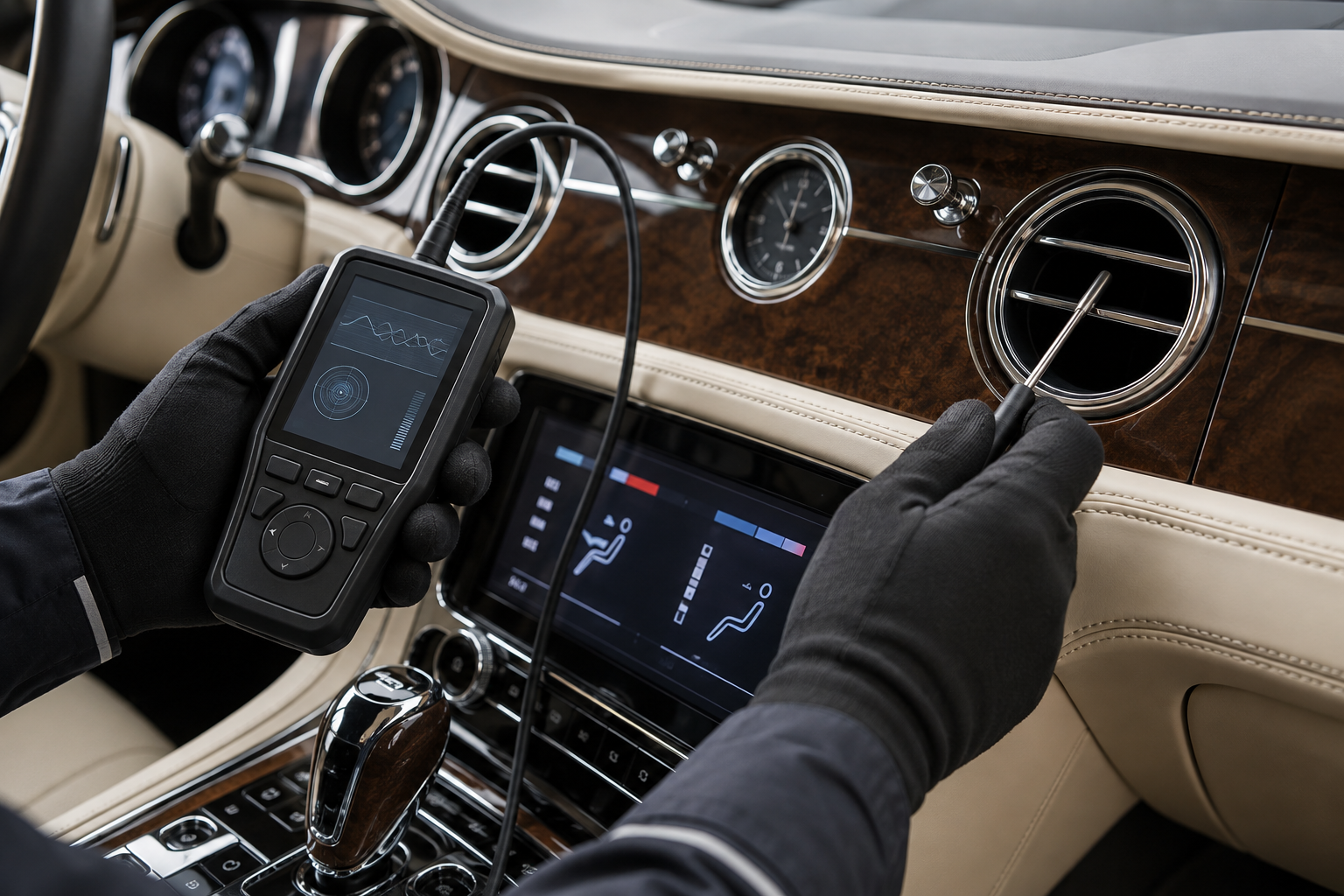
Illustrative image: vent-temperature and airflow measurements help document system performance without assuming the cause.
Why Multi-Zone Cooling Requires Careful Diagnosis
Depending on the model, model year, and equipment, a Bentley may have separate temperature and airflow controls for different seating areas. A complaint in only one zone may point toward air distribution, an actuator, a sensor, or zone-specific control rather than a vehicle-wide loss of cooling.
The correct refrigerant type, oil, charge quantity, procedures, and safety precautions can vary by vehicle configuration. The underhood label and applicable service information should be checked instead of relying on a universal Bentley specification.
Bentley provides current-model owner information through its official technology and Driver's Guide resources. Owner information can explain controls and normal operation, but physical testing is still needed when performance changes.
What a Professional Bentley A/C Diagnostic May Involve
The appropriate procedure depends on the symptoms and the vehicle's exact configuration. A methodical diagnostic process may include:
Confirm the symptom and determine when, where, and under what settings it occurs.
Identify the vehicle, model year, options, recent repairs, and relevant collision history.
Inspect visible components, lines, connectors, airflow paths, and areas affected by prior work.
Check cabin filters, blower operation, air distribution, odors, moisture, and differences between zones.
Review available diagnostic information and interpret it alongside physical tests.
Evaluate system performance using applicable temperature, airflow, electrical, sensor, fan, and refrigeration checks.
Recommend repair only after the evidence supports a cause.
Verify cooling, airflow, zone operation, and relevant diagnostic information after repair.

Illustrative image: scan information is one part of diagnosis and must be interpreted with inspection and testing.
Why Adding Refrigerant Is Not a Complete Diagnosis
Adding refrigerant may temporarily improve cooling if a system is low, but it does not explain why the refrigerant level changed. If a leak exists, the symptom can return. An incorrect refrigerant, oil, quantity, or service procedure can also create additional problems.
The U.S. Environmental Protection Agency's motor-vehicle A/C requirements apply to compensated refrigerant service. The EPA requires applicable technicians to be trained and certified under Section 609 and requires approved refrigerant-handling equipment. This is a general regulatory requirement and should not be confused with a Bentley manufacturer certification.
Bentley A/C still blowing warm? Request a diagnostic inspection from Car Geeks Collision in Hollywood before authorizing a parts replacement or refrigerant top-off.
Bentley A/C Problems After a Collision
A collision does not automatically damage the air-conditioning system. However, front-end or underbody damage can affect components and connections used by the A/C and vehicle cooling systems.
The condenser and nearby heat exchangers.
Cooling fans and airflow paths.
Refrigerant lines, seals, and connections.
Electrical wiring, connectors, and sensors.
Brackets and mounting points.
Underbody lines or shields.
Components displaced during impact or disassembly.
If cooling changed after an accident, the symptom should be evaluated alongside the impact and previous repairs. Learn more about collision repair and insurance claim assistance.
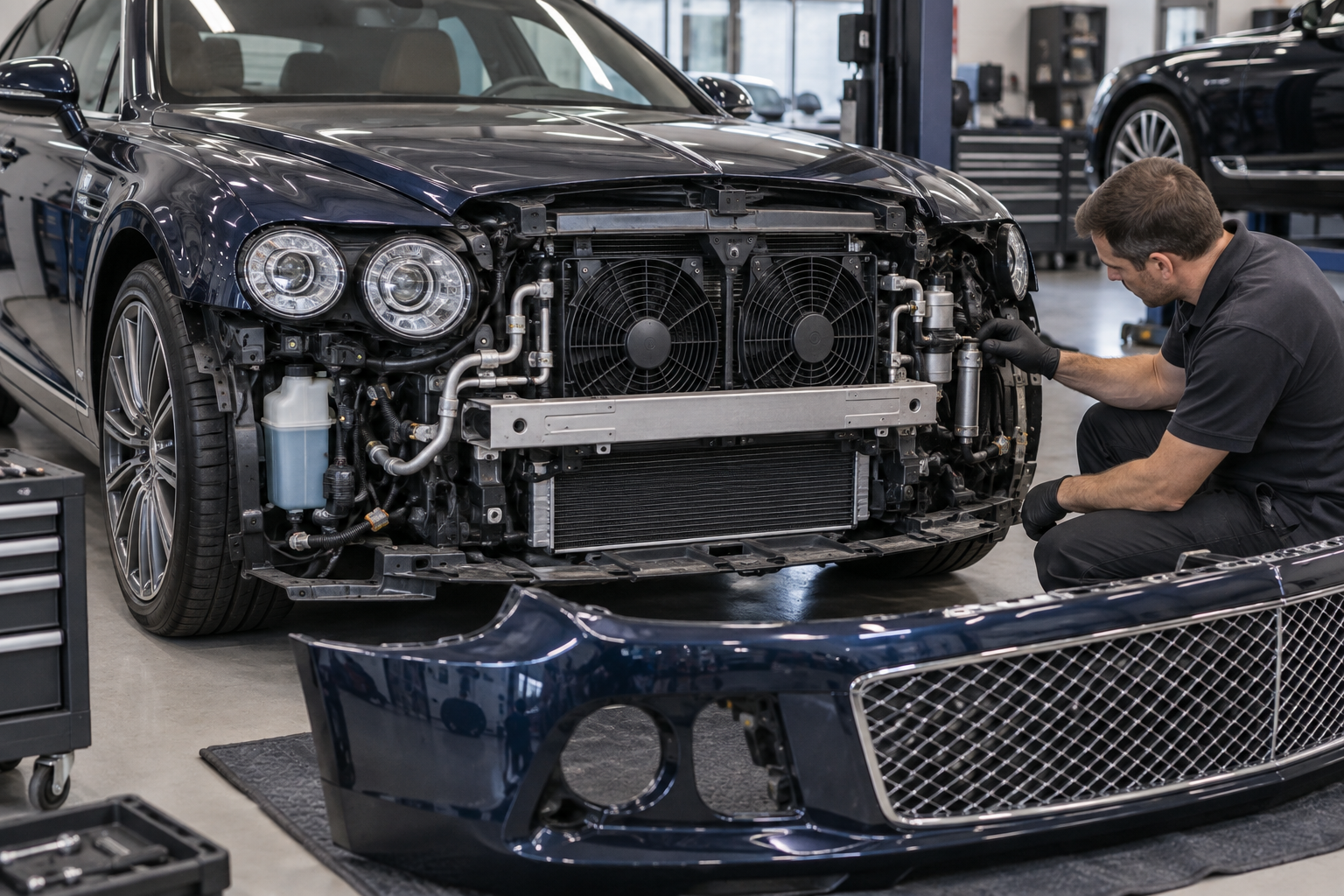
Illustrative image: post-collision inspection may include the condenser area, cooling fans, lines, connectors, and mounting points.
Why A/C Performance Matters in South Florida
Hollywood and nearby South Florida communities combine high temperatures, humidity, strong sun, and frequent climate-control use. A hot cabin alone does not prove a fault, but a consistent decline in cooling, an inability to maintain the selected temperature, uneven zones, or a warning message deserves inspection.
Pre-cooling and shaded parking may improve comfort, but they cannot correct a refrigerant leak, airflow restriction, electrical problem, sensor fault, or damaged component.
Car Geeks Collision serves luxury-vehicle owners from Hollywood and surrounding South Florida communities. Explore luxury and exotic vehicle repair or request an inspection when symptoms persist.

Illustrative image: a clearly illustrative South Florida setting; this is not presented as an actual customer vehicle or repair result.
What to Tell the Shop Before Your Inspection
Bentley model and model year.
Which vents or seating zones are affected.
Whether the problem is constant or intermittent.
Outside temperature and driving conditions when it occurs.
Any warning messages, odors, noises, or moisture.
Whether refrigerant was recently added.
Recent collision, battery, dashboard, interior, or mechanical work.
Frequently Asked Questions
Why is my Bentley A/C blowing warm air?
Possible causes include a refrigerant leak, restricted airflow, electrical or sensor faults, a control problem, a compressor-related concern, or damage near the condenser or cooling components. Testing is needed because several faults can create similar symptoms.
Why is one side of my Bentley colder than the other?
Uneven temperatures can involve zone settings, air distribution, an actuator, a temperature sensor, airflow restrictions, or a broader A/C performance problem. The affected zones and operating conditions should be documented and tested.
Can low refrigerant be fixed by topping off the system?
Adding refrigerant does not identify why the system is low. If refrigerant escaped through a leak, the cooling problem can return unless the cause is located and the appropriate repair is completed.
Can collision damage affect Bentley climate control?
Depending on the impact, front-end or underbody damage may affect the condenser, lines, fans, sensors, wiring, brackets, or related cooling components. Not every collision damages the A/C system, so inspection is necessary.
Does every Bentley use the same refrigerant and service procedure?
No universal specification should be applied to every Bentley. The correct procedure depends on the model, model year, equipment, underhood labeling, and applicable service information.
Where can I request a Bentley A/C inspection near Hollywood, Florida?
Contact Car Geeks Collision in Hollywood and provide the model, model year, symptoms, affected zones, warning messages, and relevant repair or collision history. You can request an inspection online.
Request a Bentley A/C Inspection in Hollywood
If your Bentley is blowing warm air, cooling unevenly, producing an unusual odor or noise, or displaying a climate-control warning, start with diagnosis rather than an assumed part replacement.
Request an inspection or estimate or review Car Geeks Collision's A/C and HVAC repair services. A repair recommendation should follow vehicle identification, inspection, and testing.