
Blog
Audi Convertible Roof Problems: Diagnosis and Repair in South Florida
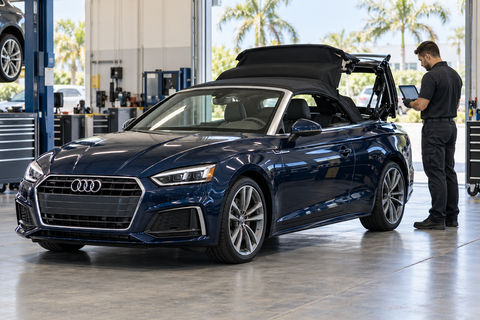
Learn why an Audi convertible roof may stop, leak, move unevenly, or show a warning—and what professional diagnosis should check in Hollywood, FL.
A convertible Audi should open and close smoothly, seal securely, and keep the cabin dry. If the roof stops partway, moves unevenly, leaks, makes new noises, or displays a warning, avoid forcing it. Continuing to operate a binding or misaligned roof can turn a smaller fault into damage involving the frame, fabric, seals, trim, wiring, or storage compartment.
Audi convertible-roof systems vary by model, year, and equipment. An A5 or S5 Cabriolet, TT Roadster, R8 Spyder, and an older Audi convertible may use different latches, sensors, hydraulic or electric drives, tensioning components, and emergency procedures. Diagnosis should begin with the exact vehicle identification and the sequence of events that led to the problem.
When an Audi roof problem needs prompt attention
Stop operating the roof if it twists, contacts bodywork, produces grinding or snapping sounds, leaves a panel unsupported, or will not latch at the windshield. Keep the vehicle protected from rain and arrange professional inspection. If the roof is partly open, follow only the model-specific instructions for securing or moving it; guessing at a manual procedure can damage the mechanism or create a safety risk.
Common Audi convertible-roof warning signs
Roof stops before completing the opening or closing cycle
One side moves ahead of the other
The roof operates slowly, intermittently, or only after several attempts
A roof, latch, or storage-compartment warning remains on
The front edge will not latch or sits unevenly
Water enters near the windshield, side glass, rear window, or roof storage area
Wind noise increases with the roof closed
Fabric appears loose, wrinkled, torn, or poorly tensioned
Clicking, popping, grinding, or hydraulic-pump noise changes
The trunk or roof-storage divider is not recognized
Windows fail to lower or index during roof movement
These symptoms guide the inspection, but they do not confirm which part has failed. A sensor fault, low voltage, misalignment, water intrusion, worn linkage, damaged wiring, or a mechanical obstruction can create similar behavior.
Why an Audi convertible roof may stop working
Low battery voltage or unstable electrical supply
Convertible-roof operation requires stable voltage and coordinated communication between several components. A weak battery, voltage drop, poor connection, or charging-system concern may interrupt a cycle or store faults. Battery condition and power supply should be checked before expensive roof components are condemned.
Position sensors, switches, and latches
The control system must know whether the roof, front latch, windows, trunk, and storage divider are in the expected positions. A misadjusted latch, damaged microswitch, sensor fault, or wiring issue can prevent operation even when the mechanical structure appears intact. Scan data and live status information can help identify where the sequence stops.
Hydraulic or electric drive concerns
Depending on the Audi model and year, roof movement may involve a hydraulic pump, cylinders, hoses, electric motors, gear drives, or combinations of these components. Leaks, worn drives, damaged gears, overheated motors, or control faults can cause slow or incomplete movement. Fluid level alone does not identify the source of a hydraulic problem, and topping up fluid without locating a leak is not a complete repair.
Linkage, hinge, cable, and tensioning problems
Hinges, bows, cables, straps, and tensioning pieces guide the roof through a specific path. Wear, looseness, binding, or collision-related distortion may allow one side to lead, create fabric wrinkles, or make the roof contact surrounding trim. The complete motion should be observed safely before parts are ordered.
Weather seals, drains, and water intrusion
A leak is not always caused by a damaged fabric top. Dirt in drainage paths, displaced seals, incorrect glass adjustment, a blocked outlet, or body alignment can direct water into the cabin or roof-storage area. Water testing should be controlled and systematic so the entry point is identified rather than masked with sealant.
Why the exact Audi model matters
Audi Cabriolet and Roadster models do not share one roof design. Component locations, initialization steps, emergency procedures, seal profiles, and control logic can differ substantially. A repair plan for an A5 Cabriolet should not be assumed to apply to a TT Roadster or R8 Spyder. The model year, installed roof system, prior repair history, and any fault codes should guide the process.
What to do when the roof stops mid-cycle
Move the vehicle to a safe, level location and stop pressing the switch repeatedly. Check for an obvious obstruction only from a safe position, and note the exact point where movement stopped. Do not pull the roof, push on the bows, disconnect hydraulic lines, or bypass safety switches.
Record the conditions that may help diagnosis:
Whether the roof was opening or closing
The approximate position where it stopped
Any dashboard message or warning tone
Whether the windows, trunk, or storage divider moved normally
Recent battery work, jump-starting, water intrusion, collision damage, or body repair
Changes in noise, speed, or left-to-right movement
Weather conditions and whether the concern is intermittent
If rain is approaching and the roof cannot be secured, protect the interior without placing weight on the fabric or mechanism and ask a repair professional about model-specific transport or securing options.
How a professional Audi roof diagnosis should proceed
A structured inspection may include:
Confirming the exact Audi model, year, equipment, and roof type
Scanning relevant modules and recording faults before clearing anything
Checking battery condition, system voltage, fuses, grounds, and visible wiring
Reviewing live sensor, switch, latch, and storage-divider status
Observing the operating sequence without forcing a binding mechanism
Inspecting hinges, bows, cables, straps, guides, motors, pump components, and mounting points
Looking for hydraulic leakage where applicable
Inspecting fabric, rear-window bonding, seals, drainage paths, glass alignment, and trim
Checking for water damage in nearby connectors or modules
Comparing left and right roof geometry and signs of earlier collision or body repair
Verifying full operation, latching, window indexing, sealing, and warning status after repair
The goal is to find the cause of the failed sequence, not simply replace the first component near the symptom.
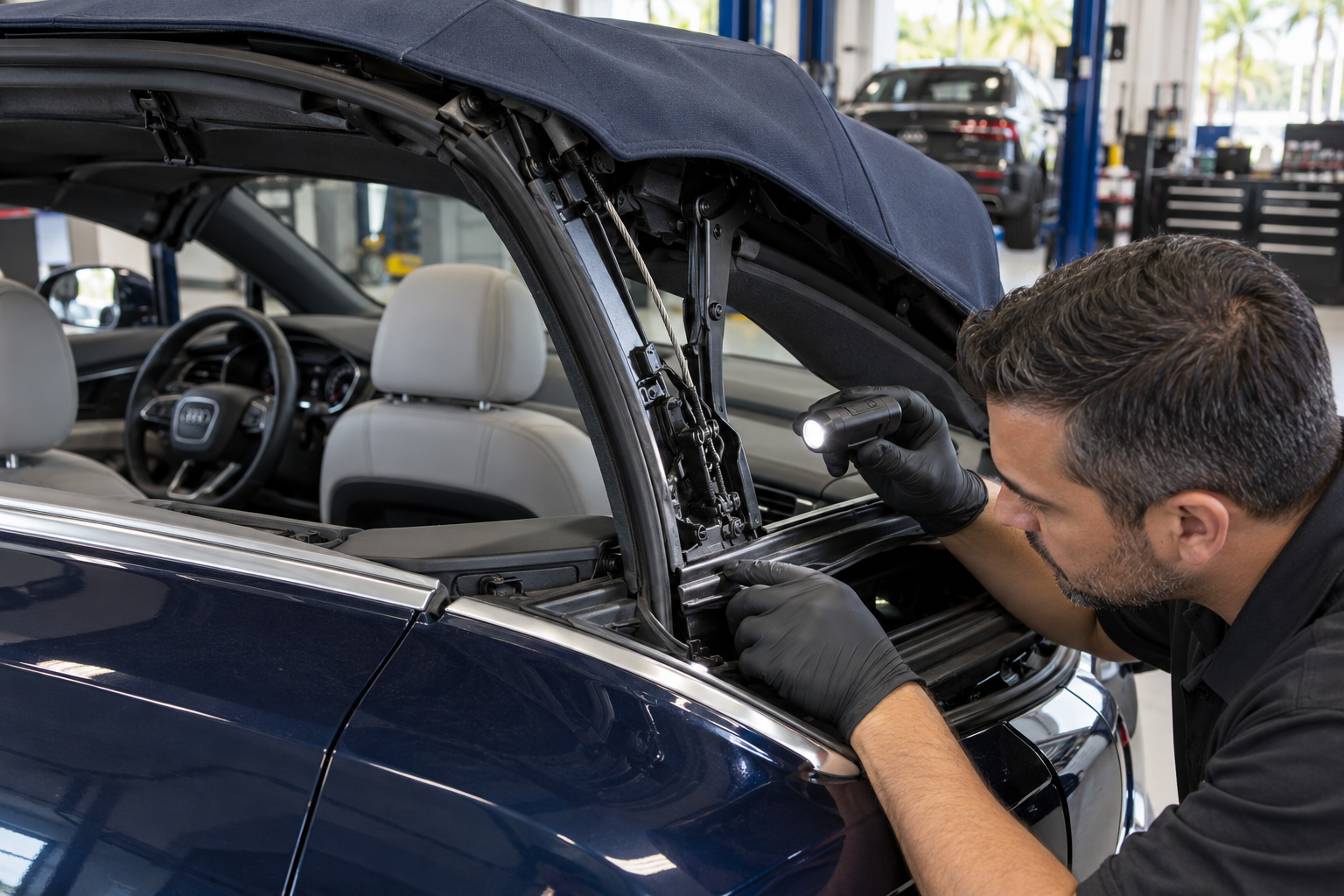
Collision damage and convertible-roof alignment
A side, rear, rollover, or structural impact can change the alignment of the windshield frame, quarter panels, roof storage area, trunk opening, or mounting points. A roof may still move while placing abnormal stress on latches, seals, cylinders, links, or fabric. New wind noise, leaks, glass contact, uneven gaps, or slow movement after a collision should be evaluated together with the body structure.
A coordinated collision repair inspection can determine whether the concern is isolated to the roof system or connected to surrounding body and mounting geometry. Installing roof parts before correcting structural alignment can lead to repeat problems.
Repair options depend on the confirmed fault
The correct repair may involve adjustment, wiring repair, latch or sensor service, restoring drainage, replacing a damaged seal, repairing a drive component, addressing a hydraulic leak, correcting glass or body alignment, or replacing worn roof hardware. Fabric or rear-window problems require evaluation of the top material and attachment method. Some repairs may also require initialization, adaptation, or calibration depending on the Audi.
Frequently asked questions
Can an Audi convertible roof be closed manually?
Some models provide an emergency procedure, but the steps and required tools vary. Use the owner’s manual or model-specific service information. Forcing the roof or improvising a procedure can damage the mechanism or leave it unsecured.
Why does my Audi roof work only sometimes?
Intermittent operation may involve voltage, temperature, wiring, switch, sensor, latch, hydraulic, or mechanical issues. Recording when the fault occurs and scanning the system before clearing codes can make diagnosis more efficient.
Why is water entering even though the fabric looks fine?
Water may travel from a blocked drain, displaced seal, glass adjustment, trim joint, rear-window bond, or body seam. A controlled water test is more useful than applying sealant to the most visible area.
Can a roof warning appear after collision repair?
Yes. A disconnected component, wiring damage, lost adjustment, changed body alignment, or incomplete initialization may affect roof operation. The repair history and the exact warning should be reviewed.
How long does Audi convertible-roof repair take?
Diagnosis and repair time depend on the roof design, fault location, access, water damage, alignment condition, and parts availability. An inspection is needed before a reliable schedule can be provided.
Schedule Audi convertible-roof diagnosis in Hollywood, FL
Car Geeks Collision helps Audi owners in Hollywood and surrounding South Florida communities evaluate convertible-roof concerns, water intrusion, collision-related misalignment, and adjacent body damage. The first step is to document the symptom and inspect the system before recommending a repair.
If your Audi roof is stuck, leaking, moving unevenly, or showing a warning, request an estimate and share the model, year, roof position, recent repair history, and any dashboard message. That information helps the diagnostic process begin efficiently.