
Blog
Audi A/C Not Cooling? Causes, Diagnosis and Repair in Hollywood, FL

Is your Audi A/C blowing warm air, cooling unevenly, or losing performance at idle? Learn possible causes and how professional diagnosis works in Hollywood, FL.
South Florida heat puts an Audi climate-control system under real pressure. If the air from the vents is warm, cooling fades in traffic, airflow is weak, or one side of the cabin feels different from the other, the system needs diagnosis—not a guess or an automatic refrigerant top-off.
Audi A/C systems vary by model, year, powertrain, and equipment. An A4, Q5, Q7, A8, e-tron, and S or RS model may use different refrigerants, compressor designs, control modules, sensors, valves, and service procedures. Accurate repair begins by identifying the exact vehicle and confirming the symptom under controlled conditions.
When an Audi A/C problem needs prompt attention
Stop using the system and arrange an inspection if you notice smoke, a burning smell, unusual grinding, visible refrigerant oil, or a belt or pulley problem. If the windshield will not defog safely, limit driving until visibility can be maintained. A flashing warning or electrical odor also deserves immediate attention.
Common Audi air-conditioning symptoms
Air stays warm with the temperature set to low
Cooling works briefly and then fades
The system cools while driving but warms at idle
Airflow is weak even at a high fan setting
One side or zone is warmer than another
The compressor cycles rapidly or does not appear to operate
A clicking, hissing, rattling, or grinding sound occurs
A musty odor comes from the vents
Water enters the cabin or does not drain normally
Climate-control or electrical warnings appear
These symptoms narrow the test plan, but they do not identify the failed part by themselves.
Why an Audi A/C may stop cooling
Low refrigerant caused by a leak
Refrigerant does not normally disappear through routine use. A low charge usually means the system should be checked for leakage at hoses, seals, service ports, the condenser, evaporator, compressor, or another connection. Adding refrigerant without locating the cause may produce only temporary cooling and can make later diagnosis harder.
Compressor or control-valve faults
Depending on the Audi configuration, compressor output may be regulated mechanically or electronically. A compressor, control valve, clutch where equipped, drive component, wiring fault, or control command can reduce cooling. Pressure readings and scan data should be interpreted together before condemning the compressor.
Condenser airflow and heat-exchange problems
The condenser must reject heat in front of the radiator. Debris, bent fins, impact damage, a restricted condenser, or an electric cooling-fan problem can cause high pressure and poor performance, especially in slow traffic or at idle. Front-end collision history is relevant because even limited bumper damage can affect nearby A/C components.
Temperature sensors, pressure sensors, and electronics
Audi climate systems use sensors and control modules to manage temperature, pressure, airflow, and compressor operation. Incorrect sensor data, wiring damage, communication faults, or lost adaptation can imitate a mechanical problem. A professional scan should be paired with physical testing rather than used alone.
Blend-door and air-distribution concerns
If one side of the cabin is warmer, a vent does not respond, or airflow exits from the wrong location, the fault may involve a temperature door, actuator, linkage, calibration, or control command. Dual-zone and multi-zone systems require zone-by-zone testing.
Cabin filter and blower problems
A restricted cabin filter, contaminated evaporator, failing blower, resistor or controller, wiring fault, or blocked air path may reduce airflow even when the refrigerant circuit is cooling correctly. Weak airflow and warm air are different symptoms and may require different repairs.
Evaporator drain or odor concerns
A blocked drain can allow water to collect or enter the cabin. Odor may result from moisture and biological growth on the evaporator or in the air path. Cleaning the visible vents alone may not reach the source, and water intrusion should be corrected before interior damage develops.
Why the exact Audi model matters
Audi has used different refrigerants and component strategies across generations and markets. Hybrid and electric models may use high-voltage electric compressors and special oil or isolation procedures. Some vehicles integrate thermal management with battery or power-electronics cooling. Service information for the exact VIN and powertrain must guide refrigerant recovery, oil selection, leak detection, component replacement, and calibration.
What to record before scheduling diagnosis
The Audi model, year, mileage, and powertrain
Whether cooling is weak at idle, at speed, or all the time
Whether the driver and passenger zones behave differently
Any noises, odors, water leaks, or dashboard messages
Recent front-end collision, bumper, radiator, electrical, or battery work
Previous refrigerant recharge or A/C repair history
Outside temperature and how long the symptom takes to appear
Clear details help reproduce an intermittent concern and reduce unnecessary testing.
Why an automatic refrigerant recharge may not fix the problem
Refrigerant quantity must match the specification. Too little can reduce cooling and lubrication; too much can raise pressures and reduce performance. Air or moisture in the system, a restriction, inadequate condenser airflow, an electrical fault, or an internal component problem will not be corrected by adding refrigerant.
A proper service recovers and measures the existing charge, checks system condition, evacuates when appropriate, and recharges by the specified weight. If a leak is present, the repair plan should address its source rather than repeatedly topping off the system.
How professional Audi A/C diagnosis should proceed
Confirming the exact model, powertrain, refrigerant type, and equipment
Interviewing the driver and reproducing the symptom when possible
Measuring vent temperature, ambient temperature, humidity, and airflow
Scanning climate, engine, body, and related modules for faults and live data
Inspecting belts, pulleys, fans, wiring, connectors, hoses, and visible components
Checking operating pressures and temperatures with the correct equipment
Testing condenser airflow and electric fan operation
Performing electronic, ultraviolet, or approved leak detection as appropriate
Evaluating zone-door operation, actuators, sensors, and calibration
Recovering and weighing refrigerant when system charge is in question
Verifying the repair with a controlled performance test and road test
The order matters. Replacing a compressor, sensor, or actuator before confirming the
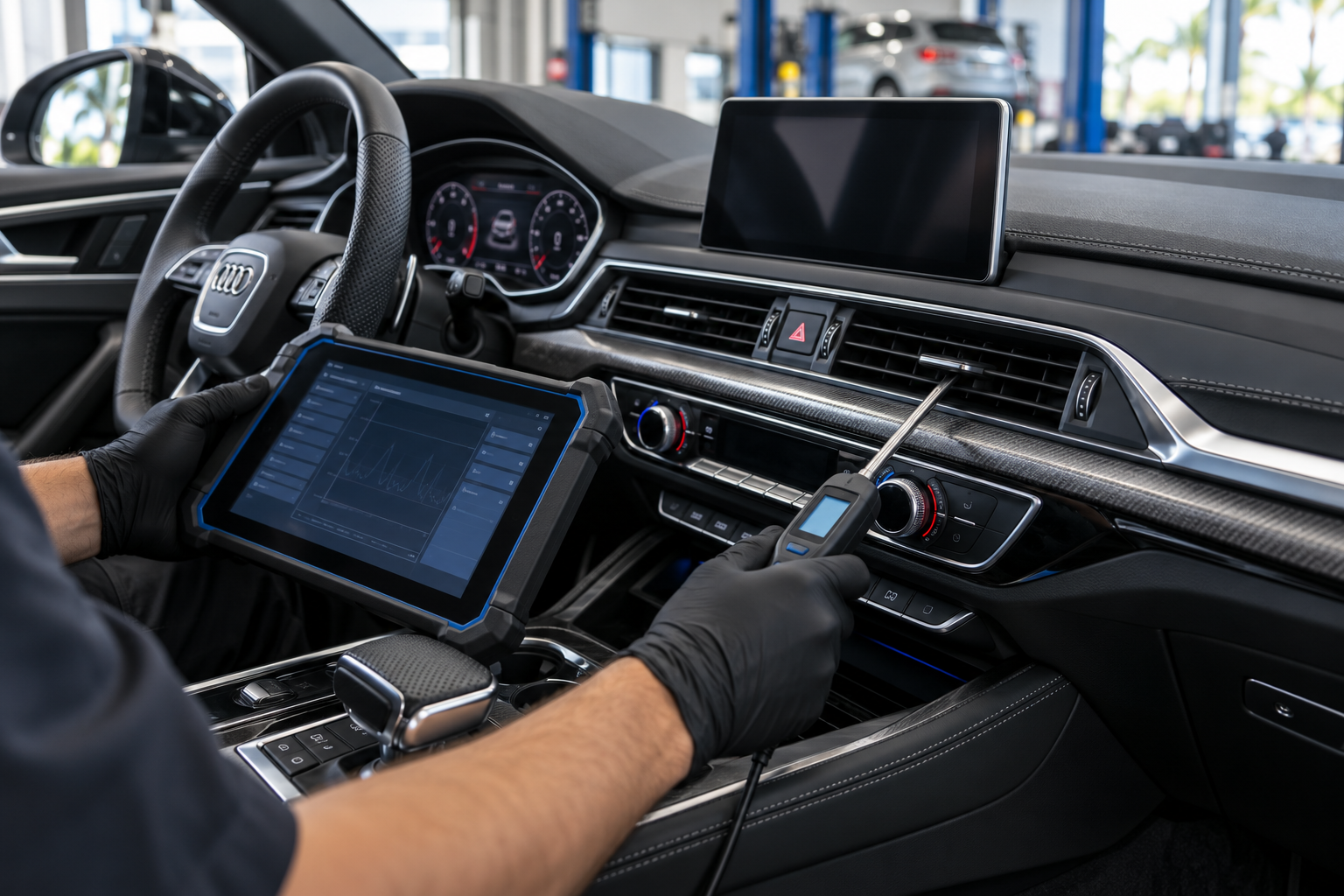
cause can increase cost and leave the original complaint unresolved.
Collision-related Audi A/C damage
A front impact can damage the condenser, lines, cooling fans, pressure sensors, wiring, brackets, or structural supports. A repaired bumper may hide a slow leak or airflow problem. Side or dashboard damage can also affect wiring, ducting, sensors, or evaporator access.
When an A/C concern begins after a collision or body repair, diagnosis should include the impact area and previous repair history. Correct mounting, airflow, electrical routing, and refrigerant-system integrity should be verified together.
Repair options depend on the confirmed fault
The correct repair may involve sealing or replacing a leaking connection, condenser, evaporator, hose, compressor, valve, sensor, actuator, blower component, fan, filter, drain, or wiring. The system may then require evacuation, the exact refrigerant and oil specification, initialization, adaptation, or a documented performance test.
Component replacement is only one part of a successful repair. The reason for the failure—such as impact damage, contamination, overpressure, electrical loss, or leakage—should also be addressed.
Frequently asked questions
Can I drive my Audi if the A/C is not cold?
Usually, a lack of cooling alone does not prevent short-distance driving, but visibility, unusual noises, odors, belt condition, warnings, and high-voltage system concerns matter. Stop driving if the condition could affect safety or cause additional damage.
Why is my Audi A/C cold on one side and warm on the other?
Possible causes include unequal zone commands, a sensor or actuator fault, calibration loss, airflow distribution problems, or an incorrect refrigerant charge. Testing is needed before choosing a part.
Does a refrigerant recharge include leak repair?
Not automatically. Recharging restores the specified quantity; it does not repair the opening that allowed refrigerant to escape. Ask what leak testing and system inspection are included.
Why does the A/C become warm at a stoplight?
Possible causes include inadequate condenser airflow, cooling-fan faults, incorrect charge, pressure-control problems, compressor output, or a heat-exchange restriction. Pressure and temperature behavior at idle should be compared with operation at higher engine or vehicle speed.
How long does Audi A/C repair take?
Timing depends on the cause, model, refrigerant type, component access, parts availability, collision history, and whether calibration or interior disassembly is required. A diagnostic inspection is needed before giving a reliable schedule.
Schedule Audi A/C diagnosis in Hollywood, FL
Car Geeks Collision helps Audi owners in Hollywood and surrounding South Florida communities evaluate weak cooling, warm vents, unequal cabin temperatures, airflow problems, leaks, electrical faults, and collision-related A/C damage.
If your Audi is not cooling correctly, request an estimate and share the model, year, powertrain, recent collision or repair history, and the conditions that reproduce the symptom. That information helps the diagnostic process begin efficiently.