
Blog
Dent Damage After a Collision: How It Is Assessed and Repaired
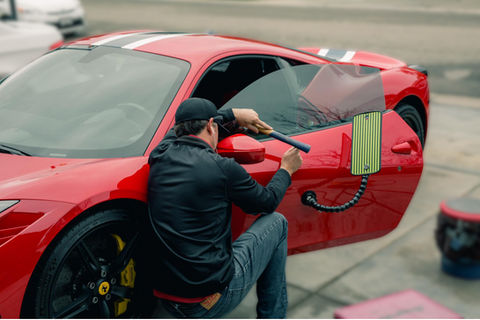
Dents found during collision repair are assessed panel by panel. Learn how a shop decides whether a dented panel can be repaired or must be replaced, and what keeps the repair safe for your car.
A dent is one of the most common kinds of damage found after a collision — a parking-lot impact, a sideswipe, or road debris can leave a panel creased or caved in. At Car Geeks Collision, dent damage is assessed and repaired as part of a collision repair, not as a standalone service. This guide explains how that assessment works, when a dented panel can be repaired, and when it has to be replaced.
How dent damage is assessed in a collision repair
Every collision repair starts with a full assessment of the damage, and dents are documented as part of that assessment. The technician records the size, depth, and location of each dent, checks whether the paint is broken or stressed, and looks for damage underneath the panel — to brackets, reinforcements, wiring, or sensors. Photos and written notes from this assessment become part of the repair file and the documentation your insurer needs.
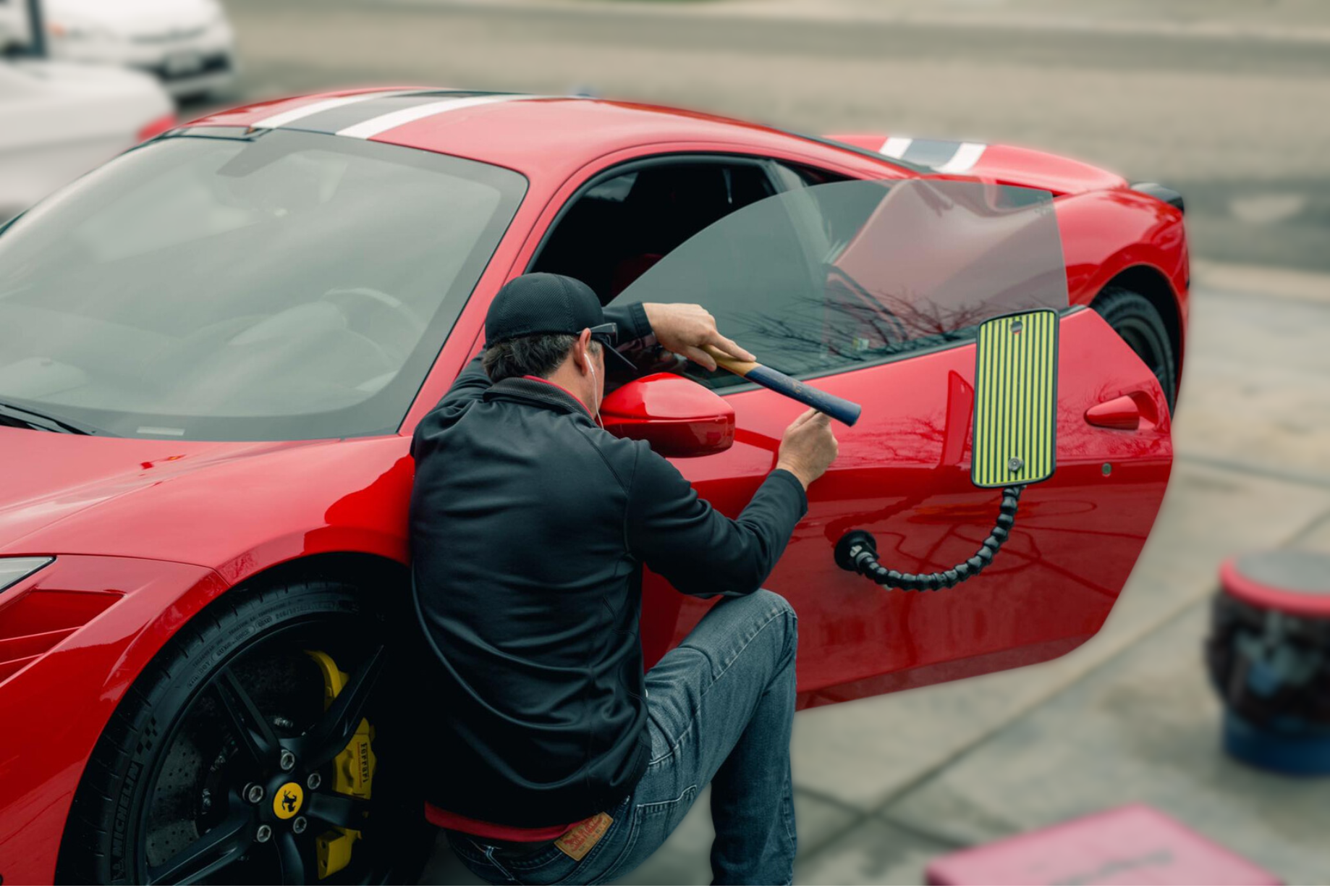
A line board — a fluorescent or LED panel reflected across the surface — is often used to read the panel contour in fine detail, showing high and low spots that are hard to see with the naked eye. That reading helps the shop decide on the repair method and gives the insurer a clear record of the damage before work begins.
When a dented panel can be repaired — and when it must be replaced
A dented panel can usually be repaired when the dent is shallow and rounded, the factory paint is intact, the metal is not stretched or torn, and the damage does not reach structural areas. In those cases the metal can be worked back to its original contour from behind the panel or with glue-tab pulling, without disturbing the paint. Keeping the original paint matters: it protects the factory finish, avoids any risk of paint mismatch or overspray, and preserves the car value.
A panel must be refinished or replaced when the paint is chipped, cracked, or flaking, when the metal is sharply creased, stretched, or torn, when there is a puncture, or when the damage reaches a structural attachment. Manufacturer repair limits also decide the question: some panels and materials have strict limits on how much deformation can be corrected, and exceeding them weakens the panel. Aluminum panels, for example, work-harden as they deform and can lose temper if overheated, so the repair must stay within the vehicle manufacturer procedures.
What paintless techniques do inside a collision repair
Paintless dent repair — often called PDR — is a technique, not a separate service at our shop. Within a collision repair, technicians may use PDR methods to restore a panel: pushing the metal back from behind with specialized rods, or pulling it outward with glue tabs bonded to the surface. Because no filler, sanding, or refinishing is involved when the paint is intact, the repair is precise and the factory paint stays in place.
PDR techniques also have hard limits. They are not used on sharp creases, torn metal, punctures, or damage where the paint is already broken, and attempting them on that kind of damage can make it worse. The assessment decides whether the technique fits — the technician does not force it.
Why the assessment matters for safety and value
A dent is rarely only skin-deep. The same impact that dented a panel can hide damage to what sits behind it, and on modern cars that can include parking sensors, cameras, and driver-assistance components that need recalibration after a repair. A proper collision assessment catches that hidden damage before the repair scope is set, so nothing is missed and the insurer documentation matches the work actually done.
Getting the assessment right also protects the car value. A repair that follows the manufacturer limits and is documented with photos and a written scope gives a future buyer — and your insurer — a clear record of what was damaged and how it was fixed.
What to do if your car has dent damage from a collision
If your car was in a collision and has dent damage, bring it in for a collision repair assessment. The shop will document the damage, explain whether each panel can be repaired or replaced, and prepare the estimate and insurance documentation. Call Car Geeks Collision at (786) 786-1387 to schedule an assessment.
Please note: Car Geeks Collision does not offer standalone dent repair or paintless dent repair as a separate service. Dent damage is addressed only as part of a collision repair. Collision repairs at Car Geeks Collision are backed by a lifetime warranty on body and paintwork.