
Blog
Alfa Romeo A/C Not Cooling? Causes, Diagnosis and Repair in Hollywood, FL
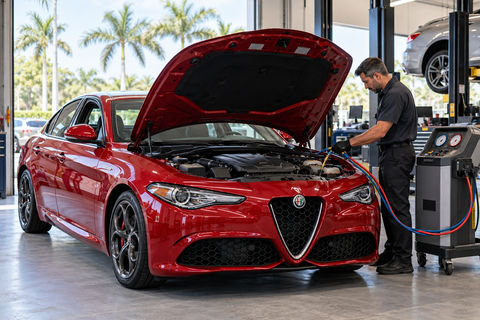
Is your Alfa Romeo blowing warm air, cooling intermittently, or losing airflow? Learn the common causes, diagnostic steps, and repair options in Hollywood, FL.
South Florida heat can turn a weak air-conditioning system into an urgent comfort problem. If your Alfa Romeo blows warm air, cools only while moving, loses airflow, or changes temperature without warning, the best next step is a complete diagnosis—not an automatic refrigerant refill.
Depending on the model, year, powertrain, and equipment, Alfa Romeo climate-control systems may use different refrigerants, sensors, compressor controls, and electronic strategies. A correct repair begins by identifying the vehicle and testing the entire system under the conditions that reproduce the complaint.
When an Alfa Romeo A/C problem needs prompt attention
Stop using the system and arrange an inspection if you notice smoke, a burning smell, loud grinding or squealing, a refrigerant warning after service, or fluid leaking near damaged components. If the engine temperature rises or a cooling fan does not operate as expected, shut the vehicle down safely and seek professional help. Some cooling-system and A/C faults can be related through shared fans, controls, or front-end damage.
Common Alfa Romeo A/C warning signs
Warm air from the vents even with the temperature set low
Cooling that starts cold and then becomes warm
Cold air only at highway speed or only while idling
Weak airflow at every fan setting
Airflow that changes between vents unexpectedly
One side of the cabin cooling differently from the other
Clicking, hissing, rattling, or squealing when the A/C runs
Musty, sweet, chemical, or burning odors
Water on the passenger-side carpet or unusual condensation
A climate-control warning or controls that do not respond normally
These symptoms are useful clues, but they do not identify a failed part by themselves. Similar complaints can come from refrigerant, airflow, electrical, mechanical, or control-system faults.
Why your Alfa Romeo may stop cooling
Low refrigerant caused by a leak
Refrigerant is not normally consumed like fuel. If the charge is low, the system may have a leak at a hose, seal, service port, condenser, evaporator, compressor, or another connection. Leak detection and a repair assessment should come before repeated recharging. Adding refrigerant without finding the cause can provide only temporary cooling and may leave the system incorrectly charged.
Compressor or compressor-control problems
Depending on the specific system, the compressor may be managed by a clutch, control valve, electronic module, or a combination of components. Warm or intermittent air can result from mechanical wear, a control fault, incorrect pressure information, wiring damage, or a protection strategy. Testing should confirm command, pressure response, electrical condition, and actual compressor performance before replacement is recommended.
Condenser damage and poor heat transfer
The condenser sits near the front of the vehicle and releases heat from the refrigerant. Road debris, corrosion, bent fins, contamination, or collision damage can reduce performance or cause a leak. Cooling that worsens at low speed may also point toward an airflow problem, but the fan system and pressure data need to be tested rather than guessed.
Cooling-fan, fuse, relay, sensor, or wiring faults
Fans and electrical controls help keep pressures and temperatures within the intended range. A blown fuse may be a symptom of another problem, not the root cause. Replacing fuses repeatedly without circuit testing can allow wiring or component damage to continue.
Cabin filter, blower, or airflow restriction
If the air is cold but the volume is weak, the refrigerant circuit may not be the primary problem. A restricted cabin filter, failing blower motor or controller, obstructed evaporator, or damaged duct can reduce airflow. Water intrusion, debris, and previous repairs should also be considered.
Blend-door and climate-control electronics
Dual-zone temperature differences, incorrect vent selection, or clicking behind the dashboard may involve actuators, doors, sensors, wiring, or control software. Because symptoms can overlap, a scan for relevant faults and an operational test are usually more useful than replacing an actuator based only on sound.
Why a recharge alone may not solve the problem
A/C performance depends on the correct refrigerant type and charge amount, stable airflow, accurate sensor data, proper compressor operation, and unrestricted heat exchange. Overcharging, undercharging, mixing refrigerants, or using stop-leak products can complicate diagnosis and may damage service equipment or components.
Avoid DIY refrigerant cans if the required refrigerant, remaining charge, and system condition are unknown. A professional service should recover and measure the existing refrigerant when appropriate, check for leaks, evacuate the system, recharge it to the applicable specification, and verify operation.
What a professional Alfa Romeo A/C diagnosis includes
A complete process may include:
Confirming the exact model, year, equipment, and refrigerant specification
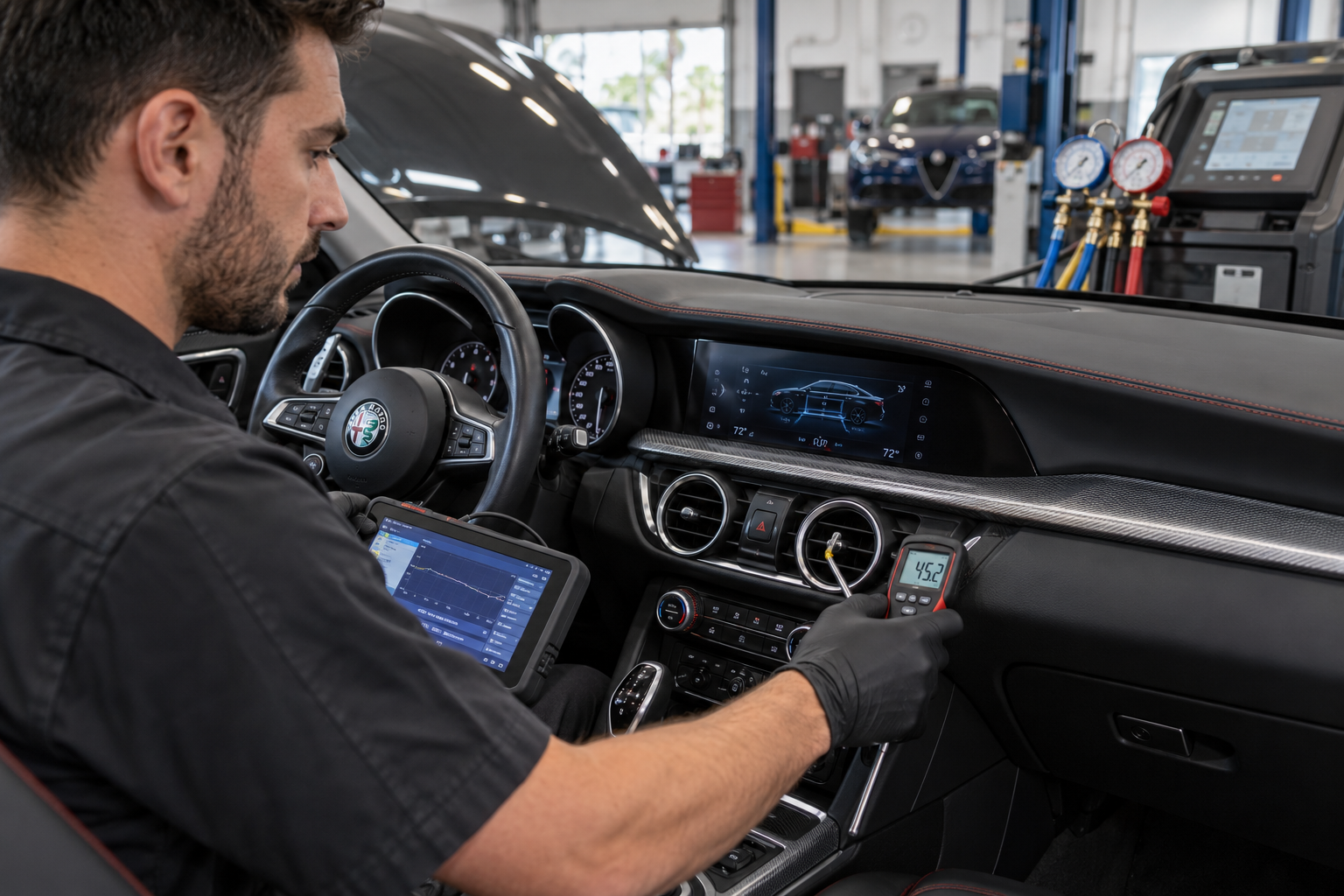
Reproducing the complaint and measuring vent temperature and airflow
Checking ambient temperature and operating conditions
Inspecting the compressor, condenser, hoses, service ports, wiring, belts, and visible connections
Scanning relevant modules for stored or active faults
Monitoring pressure, temperature, sensor data, fan command, and compressor command
Testing blower speeds, vent selection, recirculation, and left-to-right temperature control
Checking for leaks using suitable methods for the system and refrigerant
Evaluating collision history, previous A/C work, and signs of contamination
Verifying cooling performance and system behavior after repair
The sequence matters. Replacing a component before confirming the cause can increase cost and still leave the original complaint unresolved.
Collision-related A/C damage
Even a moderate front-end impact can affect the condenser, cooling fan assembly, refrigerant lines, sensors, brackets, wiring, or mounting points. Damage may be hidden behind the bumper cover, and a small leak may take time to reduce cooling. If the problem began after a collision, curb strike, road-debris impact, or body repair, tell the technician and provide earlier estimates or photographs if available.
A coordinated collision repair inspection can help distinguish isolated A/C trouble from impact damage that also involves adjacent cooling or structural parts. Bent mounting areas should be corrected before new components are installed so hoses, fans, and heat exchangers fit without stress.
Safe checks an owner can make
Before scheduling service, note whether the problem occurs at idle, while driving, after rain, after a long trip, or only on one side of the cabin. Confirm that the climate controls are set as intended and check the owner’s manual for normal operation. Record warning messages, sounds, odors, and the time it takes for the air to change temperature.
Do not open refrigerant lines, bypass pressure controls, probe live circuits, or place hands near moving fans and belts. Refrigerant service requires suitable equipment and handling procedures.
Repair options depend on the confirmed fault
The correct repair could involve sealing a verified leak, replacing a damaged hose or condenser, repairing wiring, restoring fan operation, servicing a blower or actuator, addressing drainage, or replacing a failed compressor-related component. Some repairs may also require seals, oil balancing, system flushing, receiver-drier or accumulator service, programming, or calibration depending on the vehicle and failure. Recommendations should follow the applicable repair information for the exact Alfa Romeo.
Frequently asked questions
Can an Alfa Romeo A/C system lose cooling without a warning light?
Yes. Many mechanical, refrigerant, and airflow problems may reduce cooling without producing a dashboard warning. Diagnostic data and physical testing can still reveal the cause.
Why does the A/C cool while driving but turn warm at a stop?
Reduced condenser airflow, a fan-control problem, charge condition, or another pressure-related fault may be involved. The symptom narrows the test plan but does not confirm a specific part.
Is water under the car normal when the A/C is running?
A small amount of clear water beneath the vehicle can be normal condensation. Water inside the cabin, colored or oily fluid, a strong odor, or leakage in an unusual area should be inspected.
How long does Alfa Romeo A/C repair take?
Diagnosis time and repair time depend on the fault, leak location, vehicle configuration, access, parts availability, and whether collision damage is present. An inspection is needed before a reliable schedule can be provided.
Should the cabin filter be replaced when the A/C is warm?
A restricted filter can reduce airflow, but it usually does not explain every warm-air complaint. The filter should be inspected as part of airflow diagnosis rather than treated as an automatic cure.
Schedule Alfa Romeo A/C repair in Hollywood, FL
Car Geeks Collision provides A/C and HVAC repair for Alfa Romeo owners in Hollywood and surrounding South Florida communities. Our team can evaluate cooling performance, airflow, electronics, visible impact damage, and related components before recommending a repair.
If your Alfa Romeo is blowing warm air, cooling intermittently, or showing signs of collision-related A/C damage, request an estimate and describe when the symptom began. Bringing the exact model, year, recent repair history, and any warning messages helps the diagnostic process start efficiently.