
Blog
ADAS Calibration After a Collision: Why Cameras and Sensors Must Be Checked

After a collision, cameras, radar, and parking sensors may require ADAS calibration. Learn when it is needed and what a complete repair should include.
Modern vehicles use cameras, radar units, ultrasonic sensors, and control modules to support driver-assistance features. These systems may help with automatic emergency braking, lane keeping, adaptive cruise control, blind-spot monitoring, parking assistance, and collision warnings. After an accident or collision repair, correct ADAS calibration matters because a sensor can look undamaged while its aim, mounting position, or programmed reference has changed.
A bumper impact, windshield replacement, suspension repair, wheel alignment, or change in ride height can affect what the vehicle “sees.” A warning light is not always present. The system may still operate while interpreting distance or direction incorrectly, which is why a complete repair plan must include the vehicle manufacturer’s procedures.
What is ADAS calibration?
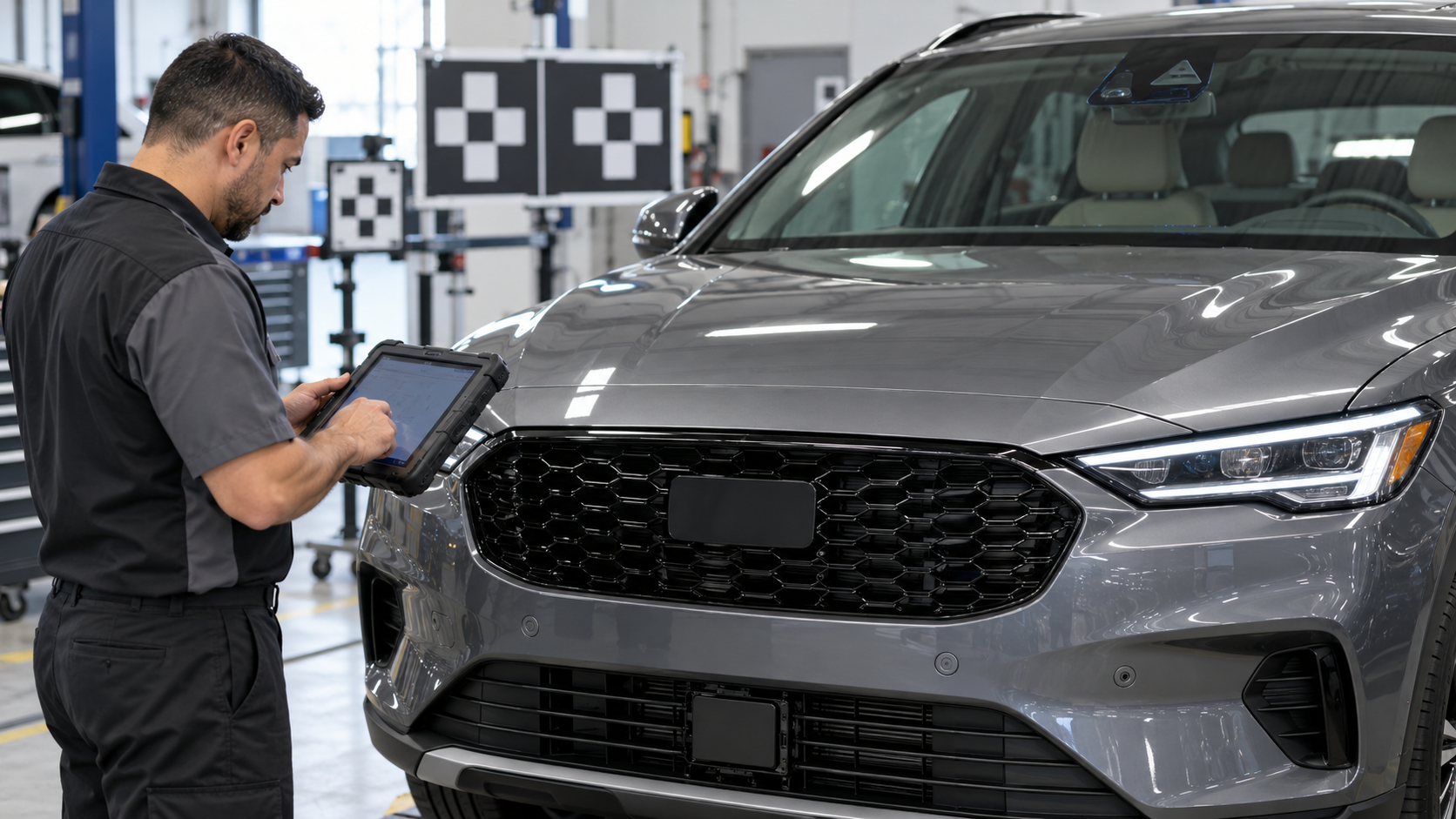
ADAS calibration is the process of confirming and, when required, resetting the aim and reference values of cameras, radar sensors, lidar units, steering-angle sensors, and related components. Calibration does not simply clear a diagnostic code. It uses manufacturer-specified targets, measurements, scan tools, road conditions, and setup procedures so the system can interpret its surroundings as designed.
Different vehicles use different equipment and procedures. Some require a stationary target setup inside a controlled work area. Others require a road test at specified speeds. Many vehicles need both static and dynamic calibration.
Why a collision can disturb cameras and sensors
ADAS components depend on exact position and alignment. A small change at a mounting bracket can alter a radar unit’s aim over distance. A camera attached to the windshield can be affected by glass replacement or a change in the camera’s position. Body-panel movement, suspension damage, wheel alignment, tire size, ride height, and steering-angle values may also influence calibration.
Common collision-related causes include:
Front or rear bumper damage
Grille, emblem, mirror, or quarter-panel replacement
Windshield removal or replacement
Radar, camera, sensor, or bracket removal
Structural or unibody repair
Suspension, steering, or wheel-alignment work
Ride-height changes or replacement of certain suspension components
Battery disconnection, module replacement, or software programming
Paint, body filler, film, or accessories placed over a sensor area
ADAS features that may be affected
Forward-collision warning
Automatic emergency braking
Adaptive cruise control
Lane-departure warning and lane-centering assistance
Blind-spot monitoring
Rear cross-traffic alert
Parking sensors and automated parking
Traffic-sign recognition
Surround-view and backup cameras
Adaptive headlights and driver-monitoring systems
The exact equipment depends on the make, model, trim level, options, and production date. The VIN and manufacturer repair information should guide the inspection.
When calibration may be required
Calibration requirements are determined by the vehicle manufacturer, not by appearance alone. A sensor may require calibration after replacement, removal, bracket movement, collision damage, body repair near the sensor, windshield work, alignment, suspension repair, or a diagnostic trouble code.
Some vehicles also require calibration after work that seems unrelated to the sensor itself. For example, correcting rear ride height may change the angle of a forward-facing camera. Replacing a bumper cover can affect radar transmission or parking-sensor position. A wheel alignment may require steering-angle reset before other systems can be verified.
Static, dynamic, and combination calibration
Static calibration
Static calibration is performed with the vehicle positioned precisely in relation to approved targets or reflectors. The work area may need a level floor, controlled lighting, specified distances, correct tire pressure, a centered steering wheel, proper fuel or cargo condition, and an unobstructed space.
Dynamic calibration
Dynamic calibration uses a scan tool while the vehicle is driven under manufacturer-defined conditions. Requirements may include certain road markings, weather, visibility, speed, traffic conditions, and driving time. A short drive around the block is not necessarily sufficient.
Combination calibration
Some systems require both methods. Completing only one step can leave the procedure unfinished even when no warning remains on the dashboard.
Pre-repair scans, post-repair scans, and calibration are different
A pre-repair scan identifies stored faults and helps document systems affected by the collision. A post-repair scan checks current faults, module communication, and repair completion. Calibration establishes or verifies the sensor’s geometric and electronic reference. These steps support one another, but one does not replace the others.
Likewise, clearing a fault code does not prove that a camera or radar unit is aimed correctly. A complete process compares scan results, physical measurements, alignment data, calibration status, and a final road test where appropriate.
Signs an ADAS system may need inspection
A collision-warning, lane, cruise-control, parking, or blind-spot message appears
Adaptive cruise control becomes unavailable or behaves inconsistently
Lane assistance pulls, reacts late, or disengages
Parking sensors sound continuously or fail to detect an obstacle
A surround-view image is misaligned
Automatic high beams or traffic-sign recognition act unexpectedly
The steering wheel is off-center after repair
The vehicle recently received bumper, windshield, suspension, alignment, or structural work
Do not intentionally test an uncertain safety feature by approaching another vehicle or obstacle. Schedule a professional inspection instead.
What professional ADAS verification should include
Identify the vehicle by VIN, trim, options, and installed ADAS equipment.
Review manufacturer repair and calibration requirements.
Perform a pre-repair scan and document diagnostic trouble codes.
Inspect sensors, cameras, wiring, connectors, brackets, bumper materials, and mounting points.
Complete structural, body, glass, suspension, and alignment work first.
Confirm tire pressure, ride height, steering position, battery support, and required vehicle setup.
Perform the specified static, dynamic, or combination calibration.
Complete a post-repair scan and address remaining faults.
Verify system operation and retain calibration documentation.
Why bumper and windshield repairs need special attention
Radar units are often mounted behind bumper covers, grilles, or emblems. Excessive paint thickness, incorrect repair materials, a distorted cover, or a bent bracket can interfere with the sensor. Parking sensors also have specific orientation and installation requirements.
Forward-facing cameras are commonly mounted near the rearview mirror. The correct windshield, glass position, camera bracket, and optical area can all matter. Calibration should follow the applicable repair information after the windshield and surrounding components are installed correctly.
Insurance estimates and ADAS operations
An initial estimate may not include every scan, alignment, setup, calibration, or sublet operation that becomes necessary after disassembly. Repair documentation should connect each operation to the vehicle’s equipment, collision damage, and manufacturer requirements. Vehicle owners can ask which ADAS systems were identified, which calibrations were required, and what documentation will be provided at delivery.
Frequently asked questions
Will the dashboard always show a warning if calibration is wrong?
No. Some faults create immediate warnings, but a system can also remain available while its physical aim is outside specification. That is why repair procedures and measurements matter.
Can a diagnostic scan replace calibration?
No. A scan reads module information and fault codes. Calibration establishes the camera or sensor reference using a separate prescribed procedure.
Does every collision require ADAS calibration?
Not automatically. The requirement depends on the vehicle, equipment, damage, and repair operations. Manufacturer procedures should determine what is necessary.
Can calibration be completed before wheel alignment?
Often the structural, suspension, tire, ride-height, and alignment conditions must be correct first. The exact sequence depends on the manufacturer.
How long does ADAS calibration take?
Timing varies with the number of systems, setup requirements, road conditions, alignment needs, fault diagnosis, and whether static and dynamic procedures are required.
Schedule collision-repair and ADAS evaluation in South Florida
Car Geeks Collision helps vehicle owners in Hollywood and surrounding South Florida communities address collision damage that may involve cameras, radar, parking sensors, windshields, bumpers, suspension, alignment, or structural components.
If your vehicle has ADAS features, ask for a repair plan that identifies required scans and calibrations before delivery. Contact Car Geeks Collision with the year, make, model, collision area, warning messages, and recent repair history so the evaluation can begin efficiently.